Hou Hsiao-hsien's films often look calm before they feel devastating. A room is allowed to settle. A family conversation runs without a pushy close-up. A street, doorway, meal, billiard hall, brothel room, or train window holds its shape long enough for the viewer to understand that ordinary life is not a pause between historical events. It is where history lands. That is the key to Hou as a director: he does not make distance cold. He makes distance ethical.[1][2][5]
The standard shortcut is to call him a master of Taiwan New Cinema, and the label is useful. BFI places Hou beside Edward Yang and Chen Kunhou as a figurehead of the movement's first wave, which broke from popular genres toward realistic portraits of national life.[1] Britannica similarly emphasizes his films' interest in Taiwan's history, family life, realism, and measured pace.[5] But those descriptions only begin the matter. Hou's real achievement is formal. He found a way to let private memory, national trauma, and social change occupy the same frame without one swallowing the other.
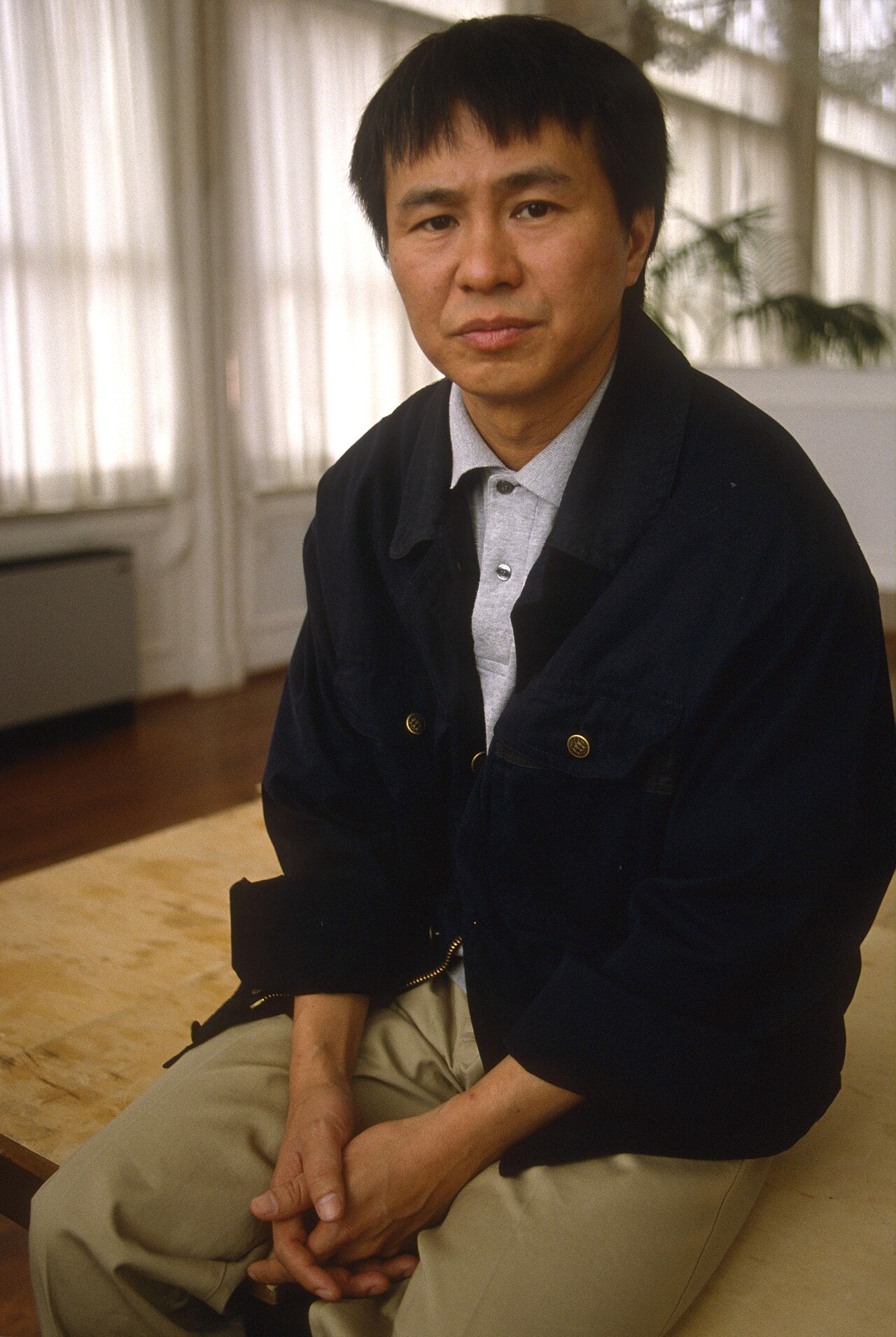
Image context: the cover uses Gorup de Besanez's 1989 photographic portrait of Hou Hsiao-hsien from Wikimedia Commons.[6] The year matters. Hou was no longer only an important Taiwanese filmmaker working through local production histories; A City of Sadness had made the island's suppressed political memory visible to international film culture. A portrait is the right image here because this piece is about method across a career, not one film's iconography.
Distance is Hou's way of listening
Hou's mature style is easy to caricature as slowness. The better word is patience. BFI notes that he rarely relies on close-ups, minimizes shot-reverse-shot, and favors long takes from a fixed axis.[1] Taiwan Cinema's official profile gives the career pivot in institutional terms: after early commercial success, Hou shifted his emphasis toward personal expression as Taiwan New Cinema gathered force, and his historical trilogy later established his international reputation through long, still takes and composed empty shots.[2]
That distance does not remove feeling. It changes how feeling becomes legible. In a conventional scene, the cut tells the viewer where to look and what to prioritize. Hou often withholds that instruction. A body moves through a room, another person waits at the edge of the composition, an older relative speaks or fails to speak, and the scene's moral force grows from relationships inside the frame rather than from editorial insistence.[1][2] The viewer has to read posture, duration, spatial relation, and interruption. Hou trusts that social life already contains enough pressure if the camera stops rushing past it.
This is why his films can feel both observational and intimate. The camera stands back, but it does not abandon the characters. It gives them a world. Children, parents, migrants, lovers, gangsters, courtesans, photographers, elders, and young women in neon Taipei are not reduced to psychological close-ups. They are shown as people embedded in rooms, habits, economies, languages, and memories.[1][5] Hou's distance is a form of listening because it lets those attachments remain audible.
Memory enters through routine
The autobiographical and historical films of the 1980s clarify the method. BFI identifies The Time to Live and the Time to Die as an ideal entry point because it turns a mainland family's relocation to Taiwan into a coming-of-age story spread across 1947 to 1967.[1] That structure matters. Hou does not treat the family as a symbol placed on top of history. He lets history appear through chores, childhood play, illness, longing, street fights, fruit-picking, and an elder's altered sense of home.[1]
Taiwan Cinema's chronology helps explain why this was not a sudden break from nowhere. Hou's early work came out of script supervision, assistant directing, screenwriting, collaboration with Chen Kun-hou, and the commercial field around films such as Cute Girl and The Green, Green Grass of Home.[2] The later stillness was not an anti-commercial pose dropped from above. It developed from local craft conditions, from trying to stage bodies in space, and from discovering that a scene could hold more meaning when it did not hurry to declare itself.[2]
That local collaborative context is crucial. A 2025 BFI essay on Taiwan New Cinema warns against making the movement only an auteur story. It foregrounds the network around Hou and Yang: cinematographers, screenwriters, editors, sound designers, producers, women filmmakers, and earlier workers who helped prepare the shift away from formulaic commercial cinema.[3] Hou's cinema belongs to that ecology. His art of memory was never merely private recollection. It emerged from a production culture rethinking who could speak for Taiwan, how ordinary people could be filmed, and how much the old studio habits had left unseen.[2][3]
History usually happens offscreen
The strongest test of Hou's method is A City of Sadness. Harvard Film Archive frames the film as a national saga set between the fall of the Japanese empire in 1945 and the establishment of martial law in 1949, built around the events leading to the 1947 February 28 Incident.[4] It also notes the film's paradoxical scale: broad historical canvas, intimate attention to daily life, and major events often occurring primarily offscreen.[4]
That offscreen quality is not evasion. It is the film's historical intelligence. Massacre, regime change, language conflict, and martial-law pressure are not rendered as a simple sequence of explanatory scenes. They enter through family damage, translation, disability, business, fear, rumor, and the difficulty of knowing what can safely be said.[4] Hou's camera does not race toward the historical headline because the headline is not the only truth. The truth is also in the silence around a table, the pause before speech, the gap between what a family knows and what it can survive saying aloud.
This is why A City of Sadness became more than a prestigious period film. BFI describes its Taiwanese release as a watershed because it was the first film to address the 228 Incident, while Harvard calls it both an act of remembrance and a landmark of world cinema made after the lifting of martial law.[1][4] Hou's restraint made that remembrance stronger, not weaker. He understood that political memory is damaged when cinema turns it too quickly into consumable spectacle. His alternative was harder: make the viewer sit inside the social texture that trauma altered.
A career built from withheld emphasis
The same withheld emphasis continues across very different films. Flowers of Shanghai confines action to late Qing brothel interiors, where social exchange and emotional damage unfold through lamps, glances, seating, and repeated ritual.[1] Millennium Mambo shifts to contemporary Taipei and lets neon, music, drifting youth, and uncertain freedom produce a different kind of suspended life.[1] The Assassin enters wuxia but does not become a conventional action machine; its elegance lies in restraint, landscape, and the pressure of choosing when not to strike.[1]
Across those changes, Hou keeps asking the same formal question: how little can the director force, and how much can the world reveal if the frame is held correctly? That question is not minimalism for its own sake. It is a politics of attention. The viewer must notice who is allowed to move freely, who waits, who translates, who remembers, who is trapped by a room that looks beautiful, and who carries history in habits too small for official chronology.[1][2][4]
Hou's greatness, then, is not that he made slow films. It is that he made time itself a moral instrument. Duration becomes the space in which a viewer stops consuming plot and starts reading conditions. Distance becomes the space in which characters are not seized by the camera but allowed to exist in relation. Offscreen history becomes the space in which trauma remains difficult, partial, and socially distributed.[1][4][5]
That is why Hou Hsiao-hsien still matters as a director-profile subject rather than only as a canon name. He changed what cinematic seriousness could feel like. He showed that a national history could be filmed through family rooms, that memory could be staged without nostalgia doing all the work, and that the camera's refusal to intrude can become a demand: look longer, listen more carefully, and let the frame teach you what the speech cannot safely say.
Sources
- John Berra, "Where to begin with Hou Hsiao-hsien," BFI, August 17, 2015.
- Taiwan Cinema, "HOU Hsiao-Hsien" official filmmaker profile.
- Hyun Jin Cho, "The many voices behind Taiwan New Cinema," BFI, May 9, 2025.
- Harvard Film Archive, "A City of Sadness" screening note, August 29, 2010.
- Encyclopaedia Britannica, "Hou Hsiao-hsien" biography and film overview.
- Wikimedia Commons, "1989 Hou Hsiao-hsien.jpg" photographic portrait, source image for the article cover.