Note: this essay discusses the film's ending.
The easiest way to reduce Erich von Stroheim's Greed is to call it a story about miserly people punished by money. That is not wrong, but it is too clean for a film this grimy. Greed does not treat money as an idea people hold in their heads. It makes money feel physical: handled, hidden, bitten over, sweated through, locked away, dragged across rooms, and finally carried into a landscape where possession and survival become the same terrible problem.
That physicality is why the film still has force even in its damaged form. The Library of Congress blog summary gives the basic history: Stroheim's original version was more than nine hours long, then cut down to roughly 140 minutes, and the surviving release version was later named to the National Film Registry in 1991.[2] Senses of Cinema likewise stresses that the MGM release is not the complete object Stroheim wanted, while noting that the 1999 reconstruction used script material and still photographs to approximate missing passages without becoming definitive.[4] The wound in the archive matters. Yet the released film is not only a mutilated monument. It is a coherent experience of compression, as if the studio cuts left the story with the same condition as its characters: too much appetite packed into too little air.
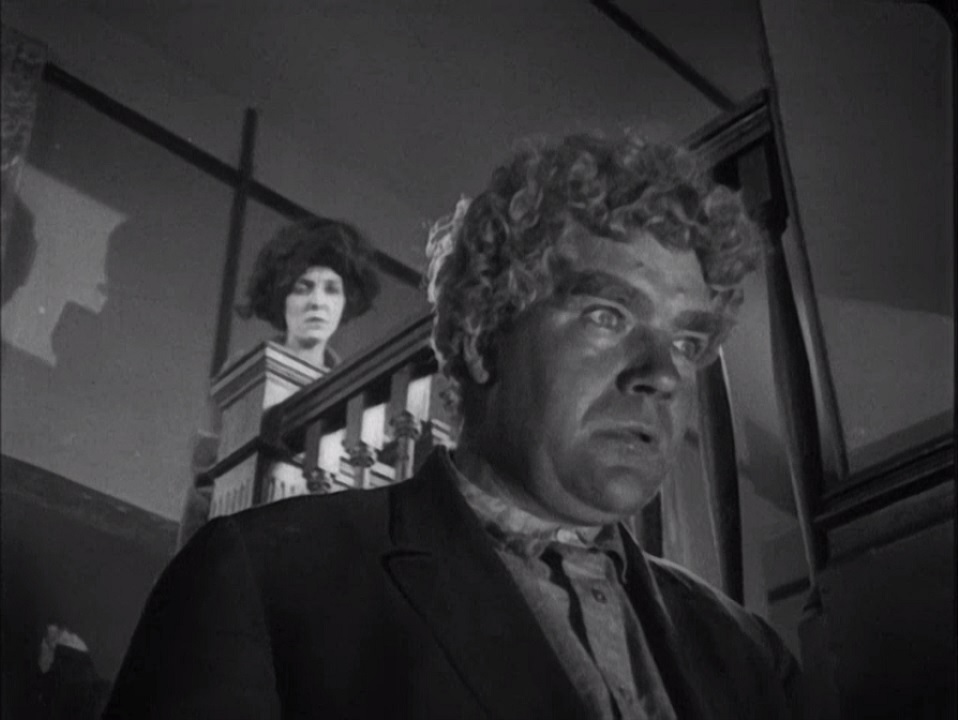
The cover frame is useful because it catches that pressure without needing a pile of coins. McTeague fills the foreground while Trina hangs behind him on the stairs, separated by railings, shadows, and different planes of attention.[6] Nothing in the image says "wealth." Everything says enclosure. That is Stroheim's method: money enters the marriage, but the visible damage appears in posture, distance, and room temperature.
The Dentist Chair Is Already A Power System
Stroheim adapted Frank Norris's novel McTeague, and AFI's production history notes how seriously he pursued the novel's locations, scouting San Francisco, Oakland, Placer County, Keeler, and Death Valley rather than treating California as a studio suggestion.[1] That commitment is often described as realism. It is better understood as pressure mapping. The film wants to know what bodies do when work, class desire, sexual hunger, law, and property squeeze them in actual rooms and actual heat.
The first crucial space is McTeague's dental parlor. Before the lottery money arrives, the film has already made possession intimate and invasive. McTeague's work gives him access to mouths, faces, anesthesia, and physical vulnerability. The dentist chair is not merely a place where he meets Trina. It is a miniature power system, a device that turns looking and touching into professional procedure.[5]
That matters because the later money story is not a clean moral switch. McTeague does not begin as an innocent man corrupted only after Trina wins. The film shows his gentleness and his coarseness together. He can rescue a bird, smile with clumsy tenderness, and also become frightening once another body is under his control. Senses of Cinema is right to resist assigning the film's title to Trina alone: Marcus, McTeague, and Trina all enter the money circuit, and McTeague's cruelty is central to the horror.[4] The film's brilliance is that greed does not replace other drives. It finds the nerves already exposed.
The Lottery Turns Domestic Space Into Storage
The lottery win should open the world. Instead, it shrinks it. Trina's money gives the couple a sum large enough to reorganize fantasy, resentment, and blame, but not large enough to free them from the habits that made them vulnerable in the first place. The Library of Congress summary identifies the $5,000 win as the event that ruins McTeague and Trina after marriage.[2] Stroheim films the consequence less as a single fall than as a change in how objects behave.
Coins stop being exchange and become touch. Savings stop being security and become bodily compulsion. Rooms stop being shelter and become containers. The film's domestic world grows tighter because Trina treats money as something that must be physically kept near, while McTeague increasingly experiences that same kept money as proof of humiliation.[5] The tragedy is not simply that she will not spend and he wants access. The tragedy is that the marriage no longer has any neutral objects. A locked trunk, a hand, a bed, a meal, a bird cage, a dental sign, a bit of gold - each begins to carry the charge of ownership.
That is why the famous finger-biting moment is so horrible. It collapses finance into flesh. McTeague cannot win an argument over money, so he attacks the part of Trina that touches, counts, saves, and withholds. The scene is not symbolic in a tidy way. It is literal: greed has moved from accounting into the hand.[4][5]
Location Realism Becomes Moral Weather
AFI's production notes make clear that Stroheim's location demands were not casual. He used San Francisco landmarks and neighborhoods, Oakland settings, Placer County mine country, Keeler, and Death Valley, while rebuilding details when the original Polk Street area had been altered or destroyed after the 1906 earthquake.[1] The San Francisco Silent Film Festival essay makes the interpretive case for why that matters: the film's real places become a poetic version of post-Gold Rush California, from old San Francisco and Oakland to the Death Valley finale.[3]
The key is that the real does not calm the melodrama. It intensifies it. In a weaker film, authentic locations might function as background credibility. In Greed, they behave like moral weather. The city is full of windows, thresholds, cramped rooms, public corners, work sites, and social performances where aspiration becomes embarrassment. McTeague wants status without refinement. Marcus wants the money he gave up in the name of friendship. Trina wants safety so intensely that safety becomes another form of danger.
This is why the film never feels like a simple cautionary tale about one bad trait. It feels like a whole environment learning to express appetite. The wedding, the apartment, the dental office, the street, the mine, the desert: each space changes the temperature of wanting. Money is not just a plot device carried through these places. It is the substance that reveals what each place was already prepared to do to people.
The Lost Film Is Part Of The Feeling
It is impossible to write about Greed without acknowledging the missing film. AFI records the long cutting history: Stroheim reduced his initial cut, Rex Ingram reduced it further, June Mathis cut it again, and the released version moved far from the vast object Stroheim imagined.[1] The Library of Congress blog preserves the familiar legend of the nine-hour film cut down to about 140 minutes.[2] Senses of Cinema adds the important caution that later reconstruction necessarily involved inference because the earlier versions were destroyed.[4]
That history can tempt viewers into watching only the absence. What would the longer version have clarified? Which subplots would have changed the balance among Trina, McTeague, Marcus, Zerkow, Maria, and the wider neighborhood? How much of Stroheim's social world has been reduced to haunted residue?
Those questions matter, but they should not turn the surviving film into a footnote. The release version has its own savage logic. Its abruptness can even sharpen the experience. People in Greed do not decline with graceful literary completeness. They are cut off: from work, from friendship, from money, from self-respect, from the possibility of ordinary household time. The film's archival damage echoes its subject without excusing the damage. A movie about possession reaches us as an object permanently marked by loss.
Death Valley Is Where Property Becomes A Sentence
The ending is often remembered because it is extreme: McTeague and Marcus in Death Valley, money between them, one man dead, the other handcuffed to him under the sun. AFI's production history says Stroheim insisted on filming the climactic fight in Death Valley itself despite studio and insurance warnings, including scenes at the Sink in August heat.[1] SFSFF's essay reads the finale as the parched floor where bourgeois yearning ends in a chain of consequences.[3]
That setting is not spectacle pasted onto a domestic tragedy. It is the film's last reduction. The city gave greed rooms. The desert gives it no room at all. What had been mediated through marriage, work, jealousy, law, and furniture becomes an immediate physical equation: water, heat, metal, corpse, money, distance. Possession has lost every social disguise. McTeague still has the gold, but the gold can no longer buy movement, forgiveness, shade, or release.[5]
The handcuffs are the film's cruelest object because they complete a pattern that began much earlier. Characters have been binding themselves to things all along: Trina to savings, McTeague to appetite and grievance, Marcus to the idea that another person's good fortune was stolen from him. In Death Valley the metaphor becomes hardware. A man is literally attached to the body of the friend-enemy through whom money became destiny.
That is why Greed remains more frightening than its title. The word sounds like a moral category. The film makes it tactile. Greed is not only wanting too much. It is the moment when wanting reorganizes touch, space, evidence, and time until the world can no longer be used for anything but possession. Stroheim's film survives because it understands that money does not have to appear glamorous to ruin people. It can arrive as a coin in the hand, a locked box, a bitten finger, a room gone airless, or a bag of gold that becomes useless at exactly the moment its owner can no longer let it go.
Sources
- AFI Catalog, "Greed" - production history, source novel context, locations, cutting history, release notes, and reception.
- Library of Congress Now See Hear, "Now Playing at the Packard Campus Theater (March 4-5, 2016)" - capsule on Greed, its plot, National Film Registry status, nine-hour original, and approximate 140-minute release version.
- San Francisco Silent Film Festival, "Greed" - Pacific Film Archive essay on Stroheim's location realism, San Francisco and Oakland settings, Death Valley finale, and MGM cuts.
- Frederick Blichert, "Greed (Erich von Stroheim, 1924)," Senses of Cinema, March 2016 - critical essay on the film's moral distribution, character violence, lost versions, and 1999 reconstruction.
- Internet Archive, "Greed (1924)" - access copy of the surviving release version used for scene-reference checks.
- Wikimedia Commons, "File:Greed, 1924, 12 scale.jpg" - source page for the article image, a public-domain film screenshot showing ZaSu Pitts and Gibson Gowland in Greed.