Note: this essay discusses the film's ending.
Jacques Becker's Touchez pas au grisbi begins after the kind of event another gangster film would treat as its engine. The Orly gold job has already happened. The loot exists, the papers are circling it, and Max le Menteur can smile because he knows where the money is. But Becker is barely interested in showing the robbery as a feat. The film's real suspense comes from a different question: can an old criminal keep his style, his friendships, and his fatigue organized long enough to leave the life that taught him how to survive?
That shift is why the movie still feels so fresh. Criterion's film page lays out the basic trap: Max, played by Jean Gabin, has pulled off a life-changing heist, only for Riton, his friend and partner, to let the secret drift toward Josy and then Angelo.[1] BFI frames the same film as a masterful work about honor and aging rather than merely a fight over stolen goods.[2] Those two descriptions meet in the film's form. The gold matters, but it is not the emotional center. The emotional center is the cost of having to move quickly when one's whole body wants dinner, sleep, quiet, and a last little pocket of dignity.
The Missing Heist Is The First Clue
The film's cleanest trick is omission. Sean Axmaker's TCM account notes that the gold has been stolen before the film opens, and that Becker saves overt violence for late in the story while giving the earlier passages a quiet elegance.[4] Geoffrey O'Brien makes the sharper formal point: Becker keeps the big actions offscreen or delayed, then fills the apparent gaps with pauses, routines, and small social adjustments.[3] The result is not a heist movie without a heist by accident. It is a heist movie that understands the real danger begins after success.
That is a tough, adult idea. A robbery can be planned as a clean operation, but aftermath is social. People talk. Lovers test loyalties. Younger men smell weakness. Old alliances reveal their maintenance costs. Max does not lose control because he lacks intelligence. He loses control because the world around the loot will not stay still. Every favor owed, every mistress underestimated, every underworld acquaintance who knows too much becomes a moving part.
Becker makes that instability visible by refusing hurry. The camera does not rush to prove that the movie has crime credentials. It watches entrances, restaurant rituals, nightclub traffic, back-room conversations, and the way Max holds himself when a lesser man would over-explain. This is not decorative atmosphere. It is intelligence under pressure. The film teaches the viewer that in Max's world, timing is etiquette, and etiquette is defense.
The Hideaway Is The Real Set Piece
The most important room in the film is not a bank, warehouse, or ambush site. It is Max's hidden apartment, where he and Riton retreat and briefly behave like tired spouses at the end of a bad day. James Steffen's TCM DVD note singles out the bedtime sequence as the richest of the film's character moments: Max and Riton brush their teeth, get ready for sleep, and quietly measure what their lives have become.[5] O'Brien similarly treats the hideaway gestures - wine, food, pajamas, hospitality - as ritual rather than filler.[3]
That sequence is the movie's thesis in domestic form. Max has built a refuge whose luxury is almost embarrassingly modest: stocked food, clean nightwear, a sense that one might finally shut the door. The stolen gold is supposed to buy retirement, but the apartment already shows what retirement means to him. It is not conquest. It is privacy. It is the right to stop performing toughness for men who are dumber, younger, louder, or more eager to turn every room into a proving ground.
Riton cannot fully read the room. That is the tragedy. He accepts the comfort, but he has already damaged the conditions that made comfort possible. Max's care for him is therefore mixed with rage. The film does not sentimentalize friendship as pure loyalty; it shows friendship as an old habit too deep to abandon even when it becomes ruinous. Max knows Riton has put everything at risk. He still lays out the pajamas.
Gabin Makes Fatigue Look Like Command
The whole film depends on Jean Gabin's face refusing to hurry. MoMA notes that the film became a major French hit and helped relaunch Gabin's career, while TCM reads Max as a postwar redefinition of Gabin's older screen authority.[4][6] The performance works because Gabin does not play age as weakness. He plays age as a compression of available movement. Max can still dominate a room, but he would rather not have to.
That reluctance is crucial. A younger gangster proves himself by escalation. Max proves himself by reducing waste. He does not need to shout when a look will do. He does not need to explain his code when everyone around him already understands the consequences of violating it. Even his violence feels administrative, something dragged into the night because others have made quieter solutions impossible.
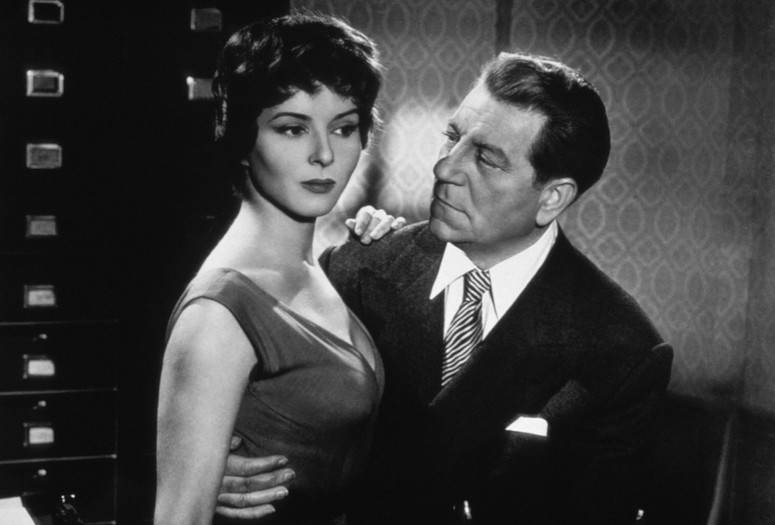
The MoMA still used here catches that quality better than a gunfight would.[6] Max stands close to Josy, but the look is not simply desire. It is audit. Jeanne Moreau's Josy is beautiful, watchful, and pointed toward the future; Max's attention carries the knowledge that the future is becoming less available to him. Becker lets the glamour remain in the frame, then drains it of safety. Social grace becomes surveillance.
The Young Criminals Move Too Fast
Lino Ventura's Angelo matters because he is not only a villain. BFI notes Ventura's first screen role, and Axmaker frames Angelo as a younger, more predatory force pressing against Max's older underworld code.[2][4] The film's generational contrast is not subtle, but Becker keeps it from becoming nostalgic propaganda. Max's code has its own brutality. He can slap, intimidate, torture, and kill. The old way is not morally clean.
What separates Max from Angelo is not innocence. It is proportion. Max wants the loot because it can end a career. Angelo wants the loot because it can accelerate one. That difference changes the rhythm of every scene. Max's criminality is organized around exit; Angelo's around entry. Max thinks in terms of containment, concealment, and reputation. Angelo thinks in terms of leverage. The same gold means rest to one man and expansion to the other.
This is why Josy is more than a loose-lipped plot device. She belongs to the film's economy of circulation: secrets, money, bodies, glances, club talk, bedroom talk. The danger is not that one woman betrays one man in a simple noir pattern. The danger is that Max's world depends on people playing roles they no longer find profitable. Once Riton's intimacy with Josy becomes Angelo's information, the private sphere has already become an operational breach.
The Ending Protects Style By Destroying Hope
When violence finally arrives, it feels both sudden and late. Becker has held the film in restaurants, bedrooms, offices, and nightclubs long enough that the final exchange and roadside gunfire seem like an interruption of routine rather than the fulfillment of genre. That is exactly the point. The gangster machinery still works, but now it works against Max's last chance to get away from it.
The ending's bitterness lies in Max's composure. The gold is gone, Riton is dying, and the public story has arranged itself in a way Max can survive. Survival, though, is not victory. Critical accounts of the film's afterlife often center on its influence on later French crime cinema, and Steffen argues that it links the older fatalism of poetic realism to the existential gangster films that followed Becker.[5] But the final force is more intimate than influence. Max returns to public performance because there is nothing else to do. He can still sit down, order, listen, and hide the wound. The code has not saved him. It has only taught him how not to show the loss.
That is why Touchez pas au grisbi is greater than its plot. It turns a crime story into a study of maintenance: how a man keeps a table, a friendship, a secret, a body, a reputation, and a favorite tune in working order. The tragedy is that maintenance cannot stop time. Becker's great invention is to make gangster honor look less like a grand oath than like a bedtime routine - the wine poured, the pajamas ready, the toothbrushes out, the whole fragile civilization of habit already collapsing around the loot.
Sources
- The Criterion Collection, "Touchez pas au grisbi" - film page with synopsis, credits, edition notes, cast, and release framing.
- BFI, "Touchez pas au grisbi (1954)" - film page with credits, running time, and honor-and-aging framing.
- Geoffrey O'Brien, "Touchez pas au grisbi: Strange Reflections," The Criterion Collection, January 17, 2005 - essay on Becker's adaptation, narrative pauses, routines, and Max/Riton friendship.
- Sean Axmaker, "Touchez Pas au Grisbi aka Grisbi (1954)," Turner Classic Movies, May 11, 2011 - article on the heist setup, old/new underworld contrast, Gabin, and restrained violence.
- James Steffen, "Jacques Becker's Touchez Pas Au Grisbi on DVD," Turner Classic Movies, April 15, 2005 - note on Simonin, character over robbery, the apartment scene, Gabin, and French crime-film context.
- MoMA, "Touchez pas au grisbi. 1954. Directed by Jacques Becker" - screening note and still image credited to Rialto Pictures.