Spoilers follow for the opening and final musical numbers of the 1933 film.
A chorus dressed as money ought to be the perfect advertisement for prosperity. At the beginning of Gold Diggers of 1933, the dancers have coins to wear and a buoyant song to sell. Then debt collectors interrupt the rehearsal. The production cannot pay its bills.[1] The joke makes a useful distinction before the film has properly begun: looking expensive and having money are different accomplishments.
That gap is also a filmmaking opportunity. The story needs a theater where a show can be rehearsed, financed and performed. Its musical numbers need somewhere much less obedient to ordinary architecture. Busby Berkeley makes the camera a participant in the choreography, choosing viewpoints that turn costumes into patterns and arranging bodies into images that a spectator seated in the fictional auditorium could never fully see.
Released by Warner Bros. in 1933, the film divides its work between Mervyn LeRoy's direction of the dramatic scenes and Berkeley's musical sequences. Rob Nixon's production account describes two shooting units, with Sol Polito photographing both and Sid Hickox covering schedule conflicts. Harry Warren and Al Dubin supplied the songs.[2] The division matters: a number could develop its own visual logic while the surrounding comedy pursued money, mistaken identities and marriages.
The opening's interruption establishes a limit that subsequent numbers keep exceeding. Onstage, an unpaid bill can stop the show. On film, a cut can give the show an entirely new scale. The pleasure lies partly in watching people whose livelihood is so precarious temporarily occupy a world that seems to have unlimited room for them.
Recorded music helped make that freedom practical. As Tom Huddleston explains in the BFI's account of Berkeley, synchronizing movement to a prerecorded track let the camera travel through elaborate sets.[3] Sound supplied a continuous structure without requiring the image to remain a stationary record of a performance. The beat could stay steady while the spectator's position changed.
This is a different task from finding the best seat in a theater. A fixed seat gives the audience a stable relationship to bodies moving across a stage. Berkeley can change that relationship. Seen frontally, a dancer has height, weight and a particular stance. Seen from above, her skirt can become part of a larger shape. The formation has to be choreographed for the lens as carefully as a step is choreographed for the music. A change of camera position can reveal work that was already happening but was previously impossible to read.
“Shadow Waltz” makes the principle unusually tangible. Harvey G. Cohen's production study describes white hooped skirts, tall staircases and a reflecting pool; the overhead views arrange the dresses into floral patterns. When the general lighting falls away, illuminated violins and bows remain visible.[4] Darkness becomes a way of selecting what the audience can see. The performers continue to support the picture even when their bodies cease to define its edges.
Peter H. Kemp describes the number's culminating formation: the smaller instruments combine into the image of a huge violin that appears to bow itself.[5] It is a lovely joke about scale. Objects that should belong to individual musicians become the components of another instrument. The audience has to stop reading the scene as a collection of separate performances and recognize a single moving picture.
Yet the sequence does not simply abandon the women inside that picture. Cohen also notes closer views in which the illuminated instruments light the performers' faces.[4] Those views allow a different pleasure: seeing a person within the construction. I find the alternation more interesting than the pattern alone. From far enough away, coordination appears effortless; a face brings back the performer whose timing helps sustain it. Berkeley can make a group resemble an ornament, then let a look briefly interrupt the symmetry.
The elegance required physical work. Nixon reports Joan Blondell's recollection that making the Warner musicals could mean working from early morning until midnight, as well as Saturdays.[2] That testimony gives the apparently frictionless images some weight. The finished number hides waiting, repetition and fatigue. Its ease is an effect that people produced together, much as the fictional showgirls must produce glamour while worrying about their next job.
The final number changes what those collective formations mean. “Remember My Forgotten Man” begins with Blondell offering a cigarette to a man in distress; Etta Moten's voice extends the lament from a window.[4] The close encounter gives the larger spectacle a human starting point. Before the image fills with ranks of men, there is someone capable of noticing one person who needs help.
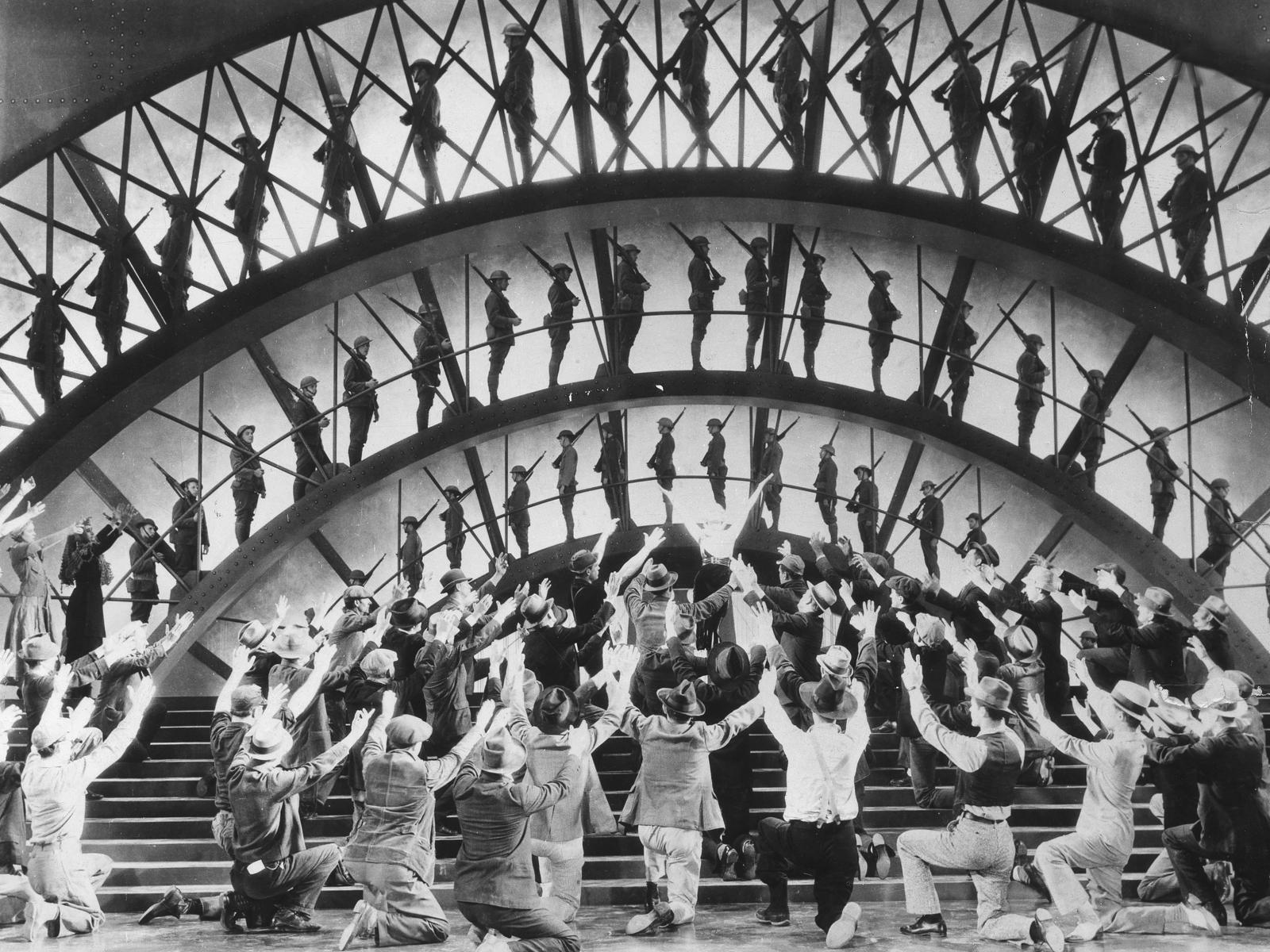
Then the arrangement expands. Military movement, wounded bodies and men waiting for food occupy the sequence; the final composition places marching silhouettes above the assembled civilians.[1][5] The film has already taught us to enjoy coordinated groups. Here, repetition becomes uncomfortable. A line suggests how readily a person can be absorbed into a system that needs his service and subsequently leaves him waiting.
The photograph above holds those two levels together. The raised arches let military silhouettes continue across the upper image while civilian figures occupy the space beneath. My reading is that the staging makes abandonment visible without requiring one character to explain it. The men remain connected by the composition even when society has stopped treating them as a shared responsibility.
Kemp notes that the film ends on this number, without a return to the romantic plot.[5] That choice leaves the audience inside the space Berkeley has built. Earlier, a room could open into a floating fantasy of dresses and light. Now it opens onto people whose need exceeds the happy fortunes of the leading characters. The camera's freedom has acquired a consequence: it can show more people than the comedy knows how to rescue.
Sources
- Harvard Film Archive, “Gold Diggers of 1933,” programme note for 16 December 2016 — the interrupted opening, musical sequences and finale.
- Rob Nixon, “Gold Diggers Of 1933 (1933).” Turner Classic Movies, 27 February 2013 — the two production units, collaborators and Joan Blondell's account of working hours.
- Tom Huddleston, “Where to begin with Busby Berkeley.” BFI, 28 October 2019 — prerecorded music, camera movement and the film image reproduced here.
- Harvey G. Cohen, “Warner Bros. and Its First Two Great Depression Musicals: Changing the Form and Reflecting the Times.” King's College London working paper, 2013, pp. 24–26 — the lighting and formations of “Shadow Waltz” and the opening of “Remember My Forgotten Man.”
- Peter H. Kemp, “Grit ‘n’ Glitz: Gold Diggers of 1933.” Senses of Cinema, December 2003 — the giant violin formation, the finale's staging and the absence of a closing plot scene.