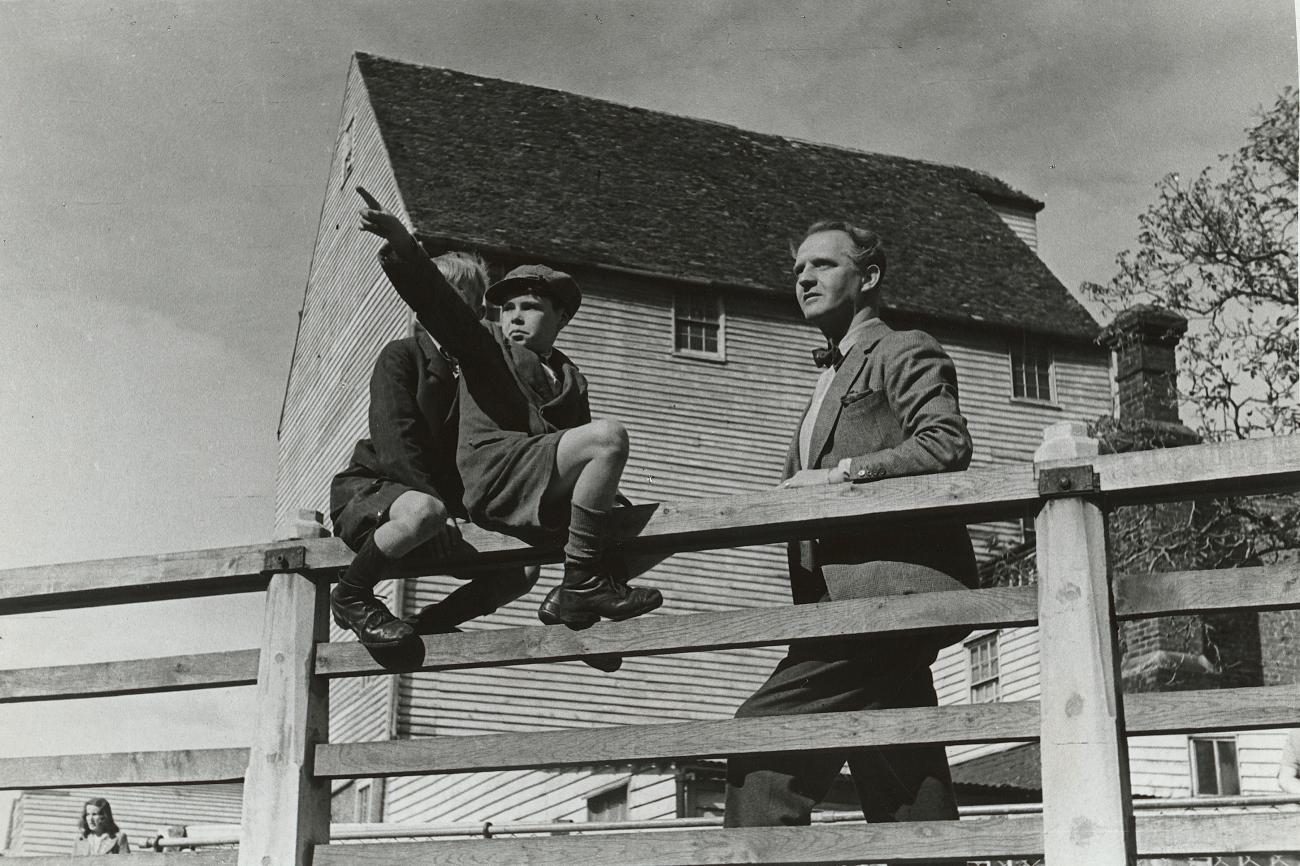
Spoilers follow, including the mystery and the ending. This essay discusses the full British version of the 1944 film, which runs about two hours.[1]
A bird rises into the sky; a cut replaces it with a fighter aircraft. At the beginning of A Canterbury Tale, centuries pass while the eye follows much the same movement.[2] The countryside survives the transition, but the people crossing it have different reasons for being there. A route once taken toward a shrine now carries travelers whose lives the war has interrupted.
Michael Powell and Emeric Pressburger bring three of those travelers together: Alison Smith, a Women's Land Army worker; Bob Johnson, an American sergeant; and Peter Gibbs, a British sergeant. Sheila Sim, John Sweet and Dennis Price play them.[1][4] Their stay in fictional Chillingbourne gives the film time to ask how an unfamiliar place can become personally meaningful. Its answer has a troublesome complication: the man most eager to teach them about Kent believes he can decide how other people should spend their evenings.
A conversation nobody has to attend
Bob finds an easier introduction. He talks with the village wheelwright about seasoning timber. Their shared knowledge gives the American a way into local life without requiring him to become English. Graham Fuller's account of the film emphasizes this conversation among its many connections across national and generational boundaries.[3]
A piece of wood is an unusually good diplomatic instrument. Both men can contribute; neither has to accept the other's expertise on trust. The subject gives them something to notice together. Their friendship begins with the pleasure of discovering that another person understands a familiar task.
This is one reason the film's leisurely movement matters. A mystery is underway, yet a conversation can keep its own pace. We are allowed to value an encounter before knowing whether it will supply evidence. In my reading, those pauses establish the standard against which the village's self-appointed educator should be judged: attention is most fruitful when someone has freely given it.
The guide who cannot bear an empty room
Thomas Colpeper, the magistrate played by Eric Portman, lectures on local history. He is also the man pouring glue into women's hair after dark. Frightening women away from dates helps leave the soldiers available for his lectures.[3][4] His devotion to the place is inseparable from a presumption that he may reorganize other people's lives around it.
The absurd weapon makes the offense easy to underestimate. Alison has to have the glue washed out; she also has to resist the suggestion that staying indoors would solve her problem. Tova Gannana's SIFF notes attend closely to her insistence on continuing to go out and catch the attacker.[2] Her freedom to use the village is at stake. A community that welcomes visitors to admire its history can still make its streets hostile to women.
Colpeper's appeal remains real. The BFI's programme notes describe both his magnetic presence and the unease his moral ambiguity caused critics.[4] Portman's character can help people feel the significance of a landscape while failing to respect the people standing in it. That makes him more disturbing than an obvious fraud. His knowledge is valuable; his claim to govern other people's attention does not follow from it.
Alison supplies a sharp corrective elsewhere. When a blacksmith tests her unfamiliarity with his trade, she asks how well he would manage behind the shop counter where she used to work.[2] The exchange lets competence travel in both directions. She can learn something here without arriving empty-handed.
A countryside assembled for strangers
The place itself is more various than its guardian's certainty suggests. As Adam Scovell's BFI location study shows, Chillingbourne combines several Kent locations: Fordwich supplies village streets, while Selling supplies the railway station.[6] The camera makes a coherent settlement from places that do not quite share an address.
That construction suits the travelers' experience. A place becomes theirs through a growing collection of encounters, rather than through possession of a complete map. The station, the workshop and the lanes acquire meaning at different speeds. Someone else's supposedly ordinary surroundings can become the setting of an unexpected friendship.
Des O'Rawe's programme essay also stresses the film's international authorship. Pressburger came from Hungary; cinematographer Erwin Hillier and production designer Alfred Junge were German émigrés.[5] Their presence complicates any claim that the film's England could only be understood from within. The affectionate image of a homeland was itself made through collaboration with people who had crossed borders.
An organ, some letters, a city still at war
In Canterbury, the three travelers receive different forms of relief. Bob gets the letters whose absence had made him doubt his girlfriend. Alison learns that her missing fiancé is alive. Peter, who played an organ in a cinema, has the chance to play the cathedral's instrument.[3] Their needs remain distinct even as the film gathers them toward a shared conclusion.
Peter's opportunity is particularly telling. A monumental building becomes accessible through something he already knows how to do. He can participate in its life. The wheelwright's conversation has prepared us for this kind of recognition: belonging can begin when a stranger's abilities find a use.
The cathedral's apparent solidity also depends on invention. Its screen interior was recreated at Denham Studios, while Canterbury's bomb-damaged streets supplied an actual wartime setting.[6] The film holds those materials together: a sanctuary constructed for the camera and a city visibly marked by destruction. Its consolations emerge inside a world whose damage remains present.
O'Rawe reads the ending's reconciliations as reaching beyond rational explanation.[5] They need not become a moral receipt proving that Colpeper was right. The people he tried to instruct discover meanings he could never have scheduled for them. That is where the film leaves me: moved by the generosity of its welcome, and still unwilling to let the beauty of a place excuse the man who tried to control access to it.
Sources
- British Film Institute, “A Canterbury Tale (1944)” — filmmakers, cast, running time and release context.
- Tova Gannana, “Film Notes: A Canterbury Tale.” SIFF, 24 September 2024 — opening transition, Alison's response to the attacks and the blacksmith exchange.
- Graham Fuller, “A Canterbury Tale.” Film Comment, March/April 1995, reproduced by The Powell & Pressburger Pages — the timber conversation, Colpeper's scheme and the three concluding blessings.
- BFI Southbank, “A Canterbury Tale,” programme notes, 25 October 2023 — Mark Duguid's account, the June 1944 Monthly Film Bulletin review and production credits.
- Des O'Rawe, “Pilgrims in a Strange Land: A Canterbury Tale,” Queen's Film Theatre programme note, hosted by Queen's University Belfast — international collaborators and the ending's reconciliations.
- Adam Scovell, “Powell and Pressburger's Kent: finding the mystical locations of A Canterbury Tale.” BFI, 25 October 2023 — composite village locations, wartime Canterbury, studio interiors and the film still reproduced here.