Spoiler note: this article discusses the surgery scenes and the ending.
Eyes Without a Face remains shocking not because it is the bloodiest horror film of its era but because it refuses to let horror look dirty.[1][2][3][4][5][6] Georges Franju takes a story about abduction, surgery, and parental obsession and wraps it in a style of almost impossible cleanliness. The house is ordered. The daughter's dress is white. The father's speech is measured. The mask is smooth, delicate, and nearly serene. Out of those elements the film builds one of cinema's coldest moral climates. Terror enters not as chaos but as control.[1][2][3]
That is why the movie keeps feeling more sorrowful than sensational.[1][2][5][6] Criterion's materials stress the film's mixture of ghastliness and lyricism, while BFI's writing keeps returning to its eerie balance of poetic fantasy and clinical violence.[1][5][6] Those descriptions point to the same achievement. Franju does not separate beauty from horror. He makes beauty itself unstable. A white face becomes an empty promise. A quiet corridor becomes an instrument of custody. A daughter's soft voice becomes the sound of a life suspended between paternal care and paternal violation.[2][3][6]
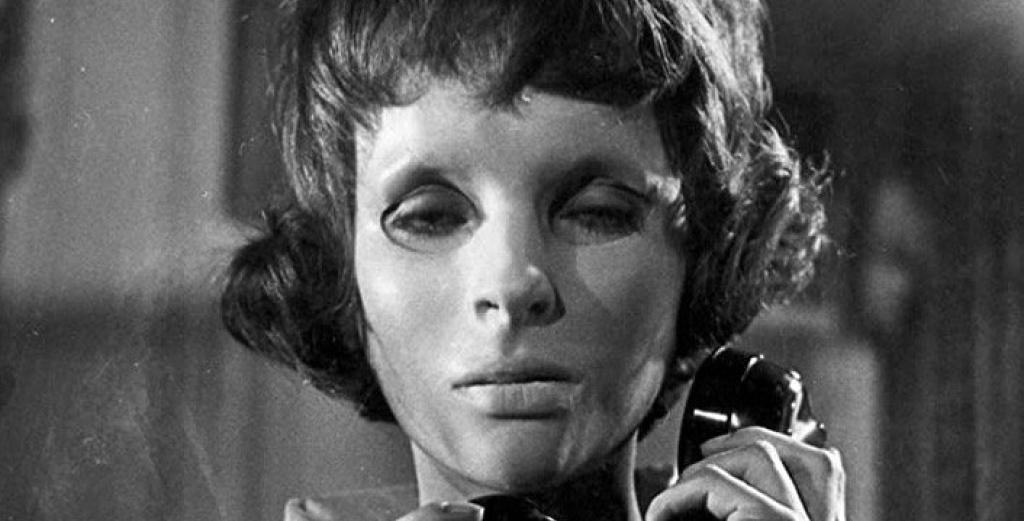
Image context: the cover still, sourced from BFI, shows Edith Scob's Christiane masked and speaking on the telephone.[7] It works as the article's visual key because the film keeps presenting Christiane as both present and unreachable. She is framed as an innocent figure, but the mask turns innocence into something manufactured, curated, and terrifyingly fragile.
The opening phone ride makes horror feel mobile before the house even appears
Few openings announce a film's emotional weather more efficiently than the first night drive in Eyes Without a Face.[5][6] Louise steers through dark roads outside Paris with a body in the car, and the movie withholds panic in favor of procedure. Scovell's BFI essay is right to emphasize the bleak hinterland setting: Franju places the story in terrain that feels neither fully urban nor fully rural, a fringe zone where ordinary civic order seems to have thinned out.[6] The road is not merely a route to disposal. It is the first sign that this film's horror will be logistical.
That matters because the opening refuses the comforting separation between respectable domestic life and criminal action.[1][4][6] The surgeon's crimes are not impulsive eruptions. They require transport, timing, disposal, records, explanations, and helpers. Louise's competence is what makes the film unnerving so quickly. She is not a cackling accomplice from Gothic melodrama. She drives, waits, moves, and lies with bureaucratic steadiness. The calm expands the horror instead of reducing it. Violence in Eyes Without a Face has already become part of an operating system.[2][6]
BFI's recommendation piece compares the film to an evil twin of Psycho, and the comparison clarifies something structural.[5] Hitchcock's film opens by thrusting a private transgression into visible risk. Franju's film begins after risk has already been routinized. The body in the car is terrible, but what lingers is the method by which the film normalizes the handling of terror. Before the chateau becomes the movie's main stage, the road has already taught us that horror here moves on schedule.
The mask does not conceal Christiane so much as turn her into a moral blank space
Christiane's mask is one of the great objects in horror cinema because it seems to promise restoration while actually displaying damage.[1][2][3] Patrick McGrath's Criterion essay is especially useful on this point: the face and the mask are not just props in the story but the film's governing pair, the place where questions of identity, soul, and violation are forced into visible form.[3] The mask is beautiful in the wrong way. It preserves outline without preserving expression. It offers purity without personhood.
This is why Edith Scob's performance feels so haunting.[1][2][3][5] Franju deprives her of ordinary facial expressiveness, then builds the entire movie around the consequences. The spectator is pushed toward voice, posture, glide, and pause. Christiane seems to float through the house rather than inhabit it. Her father wants to recover a face; the film keeps showing that what has really been destroyed is the right to appear in the world without mediation.[2][3]
Kalat's Criterion essay calls attention to Franju's balance of fantasy and realism, and the mask is where that balance becomes exact.[2] It is realistic enough to wound the viewer as an object of medical aftermath, yet stylized enough to push the film toward fairy tale. Christiane becomes something like a captive princess, but in a modern register emptied of enchantment. The white mask makes her look less hidden than embalmed. It is the visual form of being kept.
The film therefore turns looking into an ethical test.[2][3][5] Dr. Génessier sees his daughter as a project, a surface to be repaired in pursuit of his own godlike image of cure. Louise sees her as a patient to be managed. The viewer is asked to see something else: a woman whose apparent fragility is the result of systematized theft, not natural weakness. The mask becomes frightening because it shows how completely care can imitate cruelty when a person has been reduced to a problem of appearance.
The house is really two systems stacked together: the corridor of manners above, the kennels of violence below
The chateau in Eyes Without a Face is memorable because it feels both aristocratic and administrative.[1][2][4][6] Upstairs, the rooms are quiet, white, and controlled. Downstairs, the dogs wait in cages, the surgical work is prepared, and the film's violence becomes unmistakably material.[1][2] Franju uses this vertical split brilliantly. He does not need a visibly monstrous castle. He needs a respectable house under which monstrosity has been professionally organized.
That split changes the meaning of every corridor.[2][3][6] In many horror films, hallways are threatening because something might leap from them. In Eyes Without a Face, the threat is often that no one will. The corridor is where order passes from room to room. Louise escorts victims through it. Christiane drifts through it. The father crosses it with the authority of a physician making rounds. The calm geometry gives the film its chill. Space itself has accepted the crimes as routine.
The animals below the clinic matter for the same reason.[1][2][3] McGrath notes the importance of the dogs and doves, and Franju uses them as more than symbolic decoration.[3] The dogs are experimental subjects, prisoners of the doctor's ambition, and an acoustic reminder that suffering has been institutionalized under the family's daily life. Their barking rises through the house like a truth the architecture cannot fully suppress. If Christiane in white suggests innocence kept under glass, the kennels reveal the cost of that arrangement.
This is also where the famous surgery scene earns its force.[1][2][5] Franju shoots it with a steadiness that feels almost documentary, and that refusal of melodramatic distortion is exactly what makes it unbearable. The film has already prepared us for horror as procedure, so when the operation arrives it feels less like an exception than the system disclosing its real face. Clean instruments, practiced hands, white surfaces: the movie keeps proving that refinement is not the opposite of brutality. It can be brutality's preferred costume.
The ending inverts the fairy tale: the daughter leaves, the doctor is torn open, and the house loses its right to keep anyone
The last movement of Eyes Without a Face is unforgettable because it finally breaks the system of managed stillness the film has so carefully built.[1][2][3][5] Christiane releases the dogs, the doctor's authority collapses into animal retaliation, and the daughter who has been held like a relic walks outward into the night with doves around her. It is one of the strangest endings in horror because it is at once punitive, mournful, and almost weightless.
The release of the dogs matters beyond revenge.[2][3] All film long, Génessier has treated living beings as material arranged beneath his authority: patients, victims, assistants, animals, even his own child. When the dogs attack him, the film does not simply punish evil. It removes the hierarchy that let him define everyone else as usable. The basement's imprisoned life comes back upstairs. The order of the house is revoked.
Christiane's exit is even more radical because Franju refuses conventional triumph.[2][3][6] She does not stride into freedom as a newly restored self. She leaves masked, wounded, and uncertain. Yet that uncertainty is exactly what makes the ending moving. For the first time in the film, she is no longer being escorted between spaces designed by others. The image does not promise recovery. It promises the end of custody.
That is why Eyes Without a Face lasts.[1][2][3][4][5][6] It is a horror film, but also a study of how authority beautifies itself. Franju understands that dread becomes deeper when violence is housed inside etiquette, medicine, and paternal devotion. The opening road, the white mask, the corridor, the kennel, and the final walk into darkness all belong to one design. The film keeps asking what remains of a person when love has been recoded as management. Its answer is bleak, but not empty: what remains is the possibility of refusal, fragile and ghostly, still moving after the house has spent the whole film trying to keep it still.[2][3]
Sources
- The Criterion Collection, "Eyes Without a Face" film page, with synopsis, credits, restoration notes, and stills.
- David Kalat, "Eyes Without a Face: The Unreal Reality," The Criterion Collection.
- Patrick McGrath, "Appearances to the Contrary: Eyes Without a Face," The Criterion Collection.
- BFI, "Les Yeux sans visage (1959)" film page, with cast, runtime, and related critical context.
- William Fowler, "BFI Recommends: Eyes without a Face," BFI.
- Adam Scovell, "The deathly hinterlands of Eyes without a Face - 60th anniversary," BFI.
- BFI still image used for the cover, "eyes-without-a-face-1960-edith-scob-on-the-phone.jpeg."