Most war films about resistance eventually give you a burst of visible heroism: a sabotage action, a firefight, a prison break, a public speech that clarifies what courage looks like. Jean-Pierre Melville's Army of Shadows keeps moving in the opposite direction.[1][2][3] It certainly contains escape, killing, and sacrifice, but it makes all of them feel secondary to a colder fact. Resistance is first a problem of administration. Who can carry a message. Which name can be used. Which room is safe for one night. Who has been seen. Which delay can be absorbed before a whole chain collapses.[2][3][4]
That is why the film still feels so severe. Adapted from Joseph Kessel's 1943 Resistance account and reshaped by Melville's own wartime experience, it treats secrecy not as colorful spy texture but as the condition under which moral life has to continue.[2][3] The point is not simply that occupied France was dangerous. The point is that danger had entered ordinary procedure. Offices, prison camps, barber shops, train platforms, and safe apartments all become part of one hostile filing system.[2][3][5] A person survives by becoming hard to read, and the tragedy is that this unreadability eventually invades friendship, loyalty, and even grief.
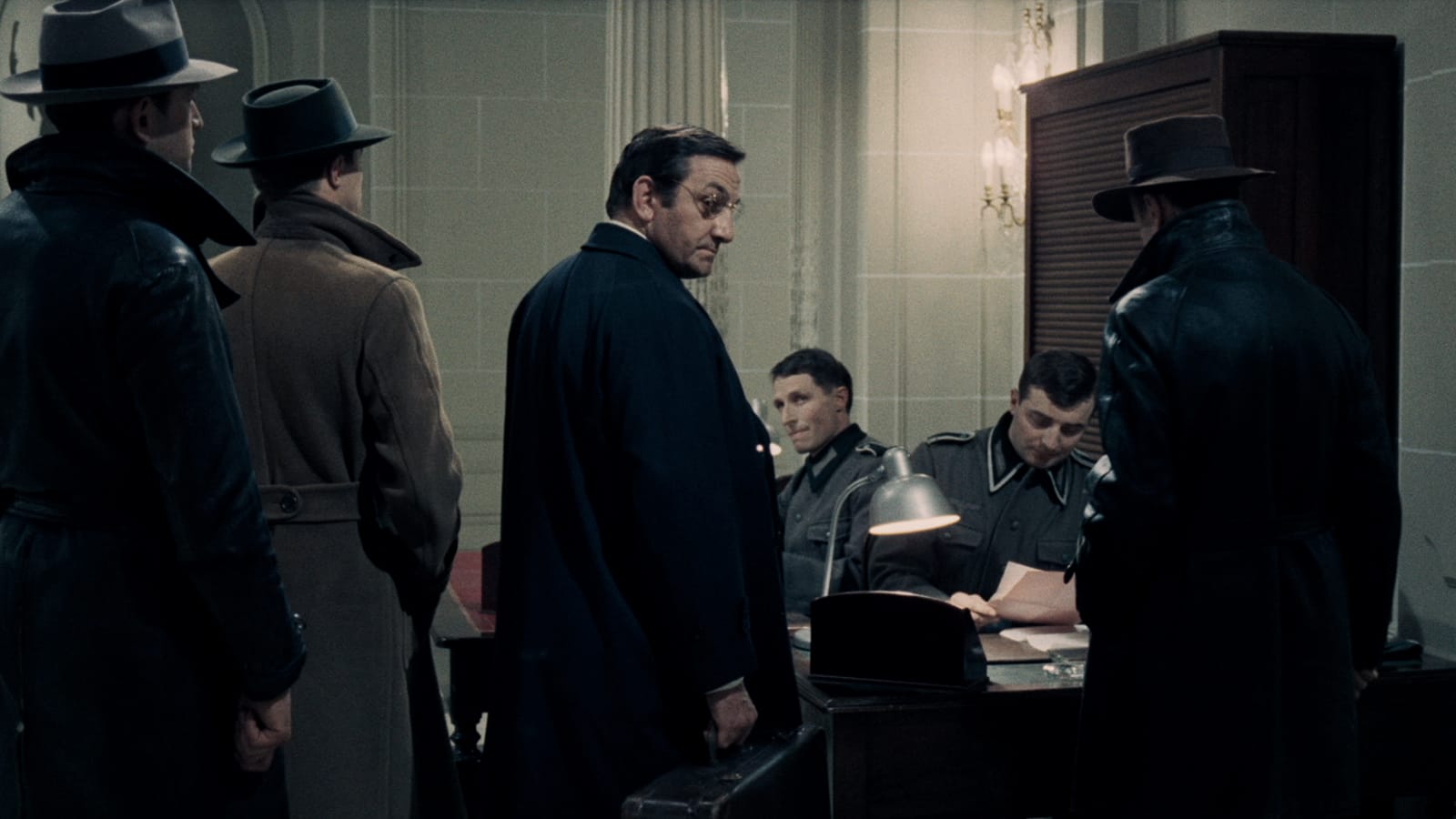
Image context: the lead image uses a real Criterion still from the film. It fits this essay because Melville keeps framing occupation as an interior of controlled observation: desks, uniforms, hats, and fixed glances turn political violence into a daily workflow.[1]
Occupation arrives as paperwork before it arrives as combat
Amy Taubin's Criterion essay is especially sharp on the film's opening shock: German soldiers marching under the Arc de Triomphe, the image freezing as if occupation itself had locked French public space in place.[2] But after that symbolic jolt, Melville does something even harsher. He drops into routine. Gerbier is not introduced while leading a glorious operation; he is handcuffed in transit, being moved through a system managed by Vichy police, bad weather, and petty accommodation.[2][3] Paxton's historical note on the film helps here because it stresses that by the likely moment of the story, probably 1943, Vichy was already assisting German repression with its own police apparatus.[3]
That framing changes the whole moral temperature of the film. Occupation is not presented mainly as battlefield confrontation. It is presented as administration backed by force.[2][3][4] People queue, wait, sign, escort, inspect, transfer, and report. The enemy's greatest power is not only weapons; it is the ability to turn movement into procedure. Melville understands that a regime becomes terrifying when it can make domination look ordinary. In Army of Shadows, clerical rhythm is part of the nightmare.
Suspense comes from process rather than spectacle
Taubin argues that viewers expecting romantic heroes or triumphant action will be thrown by Melville's "rigorous focus on process rather than action," and that is exactly the film's method.[2] The suspense in Army of Shadows rarely comes from surprise in the conventional thriller sense. It comes from watching a chain of decisions hold together under pressure.[1][2] Gerbier's escape from Gestapo headquarters matters not because Melville wants an adrenaline spike for its own sake, but because one break in procedure can briefly reverse the whole direction of power.[2][3]
The same logic governs the film's most punishing scenes. The execution of the young informer is agonizing not because Melville turns it into melodrama, but because he refuses to skip the procedural question of how it can be done quietly, with limited tools, by men who do not want to do it at all.[2] Paxton's essay also sharpens the film's relation to labor by reminding us that women couriers and radio carriers could sometimes move more safely through occupied space than men.[3] That detail is not sociological garnish. It is central to how the movie thinks. Resistance here is a relay system of bodies, objects, codes, desks, and timings. Heroism lives inside logistics.
Even the London scenes follow the same rule.[1][3] Colonel Passy appears not as myth but as one more node in an information network; Luc Jardie moves between scholarship and command; Gerbier carries the same concentrated self-control from one compartment to another.[3] Melville films all of this with the pared-down rigor Bertrand Tavernier later described as one of his defining strengths: no patriotic speeches, no inflated rhetoric, just a plot stripped to commitment, betrayal, and survival.[5] The result is a war film that behaves like an operations manual written by people who know every page could become a death sentence.
Invisibility is the condition of survival and the wound it leaves behind
What makes Army of Shadows more than an efficient thriller is that Melville never treats invisibility as morally clean.[1][2][3] Kessel's line, quoted by Taubin, that everything had to be accurate while nothing remained recognizable, gives the film its governing paradox.[2] The Resistance must hide in order to tell the truth of its situation. Names become covers. Rooms become fronts. Courtesy becomes disguise. Paxton's account of the historical models behind Gerbier, Jardie, and Mathilde only deepens that effect, because it shows how much of the film is built from actual clandestine lives translated into slightly altered form.[3]
The price of that translation is emotional thinning. Gerbier's composure is admirable, but it is also the look of a man who has accepted that intimacy must remain partially blocked.[2][3] Mathilde's competence makes her invaluable, yet the very logic that values her also exposes her to terrible judgment once security is threatened.[2][3] Melville's characters do not die because they lack conviction. They die because conviction in this world has to pass through compartmentalization, and compartmentalization eventually deforms every human bond it protects.
That is why the ending lands with such force. Taubin describes the final title cards as filmic tombstones, and the phrase is exact.[2] Melville does not conclude with cathartic release. He concludes by turning lives into brief administrative notices of execution. The form completes the argument. A film that began by showing domination as a system of files, escorts, and controlled circulation ends by showing death itself entered into the record with brutal brevity.
Its late recognition makes sense
The movie's reception history almost repeats its theme. Taubin notes that the 1969 French release collided with the political afterlife of May 1968, leading many critics to misread the film as a glorification of de Gaulle and to push it to the margins for decades.[2] The later restoration and the 2006 U.S. release allowed audiences to see something harder and stranger: not a nationalist pageant, but a tragedy about what righteous struggle feels like from the inside when nearly every option is bad.[1][2][4]
That belated recognition matters because Army of Shadows has not grown softer with time.[1][2][5] If anything, it now looks clearer. Melville understood that under extreme political pressure, the decisive drama may not be visible rebellion in the cinematic sense. It may be the maintenance of a fragile hidden structure: aliases remembered, radios moved, instructions relayed, danger absorbed one more day. Resistance in this film is not a blaze. It is an infrastructure of invisibility, and Melville never lets us forget that the same discipline that keeps it alive also leaves scars no victory parade can properly display.
Sources
- The Criterion Collection, "Army of Shadows (1969)" film page and edition notes.
- Amy Taubin, "Army of Shadows: Out of the Shadows," The Criterion Collection.
- Robert O. Paxton, "Melville's French Resistance," The Criterion Collection.
- BFI, "Army of Shadows (1969)" film page.
- Bertrand Tavernier, "Jean-Pierre Melville, My Father in the Art," The Criterion Collection.