The title of Ritwik Ghatak's A River Called Titas (Titash Ekti Nadir Naam, 1973) sounds almost modest: here is a river, and here is its name. The film spends 156 minutes revealing how much a name can hold. The Titas is a road between villages, a fishing ground, a place to bathe and celebrate, a route for marriage and abduction, and finally a bed of exposed earth. It is never just scenery. It is the material that lets a community remain a community.
That distinction matters because the film is often reduced to a grand symbol: the dying river as Bengal, Partition, ecological collapse, or history itself. All of those readings have force, but Ghatak earns them from the water level upward. He first shows what people ask the Titas to do. Boats carry workers and strangers. Fishing sustains households. Rituals gather bodies at the bank. A bride is lost in transit. Only after the river has connected these lives does its disappearance become more than a beautiful tragedy.[2][4][5]
The result is a close reading written in two registers at once. Ghatak's melodrama makes separation intimate enough to hurt; his editing and landscape compositions keep widening that hurt until it belongs to a whole social world. The river vanishes physically near the end, but the film has been teaching us to see disappearance—in missing faces, skipped years, severed relationships, and abandoned work—from the beginning.
Spoiler and version note: this essay discusses the film's deaths and final sequence. It refers to the 2010 World Cinema Project restoration, assembled from incomplete original camera and sound negatives and a complete positive print, with the opening credits reconstructed.[1][2]
A road that cannot guarantee arrival
On a map, a river connects. In the first movement of A River Called Titas, connection is also the source of danger. Fishermen Kishore and Subol travel to another village, where Kishore marries a young woman generally identified as Rajar Jhi. The newlyweds begin their journey home by boat. She has barely seen her husband's face when river bandits abduct her. She survives and washes up on the Titas, but cannot identify or recover her husband. Kishore, believing her lost, descends into madness.[2][5]
The plot is extravagant, yet its geography is exact. The bride remembers the name of Kishore's village but not enough information to recover him. A place-name remains after a face and a relationship have gone. The Titas can transport her body toward the correct bank, but it cannot restore the social knowledge that marriage was supposed to provide. Route and arrival separate.
Ghatak makes that separation visible by refusing to turn the river into an establishing shot that politely precedes the drama. Water keeps interrupting the human story. Boats cut across the frame; open sky dwarfs the figures below; banks promise orientation while currents keep carrying people elsewhere. Film at Lincoln Center aptly describes the movie as oscillating between documentary-like attention to riverside customs and extreme melodrama.[5] The two modes are not competing. The documentary texture gives the melodrama a working world to rupture.
The story changes course before the water does
After roughly half an hour of marriages, abduction, madness, and death, the film leaps ahead by ten years. Its center of gravity shifts. Rajar Jhi arrives in Kishore's village with her son Ananta, neither spouse recognizes the other, and Basanti—the girl who once hoped to marry Kishore, then became Subol's widow—takes on an increasingly central place in the child's life.[2][7]
A conventional family saga would make these transitions into clean relay points. Ghatak prefers ellipsis. Some events arrive after their consequences; some relationships become legible only when the viewer reconstructs what characters cannot know. Adrian Martin describes the film as a deliberately broken melodrama whose two halves can jump among story threads rather than advance one protagonist along a stable path.[2] Its form behaves less like a road than a river after its channels have shifted: the same bodies and memories remain in the system, but they no longer meet where expected.
This is why the film's abrupt cuts are not merely rough edges around a large production. A heightened gesture may end before it settles. A close-up can collide with a horizon. Song, noise, and silence can change the temperature of a scene faster than plot explanation could. Ghatak makes viewers feel continuity and breakage at the same time. We recognize the emotional rhyme between separated people even when the characters lack the information that would complete it.[2][7]
The method also prevents the Titas from becoming a single, tidy metaphor. The river is continuity, but its narrative keeps breaking. It is life-giving, but it carries catastrophe. It seems timeless, but its bed changes. Every large meaning encounters a contrary fact.
Water has a social body
The film's wide views matter because they are crowded with specific uses. Nets, boats, washing, crossings, songs, festivals, and shoreline arguments give the Titas a social body. The water is not a wilderness surrounding the characters; it is shared infrastructure without an institution standing apart to guarantee it.
That shared life is unequal. The BFI emphasizes that Ghatak focuses on women at the lowest level of an already poor fishing community, with widowhood narrowing their possibilities further.[4] Basanti's resilience does not grant her independence from that structure. Rajar Jhi's survival does not restore her recognized place as wife. The river may be common, but access to kinship, food, credit, and authority is not.
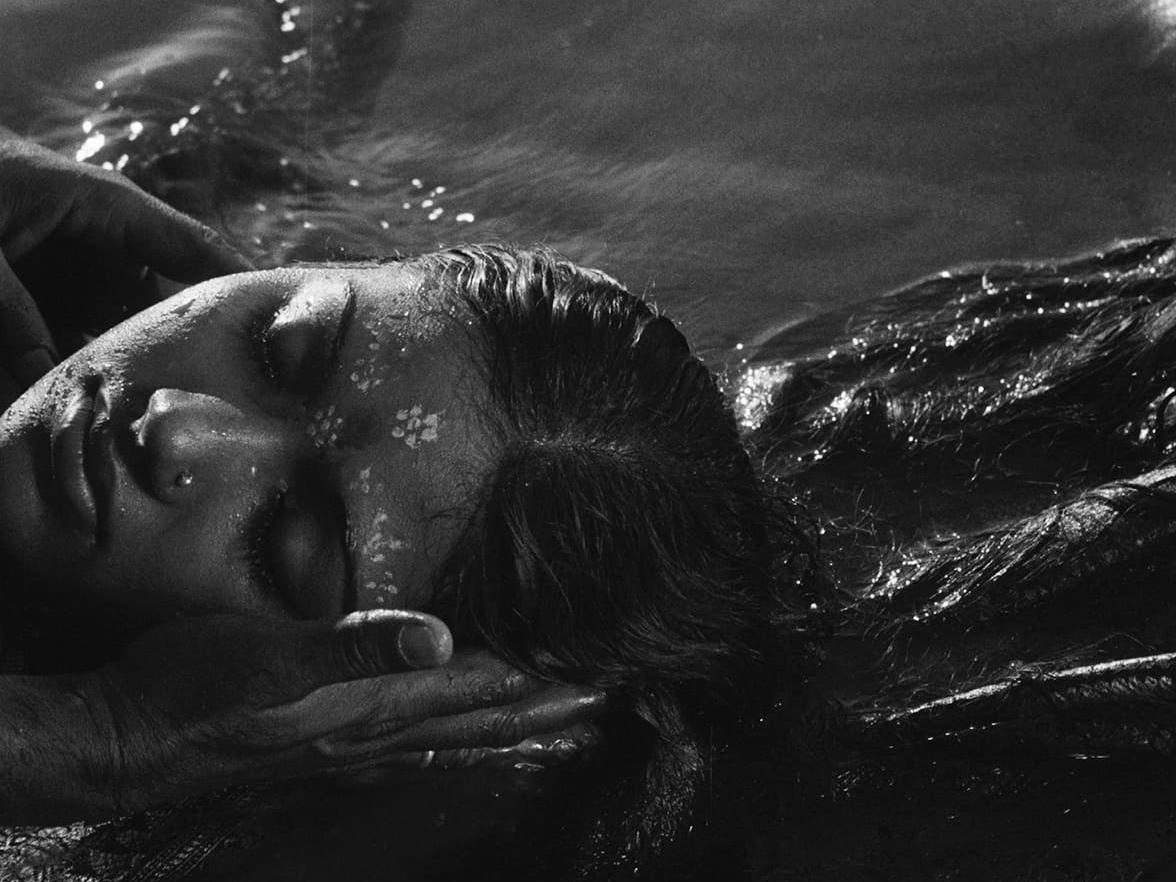
The lead still catches this distinction in one body placed directly in the water. It is not a postcard view of a river admired from safe ground. The person and the Titas occupy the same visual field; water reaches the body before it becomes an idea. That is Ghatak's governing scale. Ecological loss becomes political because it first alters ordinary movement, work, hunger, care, and exposure.[3]
There is a necessary limit to this claim. Parichay Patra records historian Gautam Bhadra's objection that the adaptation can detach Malo life from the wider economic structures and historical specificity present in Advaita Mallabarman's novel.[6] The criticism matters: landscape and myth can make a community seem eternal just when the film wants to show change. Ghatak's defense lies not in providing a complete social history but in repeatedly returning the grand image to material pressure—debt, scarce food, widowhood, fishing labor, and conflict over the land exposed by the retreating water.[6][7]
Recognition comes under an indifferent sky
The film's most painful reunion arrives during Dolyatra. Kishore and Rajar Jhi encounter one another after years of separation, each having lived beside the consequences of a relationship neither could fully recover. Ghatak does not close the world around them. He opens it. Patra notes how the figures take up only a small portion of a composition dominated by sky, river, and distant boats.[6]
That scale denies the usual reward of recognition. In melodrama, a recovered face can unlock the past and repair identity. Here recognition comes too late and remains exposed. Kishore's ecstatic movement, Rajar Jhi's gaze, Ananta's close-up, the festival music, and the huge horizon do not combine into private completion. The landscape seems able to contain their reunion without changing for it.
The scene clarifies what the film means by forces larger than individual intention. Chance separated the couple; social rules left the bride with almost no usable account of her husband; madness erased Kishore's ability to search; time placed their son between them. These are not abstractions floating above the characters. Ghatak makes each force perceptible through a face, a body, a cut, or a stretch of unanswering sky.[2][6]
Their deaths do not finish the film because the couple was never its sole container. Ananta moves onward. Basanti's care, anger, and eventual estrangement from the boy become another current. The community remains, then begins to fail at the level no reunion can repair: the river itself.
Dry land is not the same thing as recovery
When the Titas recedes, its absence initially produces something that looks useful: land. But a dry riverbed cannot simply be added to the village as new wealth. Fishing families lose the medium of their work while cultivators and landholders see ground that can be claimed. Conflict grows around the exposed bed; debt and hunger intensify; the Malo settlement disperses.[4][7]
Ghatak does not offer a technical explanation for the river's behavior. That boundary is worth preserving. A recent BFI essay reads the film as anticipating contemporary language about climate and ecosystem dependence, a compelling afterlife for the work rather than evidence that it diagnoses a particular modern climate mechanism.[3] On screen, the fact is both simpler and more radical: environmental change redistributes power because livelihoods are not interchangeable.
The ending refuses to confuse new fertility with restitution. Basanti goes to the former river for water and digs at the bed with her hands. Her final vision replaces the arid ground with a green field and a child running through it. The image contains life, but not the return of the life we have watched. A field can feed someone and still mark the disappearance of a fishing culture. A child can promise futurity without repaying the dead.[2][4][7]
This is where the title's plainness becomes devastating. The Titas still has a name after the boats are grounded and the village has thinned out. Film can preserve that name, the faces beside it, and the work once done on its surface. Preservation is not resurrection, however. The 2010 restoration recovered Ghatak's images from incomplete elements; it cannot reverse the history those images record.[1][2]
A River Called Titas therefore makes the river disappear twice. First it withdraws as a dependable bond among people: names fail, faces go unrecognized, years vanish in cuts, and care passes from one wounded household to another. Then the water withdraws from the land. By the time the bed is dry, we understand exactly what has gone missing—not an eternal symbol, but a whole arrangement of labor, memory, kinship, conflict, and motion.
Sources
- The Criterion Collection, “A River Called Titas” — official film metadata, credits, 2010 restoration partners, format, and archival element history.
- Adrian Martin, “A River Called Titas: River of No Return.” The Criterion Collection, December 12, 2013 — Ghatak's ellipses, broken melodrama, Partition context, river imagery, and restoration history.
- Sanghita Sen, “Where to begin with Ritwik Ghatak.” British Film Institute, June 1, 2026 — ecological reading, adaptation context, and source page for the BFI-hosted film still.
- Trevor Johnston, “10 great river films.” British Film Institute, March 17, 2022 — the film's women, editing, dry river, ecological volatility, and social-change frame.
- Film at Lincoln Center, “A River Called Titas” — program record on the film's documentary detail, melodramatic register, riverside customs, and landscape compositions.
- Parichay Patra, “In Defence of A River Called Titas (Ritwik Ghatak, 1973).” Senses of Cinema 82, March 2017 — close analysis of the Dolyatra reunion and the debate over the adaptation's representation of Malo history.
- itp Global Film, “Titas Ekti Nadir Naam (A River Called Titas),” August 9, 2010 — scene chronology, formal observations, land conflict, dry-riverbed ending, and version details.