Spoiler note: this essay discusses the setup and payoff of the skyscraper climb in Harold Lloyd's 1923 silent comedy Safety Last!.
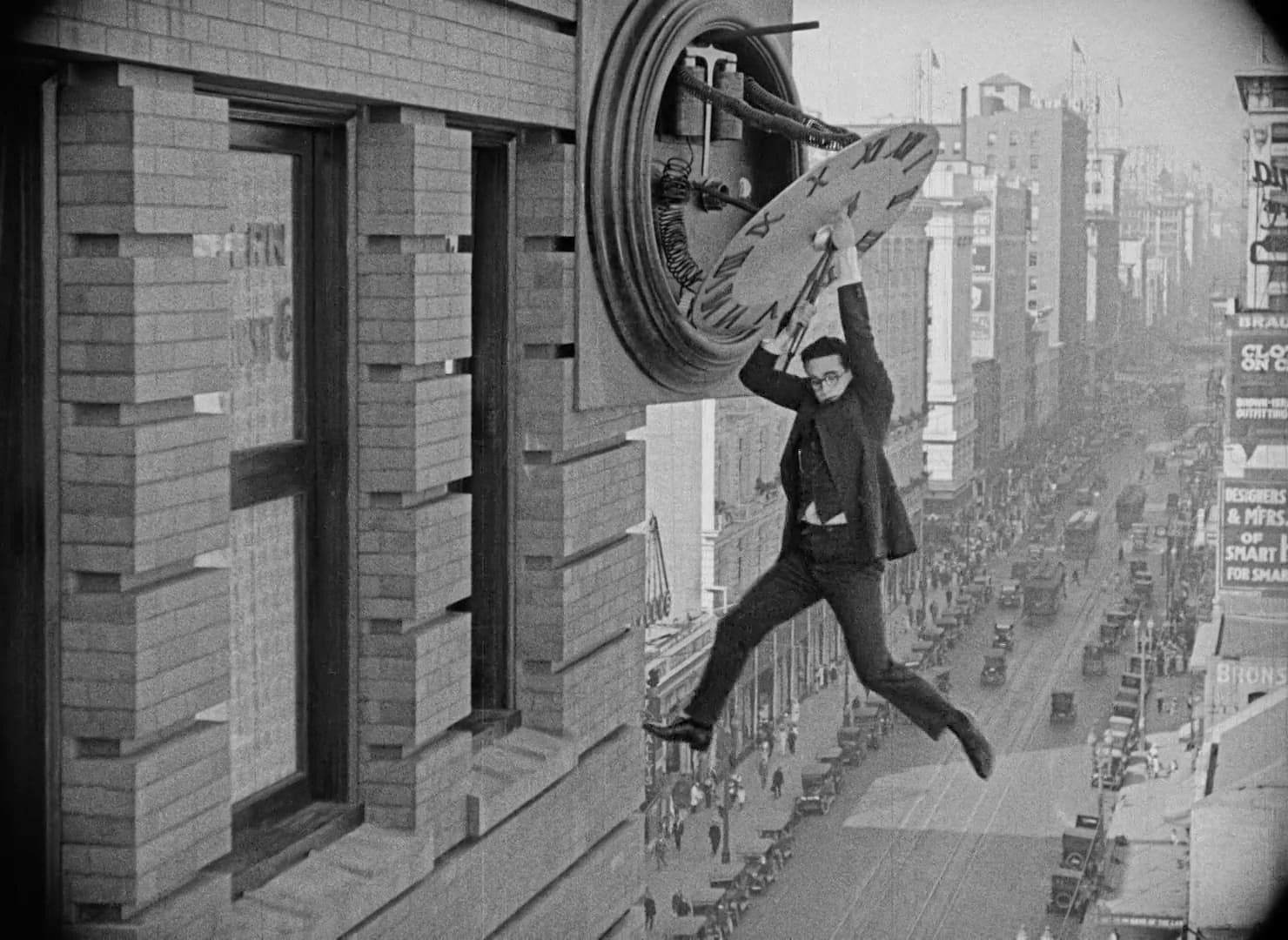
The clock shot is so famous that it can make Safety Last! look simpler than it is: Harold Lloyd, straw boater and round glasses, hanging from the hands of a giant clock above Los Angeles traffic. The image travels easily because it is clean, funny, and legible even to people who have never seen the film. But the movie's craft is not contained in the instant when the clock face breaks loose. It lies in the way the film spends nearly an hour teaching the audience to read the city as a machine of pressure, promotion, money, floors, windows, ledges, crowds, and delayed substitutions.[1][2]
That is why the climb still works. It is not an isolated daredevil stunt dropped into a weak story. It is the story made vertical. Lloyd's Boy arrives from a small town, exaggerates his success to the woman he hopes to marry, works a low-paid department-store job, and tries to convert humiliation into proof that he is rising. The final ascent takes that social fantasy literally. To "make good" in the city becomes a matter of climbing the building where he is employed, one floor at a time, while a crowd below converts private panic into public spectacle.[2][4][5]
The film builds upward before anyone climbs
The AFI Catalog identifies the core premise plainly: a store clerk's attempt to look successful becomes a publicity stunt that sends him up the side of the store building.[1] That summary matters because the climb is not framed as pure athletic display. It begins as commerce. The building is an advertising surface, the street crowd is a market, and Lloyd's body becomes the sign that might bring customers through the door.
Before the exterior stunt, the department store teaches the same logic horizontally. The Boy works behind the fabric counter, gets squeezed by supervisors, customers, and time, and performs little acts of improvisation just to survive the business day. TCM's account notes the film's store-clerk setup and the way Lloyd's eager worker persona is continually sabotaged by ordinary chores.[4] The store is already a comic machine: bodies jammed at counters, packages misdirected, status invented, authority appearing at the wrong moment.
The skyscraper sequence simply turns that machine ninety degrees. Each floor becomes a new counter, each window a new interruption, each ledge a narrower workplace. The comic principle is consistent: the Boy wants one clean path through a social system that will not stop producing obstacles. The difference is that the later obstacles are no longer merely embarrassing. They are arranged over a drop.
Real height, staged readability
The Library of Congress National Film Registry essay is useful because it pushes against a lazy myth: the effect was not created by glass shots, animation, rear projection, double exposure, or other postproduction trickery. The danger was staged through real locations, carefully selected camera positions, platforms below the action, and the crucial exclusion of those safety arrangements from the audience's field of view.[3] Lloyd did not need the climb to be literally as lethal as the fiction suggests. He needed it to be optically honest enough that laughter could not detach itself from bodily alarm.
That balance is the craft. If the audience sees only danger, the scene becomes cruelty. If it sees only protection, the gag collapses. Safety Last! holds the middle ground by keeping the street visible, the horizon plausible, and Lloyd's face readable enough that the viewer feels both performer and character are trapped in the same vertical sentence.[1][3] The AFI Catalog's production notes are important here because they describe sets built on rooftops of varying buildings to preserve the illusion of one continuous climb.[1] In Safety Last!, that real-location layer is not incidental texture. It is the source of the sweat.
The film's most important technical decision is therefore not the clock prop by itself, but the repeated composition of body, ledge, building face, and drop. Lloyd and his collaborators keep giving the audience enough spatial information to understand each problem immediately. A window swings out; the viewer knows where the body can and cannot go. A mouse runs up a trouser leg; the viewer knows why a normal flinch is dangerous. A net, platform, or mattress may be below the frame, but the image's grammar insists on vertical exposure.[3][5]
Comic delay is the real engine
The plot mechanism is wonderfully cruel. Lloyd's character is not supposed to climb the whole building. His roommate, played by Bill Strother, is the one with human-fly ability; the plan is for the Boy to begin the stunt and then hand it off after a floor or two. A policeman's pursuit disrupts the substitution, and the Boy keeps being forced upward because the rescue keeps moving just out of reach.[2][4][5]
That structure turns the sequence from stunt demonstration into comic delay. The question is not simply "Can he climb?" It is "Can the promised escape arrive before the next floor invents another reason it cannot?" This is why the climb feels so much richer than a single athletic feat. It is a chain of deferred handoffs. Each floor briefly looks like a place where the fiction might reset, only to become another trap.
The repetition is precise. The Boy reaches a window; the help he expects is blocked. He reaches another point of safety; a new hazard appears. The pattern resembles retail labor again: finish one task, find another waiting; answer one demand, get punished by the next. Jeffrey Vance's San Francisco Silent Film Festival essay is especially sharp on this structure: the five reels before the climb provide the necessary context, and the film's dominant theme is illusion, including the camera's role in making the impossible seem believable.[2] The climb is funny because it literalizes that structure with almost mechanical clarity. Inside the building, commerce humiliates him. Outside the building, commerce advertises him.
The ordinary body is the special effect
Lloyd's screen persona differs from Chaplin's tramp and Keaton's stone-faced engineer because his body reads as more socially ordinary. He does not seem mythic, destitute, or superhuman. He looks like a clerk who has accidentally been assigned a task beyond his training. Britannica's overview stresses Lloyd's ability to make comedy out of physical danger; the force of Safety Last! is that the danger attaches to someone who still appears civilian, employable, and socially recognizable.[5]
That ordinariness changes the visual effect. The glasses matter because they keep the face civilian. The straw hat matters because it resists heroic costume. The suit matters because the body remains dressed for employment, not acrobatics. When that body hangs against the side of the building, the scene does not say, "A stuntman can do this." It says, "The same person who was trapped behind a counter has been pushed into the sky by the logic of needing to appear successful."
The clock face sharpens the point. A clock is a public instrument: it regulates work, appointments, store hours, and modern schedules. By making Lloyd cling to it, the film turns time itself into a physical hazard. He is not merely late, ambitious, or underpaid. He is literally hanging from the mechanism that measures pressure. The title's joke, Safety Last!, stops being a slogan and becomes a whole urban condition.
Why the famous image still earns its fame
The final reason the clock shot endures is that it is both climax and summary. It contains the store's publicity logic, the city's vertical aspiration, the worker's false performance of success, the human-fly craze that inspired the premise, and the camera's bargain with real risk.[2][3][4] The viewer does not need to know all of that to feel the image. But the image keeps its power because the film has quietly arranged all those pressures underneath it.
The persistence of making-of accounts around the film points to the same enduring fascination: viewers want to know how the illusion was made because the illusion is inseparable from the pleasure.[1][2][3] Safety Last! is not a film where technique hides behind story. Technique is the story. The audience laughs because the movie lets us see a comic body thinking through architecture in real time.
That is why the film remains more than a museum piece of silent comedy. Its modernity is not just the skyscraper or the crowd or the publicity stunt. It is the feeling that city life converts ordinary insecurity into performance. Lloyd's Boy wants money, marriage, and recognition, but the movie translates those wishes into windows, ledges, clocks, policemen, signs, customers, and spectators. The climb is absurd because the social demand is absurd: rise visibly, keep smiling, and do it where everyone can watch.
In the end, Safety Last! turns the city into a device for making ambition physical. The clock image survives because it is not merely a stunt photograph. It is a perfectly engineered sentence: one ordinary man, one public clock, one impossible drop, and a whole modern economy pulling him upward while gravity waits below.
Sources
- AFI Catalog, "Safety Last! (1923)" film record, including credits, synopsis, production notes, and stunt context.
- Jeffrey Vance, "Safety Last!" San Francisco Silent Film Festival essay, on the film's human-fly origin, illusion structure, and climb staging.
- Richard W. Bann, "Safety Last" National Film Registry essay. Library of Congress, on the stunt design, real locations, and safety platforms.
- Turner Classic Movies, "Safety Last! (1923)" article, with plot, production, department-store setting, and Bill Strother context.
- Britannica, "Safety Last! | Cast, Clock, Summary, & Facts," overview of the 1923 film and Lloyd's physical-comedy significance.
- Wikimedia Commons, "File:Safety Last (1923) sceenshot.jpg," 1923 Hal Roach Studios film screenshot used as the article image.