CinemaScope is often remembered as the moment movies suddenly became wider.[1][2] That memory gets the sensation right and the business model only halfway. What Twentieth Century-Fox actually introduced in 1953 was a way to make the existing 35mm theater feel newly monumental just as television was teaching audiences to consume moving images at home.[1][2][4] The problem Hollywood faced was not only aesthetic. The ordinary movie house had begun to feel ordinary. CinemaScope answered by turning width, curvature, and multi-channel sound into a reason to leave the living room.[1][2][5]
What made that answer commercially potent was compatibility. AFI's catalog entry on The Robe stresses that, unlike Cinerama, CinemaScope required only one camera and one projector.[4] An anamorphic attachment squeezed a wide image onto standard 35mm stock, and another special lens unsqueezed it during projection, yielding a 2.55:1 image instead of the earlier 1.33:1 norm.[4] Fox therefore did not need to replace the gauge that already organized production, lab work, shipping, and booth practice. It kept the film strip and changed the event around it.[4]
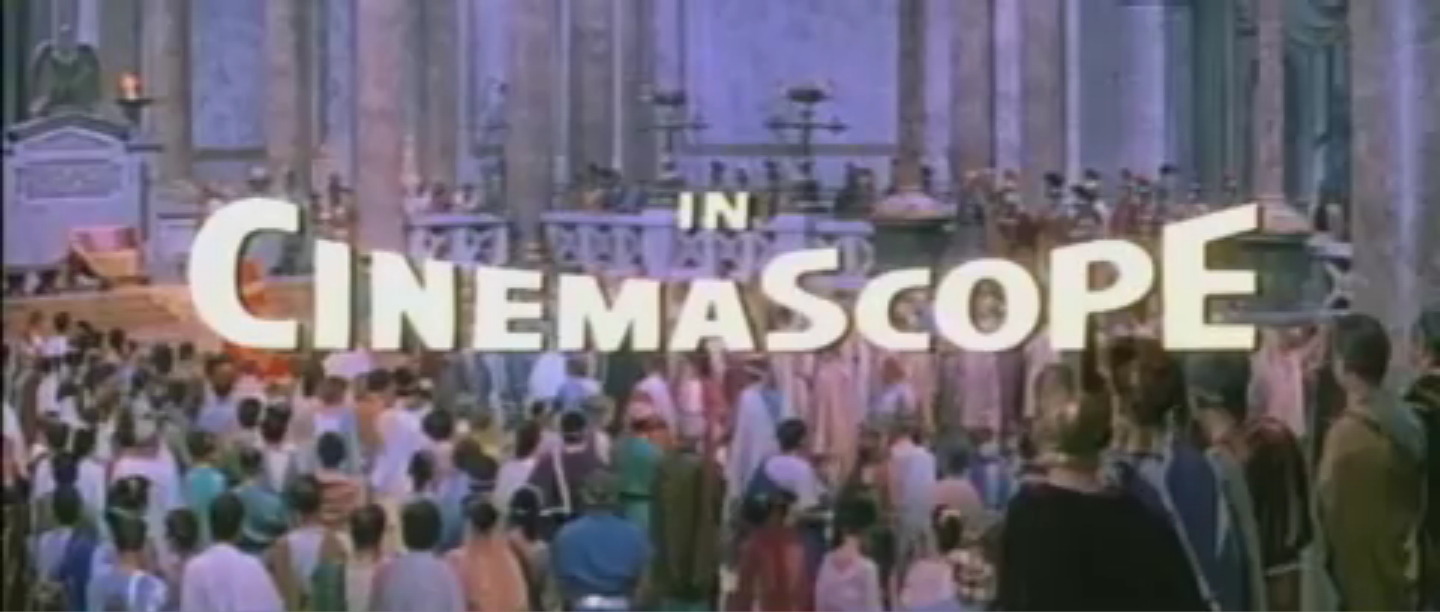
Image context: the lead image is a 1953 trailer frame from The Robe, the first feature released in CinemaScope. It fits this article because the image is not just from an early wide-screen film; it comes from the launch title Fox used to prove that horizontal scale could make a movie premiere feel materially bigger than domestic viewing.[4][6]
The squeeze was a technical compromise and a commercial masterstroke
The core technical trick was simple to describe and powerful to sell.[4] A special anamorphic lens mounted over the taking lens compressed the width of the scene so it could live on ordinary 35mm film, then a corresponding projection lens restored the image on screen.[4] In purely optical terms, CinemaScope depended on distortion twice over: first in capture, then in exhibition. In industrial terms, that compromise was brilliant. It gave studios and exhibitors novelty without asking them to abandon the base medium their entire workflow already depended on.[4]
That helps explain why CinemaScope mattered more than the myth of "bigger pictures" suggests.[1][4] It was not the largest-screen system available in the early 1950s. Cinerama was more overwhelming, and 3-D carried its own short-term aura of spectacle.[1][2][4] CinemaScope's advantage lay elsewhere. It narrowed the gap between technological ambition and everyday deployment. A format could be extraordinary and still be rentable, bookable, and reproducible through a nationwide circuit.[2][4]
The theater, not the camera alone, was the real product
The most revealing details in AFI's The Robe record concern exhibition rather than authorship.[4] The image was projected onto slightly concave "Miracle Mirror" screens whose scale turned premieres into measurements. The Roxy Theatre in New York installed a screen 68 feet wide and 24 feet tall, while Grauman's Chinese mounted its own oversized version.[4] CinemaScope entered public culture through construction crews, projection booths, and lobby rhetoric as much as through cinematography.
George Eastman Museum makes the same point from the industrial side. Its Bigger Than Life: CinemaScope at 60 note describes the process as a direct response to the rise of the small screen at home and adds a crucial operational fact: Bausch & Lomb designed and supplied anamorphic lenses to thousands of newly equipped theaters across the country.[2] Another Eastman history page on Bausch & Lomb's scientific-imaging role states the point even more plainly: the company developed the first CinemaScope lenses for film cameras.[3] Put together, those sources make the real package visible. Fox was launching a format, a manufacturing chain, and an exhibitor conversion program at the same time.[2][3][4]
That is why CinemaScope arrived with such force.[1][2] It enlarged the movie at the architectural level. The screen curved. The sound spread. The ticket once again bought something that could not be confused with the domestic set glowing in a corner of the room.[1][2][5]
Fox understood that the launch had to teach audiences what width was for
AFI records that the first major CinemaScope demonstration for exhibitors, competing studios, and reviewers took place in Los Angeles on March 18, 1953, and included New York harbor footage, a sequence from The Robe, clips from How to Marry a Millionaire, and a musical number from Gentlemen Prefer Blondes.[4] That program is more revealing than it first appears. Fox did not present the system with abstract engineering alone. It taught the trade what kinds of images the new format could flatter: skyline, pageantry, chorus movement, costuming, and bodies distributed across a strong horizontal line.[4]
How to Marry a Millionaire confirms the same sales logic from another angle. AFI notes that the film opens with an almost six-minute sequence of Alfred Newman conducting the Twentieth Century-Fox Symphony Orchestra, a prelude included specifically to demonstrate the versatility of CinemaScope and stereophonic sound.[5] That prologue functions as a lesson. Wide-screen cinema was not only more space from left to right. It was a new relationship between image width, showmanship, and sonic presence.[1][5]
Early CinemaScope filmmaking therefore carried a pedagogical quality.[4][5] The format had to make its value legible at once. It favored processions, architectural scale, bodies spaced across the frame in rank or tension, and musical display that let stereo sound act as part of the attraction.[4][5] Width alone was not enough. The audience had to feel that width was worth the extra trip.
CinemaScope won because conversion was easier than reinvention
Eastman Museum's retrospective says CinemaScope emerged as the victor in the clash with 3-D, Cinerama, and VistaVision.[2] That verdict makes sense when the question shifts from image novelty to deployment. CinemaScope could piggyback on the existing 35mm economy while asking theaters to buy a targeted set of upgrades: anamorphic lenses, new screens, improved sound, and the advertising language of magnitude.[2][4][5] Cinerama was too cumbersome to generalize. 3-D asked viewers to tolerate inconvenience that quickly felt like a strain. CinemaScope let the theater stay a theater while making it feel supersized.[1][2][4]
That is also why the influence outlived the trademark itself.[1][2] Once the industry accepted anamorphic wide-screen presentation as a viable standard, the exact brand name could evolve, be imitated, or be displaced by later systems. The deeper lesson had already landed. Audiences would leave home for scale, curvature, and sonic spread when those qualities felt materially different from what television could offer.[1][2][5]
The legacy is leverage, not width alone
Seen from 2026, CinemaScope is easy to misremember as a triumph of optics and aspect ratio alone. The optics mattered, and the new width mattered, but the decisive achievement was organizational.[1][2][3][4] CinemaScope linked camera attachments, projection hardware, theater renovation, sound presentation, and publicity into one coherent answer to the television problem. It made exhibition itself part of the content.
That is why the key images around the launch are so telling.[4][5][6] A trailer frame from The Robe, the March 1953 demonstration reel, giant concave screens, and Alfred Newman's orchestral prelude in How to Marry a Millionaire all point in the same direction. Fox was not selling a marginal improvement in photographic technique. It was renegotiating what moviegoing could feel like. CinemaScope's real breakthrough was the retrofit: it let the existing theater look larger than the living room without tearing up the whole industrial floor beneath it.[2][4][5]
Sources
- Academy of Motion Picture Arts and Sciences, "This is Widescreen" (overview of the 1950s-60s widescreen boom as a response to television, including CinemaScope).
- George Eastman Museum, "Bigger Than Life: CinemaScope at 60" (response to TV, multi-channel sound, and Bausch & Lomb supplying anamorphic lenses to newly equipped theaters).
- George Eastman Museum, "Eyes on the Science" (Bausch & Lomb developed the first CinemaScope lenses for film cameras).
- AFI Catalog, "The Robe" (CinemaScope process description, March 18, 1953 demonstration, 2.55:1 ratio, and Miracle Mirror exhibition details).
- AFI Catalog, "How to Marry a Millionaire" (orchestral opening used to demonstrate CinemaScope and stereophonic sound; second CinemaScope release).
- Wikimedia Commons, "File:The Robe 1953 Trailer Screenshot 23 (cropped).png" (1953 trailer frame source page and metadata).