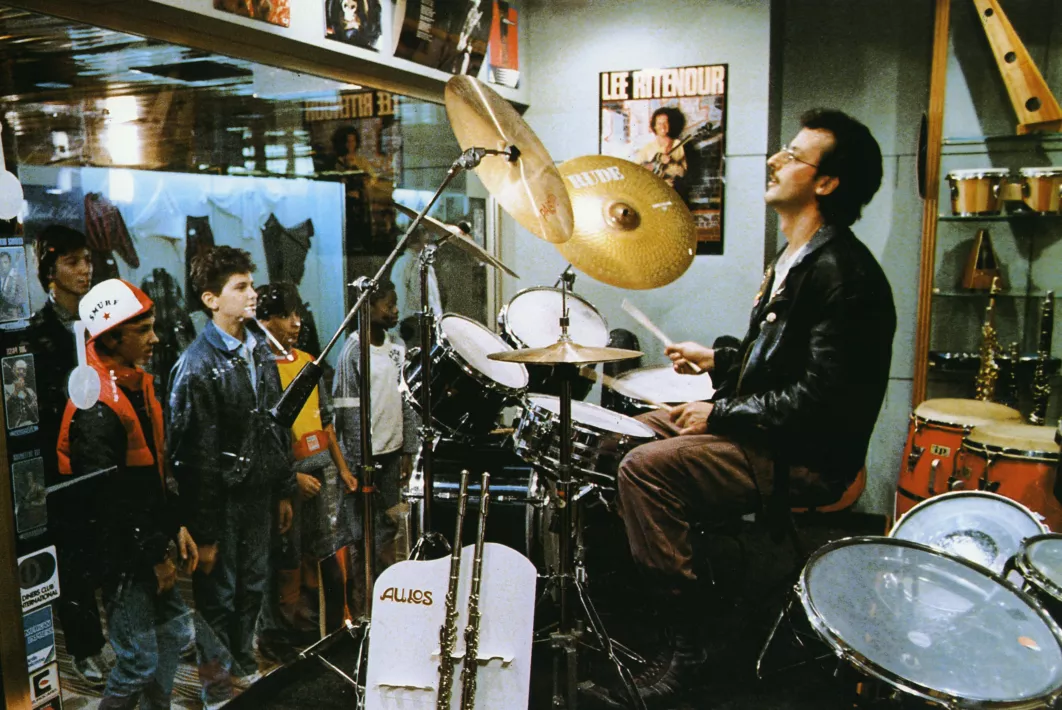
A fugitive descends into the Paris Métro and finds something more interesting than a hiding place: potential bandmates. In Luc Besson's Subway (1985), Fred, played by Christophe Lambert, has stolen documents and acquired pursuers. The expected next move is an escape. Instead, the underground offers him people with whom he can make music.[4][5]
That detour provides a useful entrance to cinéma du look, the critical label associated with Besson, Jean-Jacques Beineix, and Leos Carax. Their spectacular French films of the 1980s are often remembered as an inventory of surfaces: emphatic colour, striking clothes, young faces, music turned up. A 1989 essay by Raphaël Bassan became a key reference in the discussion, later included in The Films of Luc Besson.[1]
Look at what the characters actually do with those surfaces, however, and another connection emerges. In Beineix's Diva (1981), Besson's Subway, and Carax's Mauvais Sang (1986), style helps people occupy places that were never arranged for their comfort. A postman can carry his own opera house. A transport network can accommodate a concert. A street can become the length of a feeling.
A postman's private soundtrack
Early in Diva, Jules's moped carries a magnificent incongruity: a Rolls-Royce bonnet ornament. A luxury emblem has migrated to an inexpensive vehicle. Greg Hainge's close analysis for Sight and Sound tracks how the opening places Jules and his machine among strongly arranged reds, yellows, and blues. Before the thriller gets moving, the postman already belongs to a world composed around his presence.[2]
Sound performs a similar trick. Music from Gounod's Faust fills the opening as though it were the film's score. Then Jules switches off the player on his moped. The sound we took for an accompaniment supplied by the filmmaker turns out to have been travelling with him.[2] For a moment, his listening has determined what everyone in the audience can hear.
This is more intimate than the broad claim that the film mixes high and popular culture. Jules has found a way to make an expensive art form portable. The ornament and the recording are small acts of imaginative ownership, although the film will make ownership itself troublesome: his secret recording of singer Cynthia Hawkins draws him into a criminal intrigue.[5]
The visual abundance did not persuade everyone. In his Moviedrome introduction, reproduced in BFI programme notes, Alex Cox dismissed the film's emotional substance while emphasizing its art direction. The same notes reproduce Martyn Auty's more sympathetic contemporary account, which links its heightened settings and improbable action to opera.[3] That disagreement is useful. A beautifully arranged world can feel hospitable to one viewer and sealed against feeling to another. The pleasure of Diva depends partly on whether Jules's extraordinary surroundings seem to enlarge his ordinary life.
A station becomes somewhere to stay
Subway makes the spatial proposition more literal. Its underground is a refuge from the city above, but it is also a place with its own encounters and possibilities. Gaumont's account emphasizes Fred's movement deeper into the Métro and credits the extraordinary settings to production designer Alexandre Trauner.[4]
A station ordinarily organizes people by destination. Its ideal passenger buys a ticket, follows a route, and leaves. Fred's band changes that relationship. He begins to value people for what they might play together, and a place designed for passing through acquires a reason to remain. Harvard Film Archive's programme note identifies forming the band as the realization of his dream.[5]
This is an interpretation of the film's fantasy, rather than a claim about life beneath actual Paris. The difference matters. Besson's underground can make marginality look attractively available, as though a person might step out of an expensive city and find a ready-made alternative. Its design gives that wish extraordinary persuasive force. It does not establish that exclusion is easy to escape.
Susan Hayward and Phil Powrie's introduction to The Films of Luc Besson describes a related critical approach: the claustrophobia of Subway can be redirected into an alternative space.[1] The tunnels constrain Fred, yet the film lets him discover uses for them beyond concealment. Its fantasy becomes most convincing when it gives him something to do with other people. The band supplies that activity; atmosphere alone could not.
A street long enough for a song
Carax contracts the same possibility into a brief bodily event. Mauvais Sang gives Denis Lavant's Alex a crime plot involving a stolen medical remedy and a dangerous attachment to Anna, played by Juliette Binoche. But one of its defining passages lets the practical business fall away: Alex runs through the night to David Bowie's “Modern Love.”[6]
The movement is less smooth than the idea of a music-video interlude suggests. In her Criterion essay, Amina Cain describes its awkward beginning: Alex holds his stomach, limps, strikes out, and gradually accelerates into running.[7] The release has to work its way through his body. He does not become a different, effortlessly graceful person when the song arrives.
That resistance is what makes the sequence moving. The street offers distance; the song offers duration. Together they permit a feeling that would be smaller if delivered as a confession. Running cannot solve Alex's romantic predicament, but it gives his agitation a visible course. The pleasure comes from watching a body discover how much it can express while travelling beside a wall.
The sequence also marks a difference within the supposed movement. Beineix makes Jules's possessions and surroundings answer to his taste. Besson gathers a social world around musical performance. Carax concentrates expression in Lavant's difficult, exhilarating physical effort. The shared appetite for spectacle produces distinct kinds of intimacy.
What the label can hold
Calling these films a movement is useful when it encourages comparison; it becomes limiting when it suggests three filmmakers pursuing an identical programme. Their common features are easier to see than their different attitudes toward pleasure, danger, and other people.
Nor does defending their style require dismissing the criticism. Glamorous outsiders can become another collection of desirable images. Lavish design can invite an audience to enjoy exclusion without asking much about its causes. These films do not automatically escape that problem because their heroes are young or their police unsympathetic.
Yet their most memorable moments give beauty a specific task. Someone listens, recruits musicians, or runs. A spectacular world becomes available through an action, and its invitation lasts only as long as the action can sustain it. Jules switches off his player. Fred still has pursuers. Alex cannot run forever. The places these films offer are temporary, which is part of why their occupants cling to them.
Sources
- Susan Hayward and Phil Powrie, introduction to The Films of Luc Besson: Master of Spectacle, Manchester University Press — publisher's summary on Bassan's 1989 essay and the interpretation of space in Subway.
- Greg Hainge, “Blue movies: Diva, The Smurfs 2 and the ontology of cinema,” Sight and Sound/BFI, originally published 3 October 2014 — Diva's opening colour compositions, moped ornament, and music.
- BFI Southbank, Diva programme notes, 9 August 2025 — Alex Cox's Moviedrome introduction, Martyn Auty's Autumn 1982 Sight and Sound review, and production credits.
- Gaumont, Subway — official synopsis, 1985 release information, cast, Alexandre Trauner's sets, and the photographic still reproduced above.
- Harvard Film Archive, “Diva / Subway,” Summer Double Features, 21 July 2007 — film dates, premises, and Fred's ambition to form a rock band.
- The Criterion Collection, Mauvais sang — 1986 film information, cast, crime premise, and the nighttime sprint to “Modern Love.”
- Amina Cain, “Three Films by Leos Carax: Vital Signs,” The Criterion Collection, 29 September 2026 — Lavant's physical performance and the progression from halting movement to running.