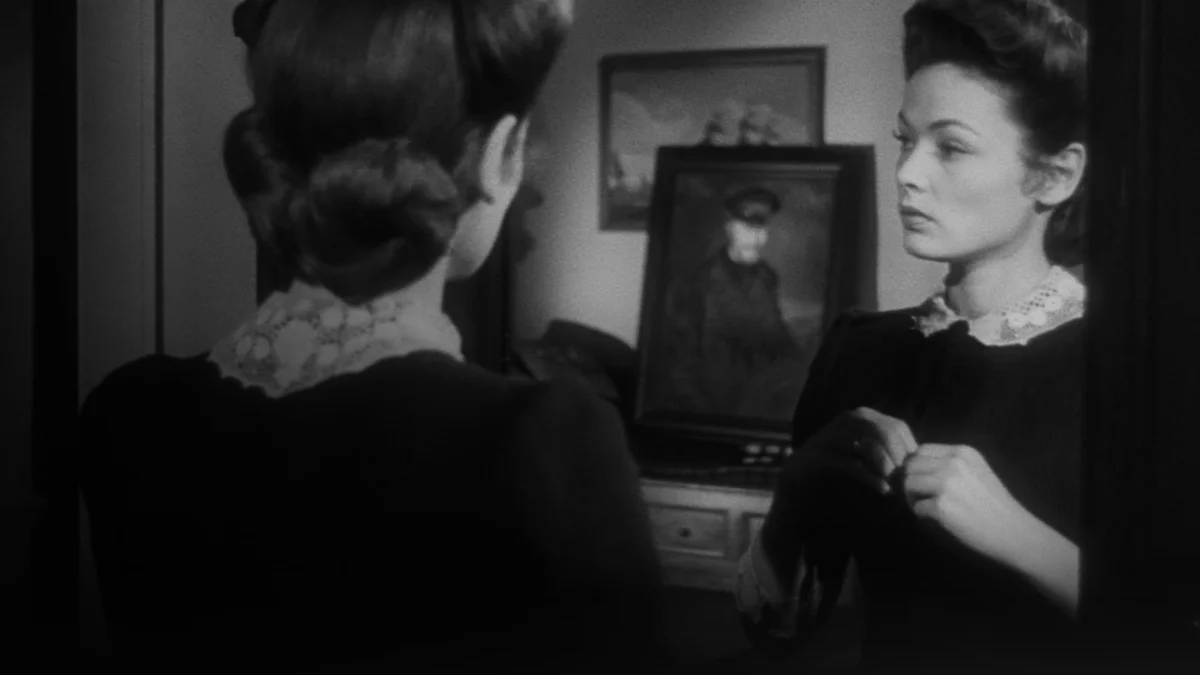
Spoilers follow, including the ending of Joseph L. Mankiewicz's 1947 film.
Lucy Muir has barely escaped one household's instructions before another man starts telling her where she belongs. This one happens to be dead. The joke in The Ghost and Mrs. Muir is that a haunting can feel familiar: someone who considers himself entitled to the house objects to a woman making herself comfortable in it.
Lucy, played by Gene Tierney, leaves her husband's family after his death and rents Gull Cottage with her daughter Anna and housekeeper Martha. Captain Daniel Gregg, played by Rex Harrison, is its deceased former owner.[1] Their encounter begins as an argument over occupancy. Watching that argument become a romance, we can see a more particular story taking shape: Lucy learns how much pleasure there is in answering back. The film's difficult turn comes when the person who encourages her also decides what she should remember.
Permission to stay
Harrison gives the captain a formidable bluster. Tierney's response keeps the encounter from becoming a demonstration of his power. As Kevin Lyons observes in his account of the film, Lucy's reaction to the apparition includes irritation; she challenges his business of frightening women.[2] A frightening noise can interrupt a conversation. It cannot settle the question of who gets to live here.
The exchange is funny because Lucy treats a supernatural emergency as something requiring manners. She wants an explanation and an arrangement. That composure makes her neither invulnerable nor secretly omnipotent. It gives her a practical way to remain in a room where someone expects her to retreat. The captain has to discover a person behind the unwanted tenant.
Later, Lucy's in-laws arrive with news that her investment income has failed. They expect her to return to London. Gregg, audible to Lucy but not to her visitors, encourages her to resist; she sends them away with the startlingly nautical instruction to “shove off.”[1] The borrowed phrase lands inside her otherwise polite speech like a chair dragged across a drawing-room floor.
There is an appealing complication here. Lucy is finding her voice through somebody else's vocabulary. Independence can begin with borrowing a useful expression, trying it aloud, and discovering that the ceiling does not fall. What matters is that she uses it to defend a decision she has already made.
The house needs an income
The money problem remains after the visitors leave. Gregg proposes that Lucy turn his adventures into a book, and their collaboration brings them closer.[3] The fantasy acquires a work schedule. Staying in a beloved house requires something that can be carried out of it and sold.
That material detail keeps the cottage from becoming a weightless refuge. Lucy's independence has expenses; Martha's presence also reminds us that this household includes domestic work. The romance does not remove those conditions. It gives Lucy a means of meeting them, though one that depends on an extraordinarily well-informed collaborator.
Their manuscript, Blood and Swash, reaches a publisher. There Lucy meets Miles Fairley, the children's author played by George Sanders, who becomes her living suitor.[1] The book therefore opens two doors at once: it supports the life she has chosen and takes her into a wider social world. Work with Gregg makes an encounter beyond Gregg possible.
That is a generous possibility for the romance to entertain. Affection might enlarge the beloved's opportunities enough to include someone else. Yet it also puts the captain's apparent respect for Lucy to a harder test than the earlier quarrels. He can enjoy a woman who stands up to her relatives. Can he accept a choice that hurts him?
A farewell she cannot answer
Gregg withdraws when Lucy chooses Miles. While she sleeps, he tells her that their time together was a dream and that the book was her own creation.[2] His departure is tender in intention and troubling in its method. He leaves her the achievement while taking away her knowledge of the companionship that helped produce it.
The scene reverses the pleasure of their first meeting. Then, Lucy could answer every assertion. Now he speaks while she cannot reply. My reading is that the film briefly makes protection resemble the paternal authority she left behind: someone who loves her decides which version of her experience will be best for her.
This need not cancel the captain's sacrifice. He is making room for a life he cannot share. It does complicate the familiar claim that letting someone go is necessarily an act of freedom. Lucy is allowed to pursue her choice with part of the evidence of her own life removed.
Miles proves to be married. Much later, Anna remembers childhood conversations with Gregg, giving Lucy independent corroboration of the encounters she has treated as dreams.[1] That disclosure matters beyond solving a ghost story. Another person's memory can restore credibility to an experience someone has learned to discount. Lucy's past becomes shareable again.
The film's tenderness also has a musical dimension. Bernard Herrmann's score is central to the romantic atmosphere highlighted by the Criterion Channel's account of the film.[4] Its emotional expansiveness allows a life spent largely around one house to feel bigger than the rooms available to it. The seaside setting holds the possibility of distances Lucy has not traveled.
At her death, Gregg returns; Lucy's younger spirit rises, and they leave the cottage together.[1] The release is moving partly because the house has done so much work. It has been contested territory, a workplace, a refuge, and a place of waiting. Finally, neither person needs to win the right to remain inside it.
The ending grants them companionship without the old physical obstacle. What stays with me is the earlier, less complete achievement: Lucy standing her ground, taking a sentence into her own mouth, and making herself heard. Their love becomes most convincing whenever it gives her someone to answer.
Sources
- American Film Institute, The Ghost and Mrs. Muir (1947), AFI Catalog — production credits and detailed synopsis, including the visitors, publishing episode, Anna's recollection and ending.
- Kevin Lyons, “The Ghost and Mrs. Muir (1947).” The EOFFTV Review, 22 June 2023 — performances, Lucy's resistance to Gregg and his farewell.
- ACMI, The Ghost and Mrs. Muir, collection record — the interrupted income, collaborative book and romantic premise.
- The Criterion Channel, The Ghost and Mrs. Muir — film identification, cast, Bernard Herrmann's score and the film still reproduced here.