Spoiler note: this essay discusses the film's final confrontation.
The station in Youssef Chahine's Cairo Station is crowded enough to make privacy look impossible. Passengers stream past porters. Vendors call across platforms. A band plays inside a carriage. Lovers, supervisors, police, workers, and strangers keep appearing in one another's sightlines. Yet the film's central danger grows in plain view.
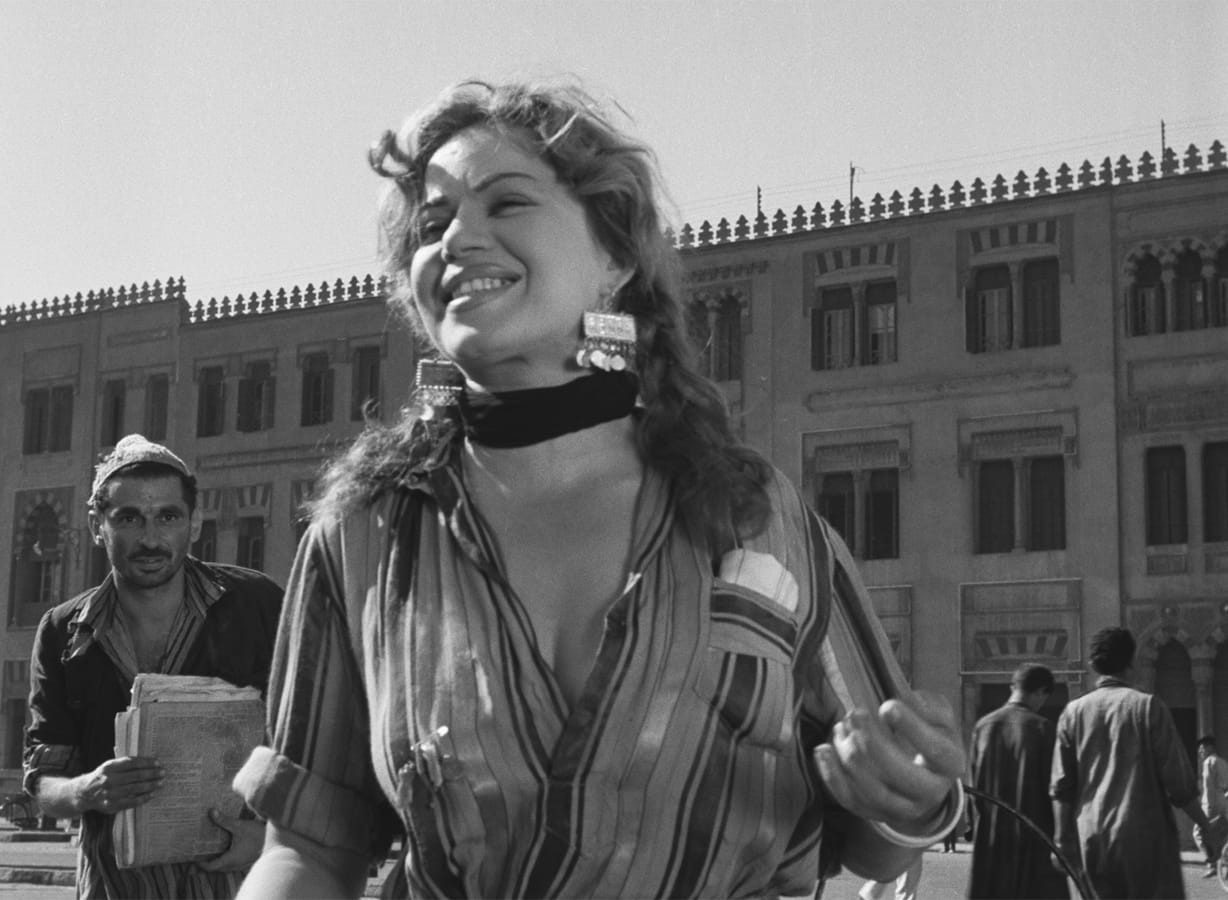
The cover frame holds that contradiction in one image. Hanuma, the soft-drink seller played by Hind Rostom, advances in the bright foreground with her face lifted. Kenawi, the newspaper hawker played by Chahine, trails behind with a stack of papers against his chest.[1] Both are visible; only one is watching the other as if attention created a claim. The distance between them is small enough for a photograph and vast enough for a tragedy.
That is the film's hardest idea. To be seen is not necessarily to be recognized, believed, or protected. Visibility can sell a drink, attract a customer, invite mockery, enforce masculine control, or turn a person into an image someone else feels entitled to possess. Over one hot day in and around Cairo's central railway station, Chahine makes public attention abundant and meaningful attention scarce.[1][2]
The station is an engine for looking
The Arabic title, Bab el-Hadid, means “the iron gate,” the former name of the capital's central station. Screenwriter Abdel Hay Adib drew the premise from the sights and sounds of a station near his childhood home in the Nile Delta, then brought the script to Chahine after other filmmakers passed on it.[2] That origin matters because the station does not feel like a symbolic set built after the argument. Its timetable, labor, commerce, architecture, and noise generate the argument.
Madbouli, the newsstand owner, opens the film by describing a place where people arrive and depart from every direction. His narration promises a social cross section, and Chahine supplies one: rural travelers, urban workers, clandestine vendors, a feminist campaigner, disapproving religious men, young musicians, a waiting lover, and porters trying to organize. Critics have long struggled to put a single genre around the result. Neorealism, melodrama, noir, comedy, social protest, and psychological thriller all pass through the same gates.[2][4][5]
The mixture is not indecision. Each genre changes what looking can do. Social realism scans the workers as a class. Melodrama isolates faces and desires. Noir turns crates, tracks, and service corridors into possible hiding places. Comedy lets a glance ricochet through a crowd. The thriller asks whether anyone will interpret the evidence before attention becomes violence. Chahine's camera moves among these functions with the agility of a commuter changing trains.
Alvise Orfanelli's black-and-white photography repeatedly arranges several claims on the eye at once. A face may dominate the near plane while business continues behind it; people enter a frame already occupied by work; trains interrupt one view and reveal another. Joseph Fahim identifies the dramatic play between foreground and background as part of Chahine's visual language, while the BFI programme notes emphasize how unusually much the director communicates through images in a film culture celebrated for verbal exchange.[2][3] The station is therefore more than a place where everyone looks. It is a machine that keeps deciding whose look organizes the frame.
Hanuma makes visibility earn a living
Hanuma understands public attention as labor. She must be noticeable enough to sell cold drinks, quick enough to move through passenger traffic, and alert enough to evade the authorities policing unlicensed vending. Her voice, striped dress, teasing confidence, and physical speed are parts of a working method. Rostom's performance refuses the idea that display cancels agency. Hanuma can enjoy being watched, recruit a gaze, mock it, and still reject what a watcher wants from her.
The carriage sequence with the young band is crucial because Chahine lets pleasure and risk occupy the same performance. Rhythm loosens the compartment; Hanuma becomes its kinetic center; onlookers receive the moment as entertainment. The film undeniably shares their fascination. Its camera enjoys Rostom's comic timing and sensual command. But it also keeps asking who is allowed to convert that enjoyment into authority. Public charm is not an open contract.
The distinction becomes sharp in Hanuma's encounters with Kenawi. She jokes, asks for help, sometimes offers kindness, and clearly refuses his marriage fantasy. None of those gestures is consent to be rewritten. Fahim's account of the film stresses how Rostom makes Hanuma difficult to reduce: independent and pragmatic, mocking and empathetic, exuberant and wary.[2] Her complexity is not a puzzle that excuses Kenawi's misreading. It is precisely what his fantasy removes.
Hanuma's fiancé, Abu Serih, also watches her. His attention carries a different social power: he is physically admired, publicly assertive, and treated as a plausible husband. Yet his possessiveness reveals that approved masculinity can constrain Hanuma as effectively as rejected masculinity threatens her. The film does not divide its men into one deviant watcher and one healthy protector. It distributes entitlement across the station, then varies its degree and consequence.
Kenawi turns an image into a promise
Kenawi lives at the center of circulation but remains tucked into one of its margins. Madbouli has given him work selling newspapers; other people ridicule his body, his poverty, and his awkwardness. Chahine's performance makes that humiliation legible. The film asks for compassion before it asks for judgment, which is why its later violence cannot be dismissed as the arrival of a monster from outside the social world.[2][3]
At the same time, explanation is not absolution. Kenawi's room is covered with cut-out photographs of women. He trims, touches, and retouches them, turning the female image into a private surface that never contradicts him. Hanuma enters this system not as another pin-up but as a living person, and that difference is what his desire cannot tolerate. He does not merely want her attention. He wants her attention to confirm the obedient wife he has already composed.
Near the statue of Ramses II, Kenawi offers Hanuma a future house in his village. The proposal sounds like escape from his station hovel, but it has no room for her stated life. His gaze remains fixed; hers moves, including a playful glance toward the camera that keeps her relation to the scene open.[2] He presents an imagined home as generosity while treating the woman who would inhabit it as a completed image.
This is also where the film's treatment of disability needs care. Cairo Station risks fastening bodily difference, sexual exclusion, and homicidal danger into one sensational chain. Its better insight lies elsewhere: Kenawi is injured by contempt, but contempt does not create a right to Hanuma. His marginalization and her refusal can both be real without the second becoming compensation for the first. The film's tragedy begins when a legitimate wish to be treated as fully human is converted into a demand that another human being surrender her freedom.
The newspapers sharpen that conversion. A report about a murdered woman whose body was placed in a trunk circulates through the station as sensation; Kenawi adopts its form as a plan.[6] Information reaches him, but recognition does not. A public story about violence becomes a private script for repeating it. The newspaper can expose a crime and teach its image at the same time.
The union promise is wider than the man who makes it
Abu Serih's effort to organize the porters is not a detachable political subplot. It offers the film's clearest alternative model of attention. After a worker is nearly crushed, the porters confront the fact that an injured man without collective protection can simply disappear from the payroll. A union would make anonymous labor visible as a shared condition: injury, scheduling, pay, and bargaining would no longer be left to a supervisor's favor.[2][3][6]
That is a genuine achievement. The BFI notes describe the workers' growing support and the eventual recognition of the union by a government official.[3] Chahine does not sneer at solidarity. He shows why collective organization matters in a workplace structured to treat bodies as replaceable.
Chahine makes the contradiction sharper because Abu Serih's rhetoric is broader than the porters alone. When an opponent compares the independent porters to the soft-drink sellers, Abu Serih answers that he will form a union for the sellers too and condemns the exploitation of both groups. The promise recognizes Hanuma and her peers as workers, at least in principle. It is an expansive political claim.
Abu Serih's conduct toward Hanuma nevertheless remains possessive and physically commanding. The man who can identify exploitation in the market does not reliably recognize coercion in his own relationship. His public politics reaches across categories of work while his intimate politics remains hierarchical. The contrast keeps Cairo Station from becoming a neat parable in which correct collective analysis automatically reforms private conduct. Kenawi's violence is personal, but the permissions around it are social: men watch women, blame them for being watched, and confuse masculine status with access. Solidarity is necessary; the film insists it has to become practice at home as well as policy at work.
A crowd is not the same as a witness
By the climax, the station has produced countless partial observations. Madbouli has seen Kenawi's loneliness and his pin-ups. Hanuma's friends know he follows her. Abu Serih sees a rival. Passersby see odd behavior, a scuffle, a vendor, a disabled man, a trunk. Each look captures a fragment. No institution assembles the fragments early enough to protect Hanuma or the woman Kenawi attacks by mistake.
This failure is not caused by secrecy. It is caused by interpretation. The crowd knows how to turn difference into ridicule and female visibility into blame; it is slower to recognize escalating danger. Once Kenawi pursues Hanuma onto the tracks and holds her at knifepoint, spectators gather immediately. At last everyone is looking at the same thing. The shared view arrives only after danger has become spectacle.
Madbouli ends the standoff because his attention has included memory. He does not overpower Kenawi through a superior stare. He enters the marriage fantasy, tells him the promised wedding is ready, and guides him into what is actually a straitjacket. The deception is painful: care, coercion, and public containment collapse into one gesture. Yet it works because Madbouli understands the story Kenawi thinks he is living. The crowd sees a weapon; Madbouli recognizes the script holding the weapon in place.
That recognition saves Hanuma in the immediate sense. It does not make the station protective. The porters have a union and the drink sellers have been promised one, but women still move through a workplace where attention can become surveillance. Kenawi is removed, but the contempt and entitlement around him remain distributed among ordinary men. The public has witnessed a crisis without necessarily learning how its earlier signs were normalized.
This is why Cairo Station remains more disturbing than a story about dangerous obsession. Chahine does not oppose an isolated gaze to an innocent crowd. He builds a whole economy of looking: the camera looks, customers look, lovers look, workers look, moralists look, and the audience looks. Some attention creates pleasure. Some earns money. Some organizes collective power. Some confines. The ethical question is not whether looking can stop. It is whether attention can become answerable to the person being seen.
Hanuma's place in the foreground of the cover frame is therefore not proof that she is safe or even fully known. It is a demand placed on the viewer. Kenawi is visible behind her, but visibility alone does not interpret the distance between them. The film asks us to do what its station repeatedly fails to do: distinguish performance from permission, sympathy from excuse, and a gathering crowd from a community capable of protection.
Sources
- The Criterion Collection, “Cairo Station” — film credits, release specifications, 4K restoration details, and the official frame gallery used for the article image.
- Joseph Fahim, “Cairo Station: Of Time and the City,” Current, The Criterion Collection, 2025 — production history, postrevolutionary context, star performances, visual style, watching motif, and Egyptian reception.
- BFI Southbank, “Cairo Station” programme notes — Ibrahim Fawal's account of the film's visual storytelling, social awakening, union subplot, critical debate, and initial reception.
- Misr International Films, “Cairo Station / Bab El Hadid” — company library page with production credits and stills, reproducing a Harvard Film Archive synopsis and its neorealist and expressionist framing.
- Joel Gordon, “Broken Heart of the City: Youssef Chahine's Bab al-Hadid (Cairo Station),” Journal for Cultural Research 16, nos. 2–3 (2012) — scholarly analysis of genre, metropolitan change, and the station as a claustrophobic social center.
- David Sterritt, “Cairo Station,” Turner Classic Movies, 2013 — narrative, production and reception history, the union campaign, the circulating murder report, and the station's choreographed social turbulence.