Spoiler note: this essay discusses the film's killing, imprisonment, and final request concerning the child.
At first, The Goddess appears to offer two separate kinds of villainy. One is easy to name: a street thug called the Boss takes an unnamed woman's earnings, claims her as property, and spends her money at the gambling table. The other arrives in respectable clothes. Neighbors gossip, parents write complaints, and a school board decides that her son must carry the stigma of work he neither chose nor performs.
Wu Yonggang's 1934 silent film binds those injuries together. The woman, played by Ruan Lingyu, walks Shanghai's streets at night so that her child can eat, live indoors, and eventually attend school. Her labor keeps changing purpose as it moves: a customer pays for sex; the same money becomes food, clothes, and tuition; savings become a plan for escape. Yet every gatekeeper tries to freeze the money at its point of origin. The Boss says the earnings belong to him. The school says they can never buy the boy belonging. By the final prison visit, even the mother's place in her son's memory appears to be a price that must be paid.[1][4][7]
This is why the film exceeds the familiar label of “fallen woman” melodrama. The University of British Columbia's Chinese Film Classics project places it within that genre and within the tradition of maternal sacrifice, while Kenny K. K. Ng cautions that neither generic nor political labels fully account for its visual and emotional design.[1][3] The Goddess is not only about a good mother condemned for stigmatized work. It is about the social machinery that consumes the results of her care while declaring its source unclean.
The first room refuses the moral split
The film introduces the woman through an inventory. Before it explains her work, it moves among the things in her modest room: cosmetics and dresses, a child's toy and food, a bed and a crib.[1] Wu does not give each life a separate set. The same room holds both.
That adjacency is the film's first moral decision. A simpler melodrama might purify the mother by treating prostitution as a costume she removes at the door. The Goddess instead shows one body and one household transforming paid labor into care. The title itself carries the contradiction: shennü can sound exalted while functioning as a euphemism for a prostitute.[5] The film does not resolve the contradiction by announcing which identity is “real.” It asks why society needs the identities separated in the first place.
Chinese Film Classics emphasizes the movie's contrasts between indoors and outdoors, night and day, private and public space; it also notes that the young Wu worked with a small budget and a set he designed himself.[1] Those constraints sharpen the result. The room is sparse enough that every invasion registers. A hanging dress, a toy, a table, and the child are not background dressing. They show what the woman's earnings have already become before anyone else tries to define them.
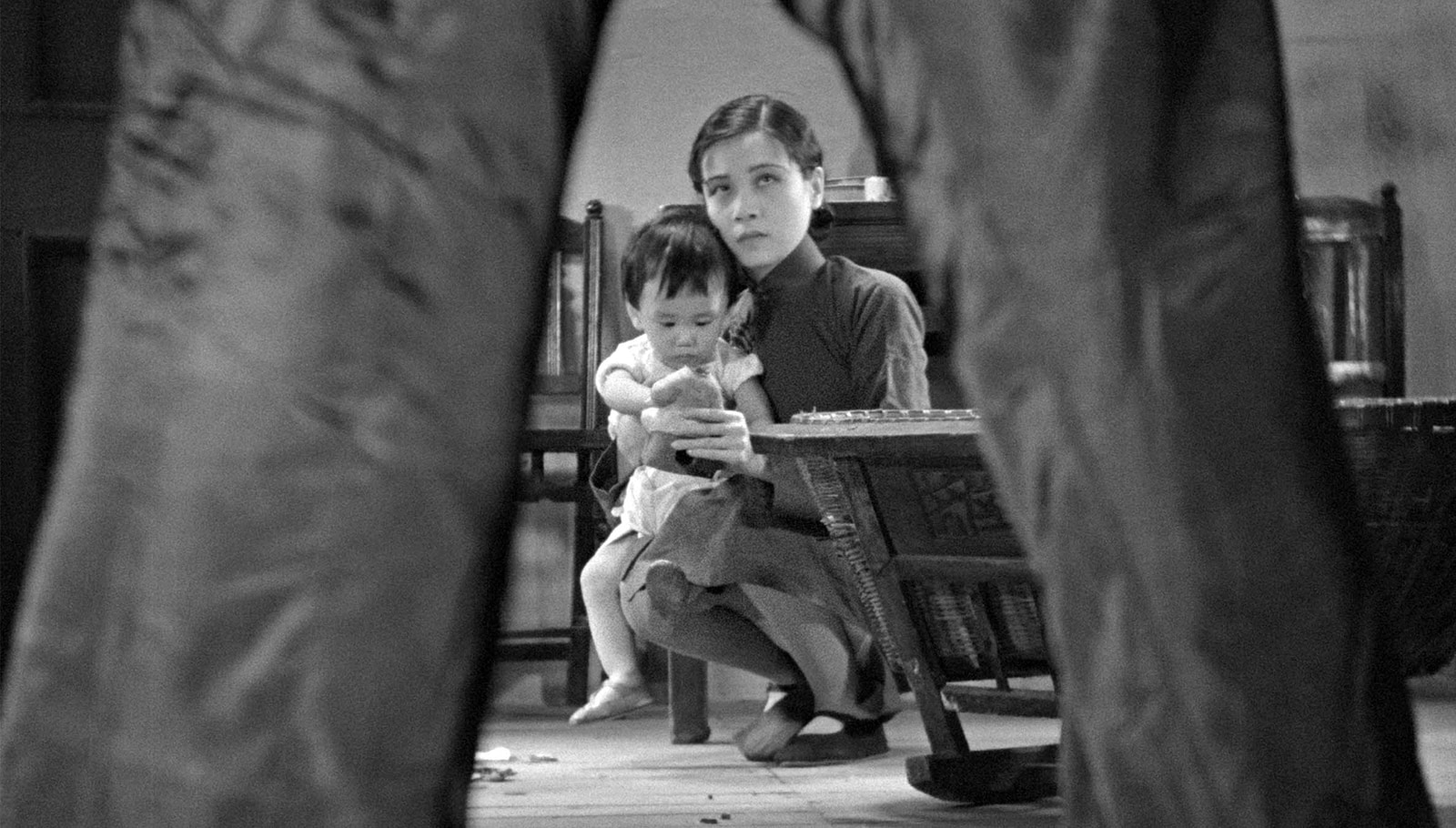
Art historian Lisa Claypool tracks how the film's flickering neon skyline recurs as a place of work, fantasy, and threatened hope.[6] Yet Wu's most severe contrast is smaller than a skyline. It is the distance between an adult man's legs and a mother holding her baby.
The Boss turns shelter into an invoice
The woman meets the Boss while fleeing a police raid. She slips into his room; he vouches for her; he then demands sex as payment for the favor. Jason McGrath's close analysis of this sequence tracks the remarkable changes in Ruan's performance: calculation, recognition that there is no clean exit, resignation, and then the practiced poise with which she crosses the room and asks for a cigarette.[5] Protection is never a gift. It is an invoice whose terms he writes after she is already trapped.
The arrangement soon expands from one coerced night into control. The Boss follows her home, poses as a husband, takes her income, and uses violence and her child to defeat an attempt to flee.[4][7] He does not need a legal deed to occupy the room. Wu makes possession visible through scale.
The cover frame is the bluntest example. The Boss's trousered legs fill the near plane, forming a dark human gate. Farther back, the mother sits low with her infant on her lap. The Hong Kong Film Archive's note on the 2026 China Film Archive restoration calls attention to Wu's expressive wide shots and low-angle framing; here those choices become a power diagram made from actual bodies, not an analytical graphic.[2] The Boss has turned the woman's home into territory viewed through him.
Ruan's gaze prevents the image from becoming a simple emblem of helplessness. She looks upward and outward, alert to the threat and to possible movement. Her arms secure the child even as the frame encloses them. That combination—constraint without passivity—is central to her performance. UCLA's archive note calls Ruan the film's electric center and stresses that Wu never judges the character for the work she does.[4] The camera may show how little room the Boss leaves her, but it does not grant him authority over what her face means.
His extortion is vulgar because its conversion is obvious. Her body becomes earnings; her earnings become his bets. He strips labor of its intended destination and calls the proceeds his own. The film's next movement shows that respectable institutions can perform a parallel conversion with cleaner hands.
Money can buy lessons, not tolerance
As the boy grows, the woman saves for his education. School opens the film outward: a gate, a courtyard, classmates, a performance, teachers, letters, and a boardroom enter a story that had been concentrated in streets and rented rooms.[1][7] For a brief interval, money seems able to cross a boundary that the mother cannot. Her night work becomes a school day.
The change matters because The Goddess never treats cash as morally fixed. The Boss sees a bankroll. The mother sees time, safety, and a future in which the boy will have choices she lacks. The same notes can finance gambling or tuition. Purpose comes from the person directing them, not from some stain carried in the currency.
The school refuses that logic. Other children repeat what adults say about the boy. Parents send complaints. The principal visits the home, sees the relationship that rumor has flattened, and argues that the child should not be punished for his mother's occupation. The board rejects the case; the principal resigns; the boy is expelled.[1][4][7]
The school does not steal the hidden savings in the literal way the Boss later will. Its extraction is social. It lets the mother pay for lessons, then declares that payment insufficient because the wrong woman earned it. The boy's “background” becomes an inherited offense. Education, supposedly the route by which a child can enter a broader civic world, becomes the mechanism that carries adult stigma into his future.
Wu gives the two forms of coercion different visual manners. The Boss crowds a small room with his body. The school board sits behind furniture and lets complaints speak for absent parents. One system works by proximity, the other by procedure. One says, “Your money is mine.” The other says, “Your money cannot make your child one of us.” They are not morally identical—the Boss is a violent exploiter, while the principal acts with real courage—but the consequences rhyme. In both cases, the mother's labor is separated from the purpose she gives it.
Ruan's face competes with the paperwork
The school plot could have reduced the woman to a case study in prejudice. Ruan's acting keeps restoring contradiction. McGrath argues that her silent-film performance can hold a socially performed surface and an underlying feeling in the same gesture; Wu himself praised her precision and responsiveness.[5] That doubleness is more than star charisma here. The character survives by presenting different versions of herself to customers, police, the Boss, neighbors, the principal, and her son.
The viewer does not receive a single unguarded “true face” behind all those performances. Instead, close-ups show thought changing under pressure. A look hardens, softens, calculates, or withholds. In the early coerced encounter, resignation turns into the controlled manner of a worker who knows how to play toughness. During the principal's visit, shame, hope, and defiance coexist. Ruan makes the woman's face an active negotiation rather than proof of one approved identity.[4][5]
That is what the parents' letters cannot contain. Paper converts a household into a category: disreputable mother, contaminated child, institutional problem. The principal's visit reverses the direction of evidence. He enters the room, sees the boy and the woman together, and recognizes care as conduct rather than reputation.[1][7] His failure before the board is therefore not a failure to discover the truth. It is a failure to make embodied evidence outweigh respectable fear.
Ng's formal argument is useful here: The Goddess works through a crafted mixture of classical continuity, montage, performance, and specifically Shanghai conditions, not through social message alone.[3] Wu does not merely tell us that the board is hypocritical. He makes accusation travel as letters and care travel as looks, labor, saved cash, and physical closeness. The institution chooses the thinner form of evidence because it is the form that protects its own standing.
The last payment is the mother's disappearance
After the expulsion, the woman decides to leave with her son. She reaches for the money that should make flight possible and discovers that the Boss has found it and gambled it away. The film's two systems now close at once. Respectability has rejected what the savings were meant to buy; the Boss has destroyed the savings themselves.[2][7]
She confronts him and kills him with a bottle. The act is desperate, not cleansing. Imprisonment gives public authority a visible crime it knows how to punish, while the long coercion that preceded it never attracted comparable intervention. The Hong Kong Film Archive's account identifies the twelve-year sentence; UCLA describes the killing as the terrible end of the Boss's theft and control.[2][4]
The final prison visit completes the argument. The former principal offers to raise the boy. The mother accepts, then asks him to tell her son, when he is older, that his mother is dead. She is trying to spare the child the very stigma the school has made hereditary.[1] Her request is loving, strategic, and devastating. His future seems to require not merely separation from her work, but erasure of the person who turned that work into his future.
That is respectability's deepest extortion in The Goddess. The Boss takes the money and leaves the mother with nothing to spend. The respectable world offers the child a path forward only when the mother volunteers to disappear from his biography. Care is accepted, but its author must be concealed.
Cinema refuses that bargain. The China Film Archive completed a 2K restoration in 2014, then scanned the original 35 mm nitrate negative for the film's first 4K restoration, which premiered at Berlinale Classics in February 2025; the Hong Kong Film Archive presented that restoration in May 2026.[2][8] Preservation does not repair the ending or give the woman justice. It does, however, keep her image where the social order inside the film does not want it: attached to the labor, savings, fear, resolve, and love that made the boy's future imaginable.
The child may be told to forget. The film remembers who paid.
Sources
- Christopher Rea, “Module 3: Goddess (1934),” Chinese Film Classics, University of British Columbia — full English-subtitled film, release details, genre context, set design, spatial contrasts, and lecture notes.
- Hong Kong Film Archive, “The Goddess (4K Digitally Restored Version)” — credits, plot outline, visual-style note, 2026 China Film Archive restoration details, and source page for the article image.
- Kenny K. K. Ng, “A Revisionist Reading of The Goddess: Visual Narrative Power in Chinese Silent Cinema,” Journal of Chinese Film Studies 3, no. 1 (2023) — peer-reviewed account of form, melodrama, politics, and 1930s Shanghai production conditions.
- UCLA Film & Television Archive, “The Goddess / New Women” — film credits, performance context, narrative outline, and discussion of the protagonist as a condensation of gender, family, capitalism, and star image.
- Jason McGrath, “Acting Real in Chinese Silent Cinema,” in Chinese Film: Realism and Convention from the Silent Era to the Digital Age. University of Minnesota Press, 2022 — close analysis of Ruan Lingyu's coerced-cigarette scene and performance style.
- Lisa Claypool, “Wu Yonggang's The Goddess (1934),” Staring at the Ceiling, April 1, 2024 — an art historian's close reading of the recurring neon skyline, bound-mother relief, intertitles, and visual materiality.
- China Film Archive, “The Goddess” — official Chinese-language catalog record with synopsis, twelve-year sentence, principal's promise, cast, runtime, subtitles, and aspect ratio.
- China Film Archive, “4K restored The Goddess premiered at Berlinale Classics,” February 24, 2025 — authoritative 2K/4K restoration history, original nitrate-negative source, premiere, and 5.1 score details.