Spoiler note: this essay discusses the apartment scene, the refreshment-room farewell, and the ending of Brief Encounter.
The heartbreak of David Lean's Brief Encounter does not come from scandal at full volume.[1][2][3] The film is too exact for that. It takes an adulterous premise that could easily have become lurid and instead gives it the shape of a timetable: arrivals, departures, weekly recurrence, snacks taken standing up, walks squeezed between obligations, and one private room that never becomes usable.[1][4] Laura Jesson and Dr. Alec Harvey do not fall in love in spite of routine. They fall in love inside routine, and Lean makes that fact the movie's deepest formal decision.
That is why the railway station matters more than as an attractive British location.[1][2][6] Vic Pratt's BFI essay calls the film a story told through tiny gestures, train timetables, and mundane activities made marvellous, while the BFI's film page stresses Robert Krasker's atmospheric black-and-white photography and the power of Rachmaninoff's Second Piano Concerto.[1][2] Put those two observations together and the method becomes clear. Brief Encounter does not set passion against ordinary life as if they were separate worlds. It makes ordinary infrastructure carry passion until clocks, platforms, and refreshment rooms start feeling charged enough to wound.
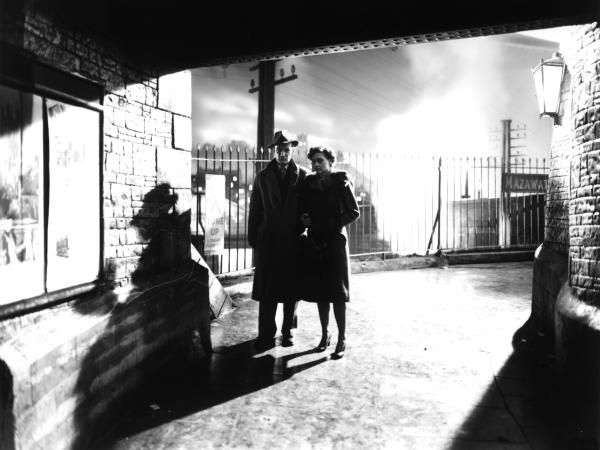
Image context: the cover still shows Laura and Alec under a railway underpass rather than in a conventional romantic close-up.[1] That choice fits the argument of this essay. The film never grants them a world entirely their own. It keeps placing them inside passages, thresholds, and borrowed transit spaces, so even intimacy arrives under the sign of movement and departure.
The station is the film's real grammar before it is its setting
The affair begins because a train hurls grit into Laura's eye and Alec removes it on the platform.[4] That famous tiny event matters because it immediately fuses accident, machinery, and intimacy. A huge transport system passes through at speed; a microscopic irritation interrupts ordinary composure; a stranger steps close enough to touch her face. Adrian Turner's Criterion essay is helpful here because it frames the film as Laura's narrated flashback while insisting on the plausibility and realism of the lovers' conduct.[4] The station is where that realism gets stylized. Everything about it is public, scheduled, and repeatable, yet it becomes the place where Laura's life first slips out of its assigned lane.
Lean keeps returning to the station because it already contains the contradiction the film needs.[1][2][4] It is impersonal enough to permit chance and crowded enough to conceal emotion, but it is also disciplined by clocks, routes, and the knowledge that no one stays there for long. Laura and Alec can meet because the station belongs to nobody in particular. They are also doomed because the station belongs to nobody in particular. It offers adjacency, not shelter. Every reunion is already haunted by the next departure.
This is where the refreshment room becomes one of the most important rooms in the film.[1][6] It looks modest, even drab, but modesty is its dramatic advantage. Cups, buns, small talk, and routine service keep providing Laura and Alec with a nearly invisible enclosure. They can sit there without declaring themselves. The ordinariness does the hiding. Yet because the room is part of a transport system, it cannot stop being provisional. It is a waiting room with tea, not a home. Lean never lets the viewer forget the distinction.
Celia Johnson's voice and face make restraint feel louder than outburst
The station logic would mean less without Laura's narration and Celia Johnson's performance.[3][4][5] Turner notes that Lean begins at the end and unfolds the affair through Laura's voice, which turns the whole film into remembered pressure rather than present-tense spontaneity.[4] Dan Callahan's Criterion piece sharpens the acting problem further: Johnson's Laura is self-described as an ordinary woman, yet her eyes are so watchful and so near to giving everything away that tiny shifts in gaze generate suspense on their own.[5]
That combination is the miracle of the film.[3][5] The voice-over says what social behavior cannot say aloud, but even there Laura rarely sounds grand. She sounds scrupulous, embarrassed, overalert to proportions and consequences. Meanwhile Johnson's face performs a second, more dangerous track. Lean can hold on her in a cafe, in a carriage, or after some apparently trivial exchange, and the audience sees feeling trying to remain compatible with manners. In many love stories confession is the climax. In Brief Encounter, self-command is the spectacle.
Rachmaninoff matters because the score does not cancel that restraint; it amplifies it.[2][3][5] The music surges where the characters cannot. The result is not sentimental overstatement, as if the soundtrack belonged to another movie. It is a formal division of labor. Laura's speech stays decorous. Her face trembles at the edge of exposure. The concerto carries the emotional mass that neither speech nor action can safely carry in their world.[2][3]
The underpass and the borrowed room keep turning privacy into transit
The middle stretch of the film is built from spaces that Laura and Alec can use briefly but never possess.[1][4][6] They walk beneath arches, take trains, sit in cafes, go to the cinema, go out into the country, and then attempt the one move that would convert passing time into actual privacy: the borrowed flat of Alec's friend Stephen.[4] Lean stages this progression with cruel clarity. Each outing feels slightly more deliberate than the last, but the settings remain borrowed from other social functions. Leisure, commuting, friendship, and hospitality all lend the lovers cover without ever granting them a legitimate room.
That is why the apartment scene cuts so deep.[4][7] On paper it looks like the point where the romance might finally become consummated melodrama. Kevin Brownlow's production notes are useful because they underline how risky and apparently fragile the material seemed in wartime Britain.[7] Lean answers that risk not by making the scene torrid but by making it awkward, hurried, and exposed to interruption. The room exists, yet it does not turn into refuge. Stephen returns too soon. The lovers are left scrambling to preserve dignity in a place that was supposed to suspend scrutiny for an hour.
The apartment therefore confirms the film's deeper argument.[1][4][7] Laura and Alec are not prevented from happiness only by conscience or social rule. They are also prevented by form. Their love has learned to live in passing spaces. Once it tries to occupy a stationary interior fully, it looks frightened, improvised, and unsustainable. The borrowed room is the station's opposite, and Brief Encounter shows that the affair does not know how to survive there.
The final interruption is devastating because it is so ordinary
The most brutal moment in the film is not a denunciation or a dramatic discovery. It is Dolly Messiter talking too much in the refreshment room while Alec says goodbye with a light touch on Laura's shoulder.[1][4][5] Lean's genius is to let banality perform the violence. A chatterbox acquaintance, a public table, a train schedule, and one brief physical gesture do more damage than a scene of theatrical exposure could have done. The film has spent its whole length proving that ordinary settings are enough to hold extraordinary feeling. At the end it proves the harsher companion truth: ordinary settings are also enough to crush it.
The husband's final kindness is what keeps the movie from turning cynical.[4][5] Laura returns home shattered, and Fred's simple, attentive response does not erase the affair, excuse it, or fully understand it. It restores scale. The world of schedules, meals, domestic repetition, and quiet regard remains standing. What has changed is Laura's knowledge of how much feeling that ordinary world had failed to register. The last sob is devastating because the film has denied itself larger releases until that point.
Brief Encounter lasts because Lean makes morality visible as a problem of time and space rather than sermon alone.[1][2][3][4] The station clock, the underpass, the buffet table, the borrowed room, and the final shoulder touch all belong to one design. This is a love story in which desire never secures a territory; it only borrows intervals from a transport network and tries to live inside them. That is why the film feels so piercingly sad. Laura and Alec do not lose a private paradise. They discover that paradise was always being announced over the platform as a departure.
Sources
- Vic Pratt, "Brief Encounter - a return ticket to Temptation," BFI.
- BFI, "Brief Encounter (1945)" film page.
- The Criterion Collection, "Brief Encounter" film page.
- Adrian Turner, "Brief Encounter," The Criterion Collection.
- Dan Callahan, "Flickers of Passion: Celia Johnson in Brief Encounter," The Criterion Collection.
- Carnforth Heritage, "Welcome to the Home of Brief Encounter."
- Kevin Brownlow, ""Riskiest Thing I Ever Did": Notes on Brief Encounter," The Criterion Collection.