J. M. Shumaker helped move hundreds of people to Grandview Cemetery in the hope of finding his wife. She had disappeared in the Johnstown flood of May 31, 1889. By autumn, many of the dead lay in temporary graves scattered around the Pennsylvania valley. Bringing them to one hillside would give families another chance to recognize someone. Thirty-six people were identified during the work. When the state Flood Relief Commission filed its report, Shumaker still did not know where his wife lay.[1][2]
Three years after the flood, nearly ten thousand people gathered at Grandview to dedicate a memorial. A visitor who came for the ceremony could mourn everyone buried there. A visitor who came looking for one person needed something more particular. To understand what the graves could tell that second visitor, it helps to begin down the hill, at a schoolhouse that had served as a morgue.[1][2][3]
What an envelope could tell a family
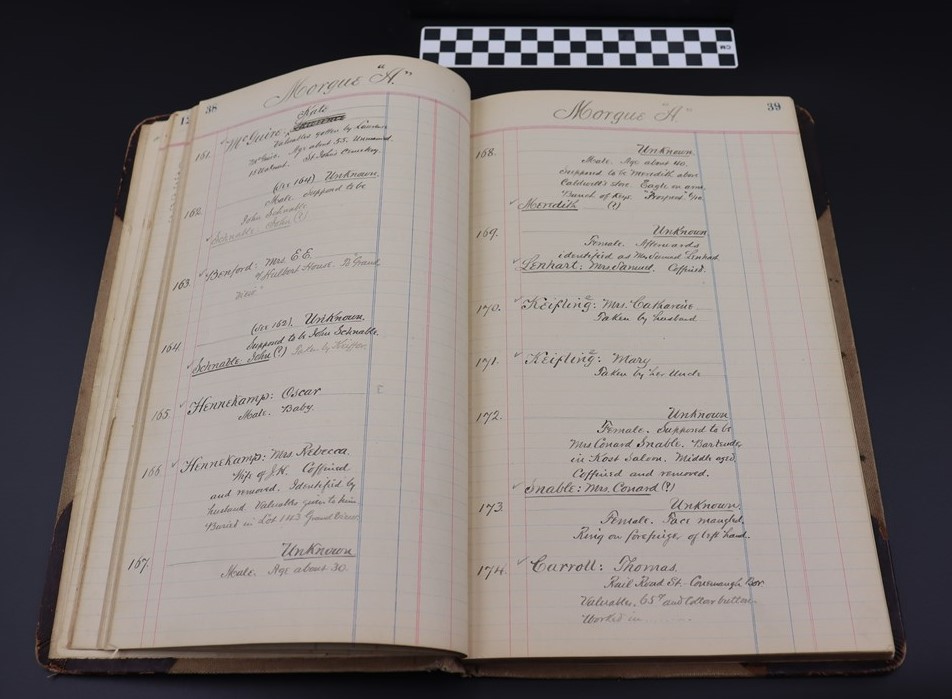
At the Fourth Ward schoolhouse, the woman entered as number eleven had an envelope bearing three initials, “F. L. F.” The recorder kept the initials alongside the word “Unknown.” The entry leaves room for a possibility familiar to anyone who has carried someone else’s letter. Those letters might mean something to a relative, but whose name could the recorder safely enter on their strength? A few entries earlier, someone had recognized Laura Hamilton well enough for her brother to take her body home. The record even preserves the news that she was to have married the following Tuesday.[3]
Reverend David J. Beale, who supervised the morgues, recalled writing on scraps salvaged from the wreckage or pulled from pockets. At one church, the priest could keep little more than a count as the dead came in. The bound ledger now held by the National Park Service gives this work a more orderly appearance than its beginnings would suggest. A family’s chance of finding someone could depend on which door the body had passed through and whether anyone there had time and paper enough to describe a ring.[3][4]
A second examination
The commission traced the reburial plan to a conversation with a Johnstown resident, Herman Baumer. The daily papers gave notice so that people could attend when the bodies were moved. Workers examined each one again and compared clothing with the earlier records. Where a name still eluded them, they wrote a fresh description and gave it the number of the grave at Grandview. The number now pointed in two directions. Someone standing at a grave could trace it back to a description. Someone who recognized a detail in the record could find the place where the person lay.[1]
The arrangements for the land mattered as much as the care taken with the paperwork. The mayor held the deed as trustee, and the cemetery company charged enough to provide for the plot’s upkeep. The committee intended to put a marble marker at each grave. In the same report, the secretary mentioned the prospect of a monument for the whole plot, adding that it depended on how much money remained. There was already a public duty attached to each burial while the monument was still a wish.[1]
On May 31, 1892, the memorial drew its crowd. The editor of the Johnstown Tribune urged his neighbors to look to the future. It is possible to see why the third anniversary offered the city an occasion to say the work was over. Yet the people who laid out the plot had made provision for someone to come back with an unanswered question. Shumaker himself had such a question. For a family in his position, one of the most generous things Johnstown had done was to keep a particular grave findable, even while its occupant’s name was unknown.[1][2]
Sources
- Pennsylvania Flood Relief Commission, Report of the Secretary, pp. 32–33, on the Grandview reburials and J. M. Shumaker.
- Historic American Buildings Survey, City of Johnstown, PA-5669, on the cemetery dedication and the Tribune editorial.
- National Park Service, Record of Bodies, David J. Beale’s account and transcribed morgue entries.
- Johnstown Flood National Memorial, Collections, photographs and catalogue description of Beale’s morgue book.