Two girls on a swing look down and see their shadow on the grass. Longfellow gives the pair just one shadow. You can see what makes them laugh. Up here are four hands holding tight and two bodies leaning into the ride. Down there a single dark shape skims the lawn. When laughter comes again in “The Ropewalk,” the people making it are standing on solid ground, waiting for someone else to swing. [1]
The person who imagines both scenes has spent the whole poem indoors. He is watching rope being made. At a hand ropewalk, a spinner could carry loose hemp around the waist, feeding out fibers while stepping backward between reels. The building had to accommodate the length of the work. On its sign at the site of the Jones Point ropewalk in Virginia, the National Park Service quotes Longfellow’s opening stanza to help visitors picture that peculiar backward gait. In the poem, this is also where the observer and the workers part company. Their feet have to keep going down the lane. At the sound of the wheel his mind goes out the door. [1][2]
The girls get the first ride. In the very next stanza another girl is aloft, this time with the cord under her feet and a spangled costume on her back. The girls on the swing get to look at something. The girl on the tightrope is the thing people have come to see. Close enough in imagination to make out the weariness in her face, the speaker seems to have a better view than a paying customer could hope for. What he does with that privilege is a little troubling. He admires her faded beauty, allots her the same six lines as the girls on the swing, and moves along. [1]
By the time we reach the prison yard, Longfellow has taught us a small game. Guess where the rope is. At the well it hauls up a bucket. In the bell tower it nearly hauls up the bell ringer, a joke at the expense of a man who thought he was doing the pulling. The prison stanza lets three lines go by while we scan the crowd. We have the set faces and the ugly laughter before we have the apparatus that explains them. “Ah! it is the gallows-tree!” sounds like someone who has been playing along and suddenly wishes he had been slower to guess. [1]
There is no account of the crime. We never learn whose neck the rope will take. What we do learn, with unusual precision, is where we have been standing. The speaker and the reader have approached the scaffold from the spectators’ side. For once he wants the object in his field of vision swept from the earth. Then comes one of the hardest little words in the poem, the same “Then” that brought on the tightrope act. A boy is flying a kite. The wish has had time to find a rhyme. Whether it has done anyone any good is a question the sight of the boy leaves open. [1]
One more use for rope suggests what a spectator might do with the power to notice. Near the end, sailors in fog take soundings. A weighted line goes overboard until the lead touches bottom. The mark at the waterline gives the depth. Longfellow’s “lessening line” lets us feel the approach to shore through a sailor’s hands. On each cast there is a little less line to pay out. A person with obscured vision can still learn something on which other lives depend. [1][4]
Back indoors, the spinners are walking backward still. Nothing in their movements tells us which length will steady a pair of girls and which will end up in a prison yard. The visitor has had the leisure to follow both. I think that is why the first laugh carries so far. The girls can look down and delight in what their bodies are doing. When the same sound rises from the yard, the person with the freedom to look down is the one on the safe side of the rope. [1]
Sources
- Henry Wadsworth Longfellow, “The Ropewalk,” reproduced in California State Parks’ rope-making teaching guide, p. 6.
- National Park Service, “Information Panel: The Jones Point Ropewalk,” on hand spinning and the exhibit’s use of Longfellow.
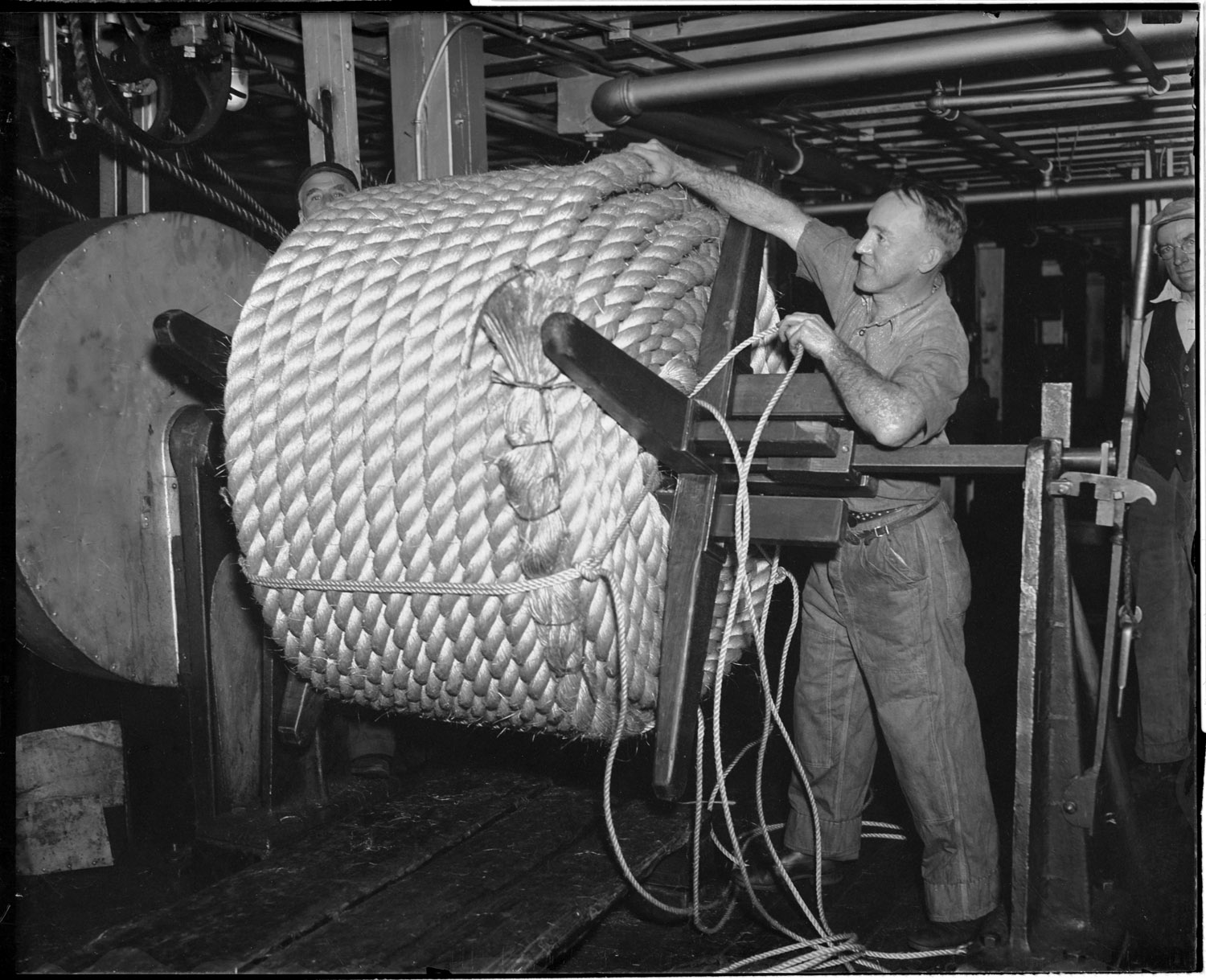
- Boston National Historical Park, “Charlestown Navy Yard: Ropewalk,” including Leslie Jones’s photograph of James R. Lee.
- NOAA, “The Water Writers,” in Discover Your World with NOAA, p. 25, on how sailors used a marked lead line to sound the depth.