
The BBC camera does not simply find a solitary poet in Hull. It composes one. In the surviving 1964 footage, Philip Larkin appears indoors beneath patterned wallpaper and outdoors among headstones and long grass. John Betjeman, an admiring fellow poet, invites him to connect temperament, surroundings, and verse. The locations seem to answer before Larkin does: here is the withdrawn observer, apparently made by a provincial city and already at home beside mortality.
That image has proved unusually durable. The Poetry Archive notes that Larkin’s name now evokes a gloomy, death-conscious, darkly comic persona, then immediately warns that both the man and the work are more complicated.[5] The film matters because it supplied moving pictures for that popular image. It also preserved evidence that works against it. The most important counter-image is neither church nor cemetery but the university library: a collective institution that Larkin helped transform while writing some of the poems on which his reputation rests.
The timing sharpened the portrait. Larkin had become University Librarian at Hull in 1955 and moved into the top-floor flat at 32 Pearson Park the following year. He remained in that flat for eighteen years, writing much of his mature work there; much of the Monitor programme was also filmed inside it.[3] The Whitsun Weddings appeared in February 1964, and the broadcast followed in December, so television arrived just as a successful new collection made the private librarian newly visible to a national audience.[2]
Meanwhile, his paid work was not a decorative day job. When Larkin arrived, Hull’s university library held about 124,000 items and employed twelve staff for 727 students. By 1985, after two phases of construction and major organizational change, it held more than 750,000 items, employed more than eighty people, and operated computerized catalogue and circulation systems.[4] The scale of that transformation makes the familiar split—poet by night, harmless librarian by day—too simple. Administration, architecture, technology, service, and verse occupied the same adult life.
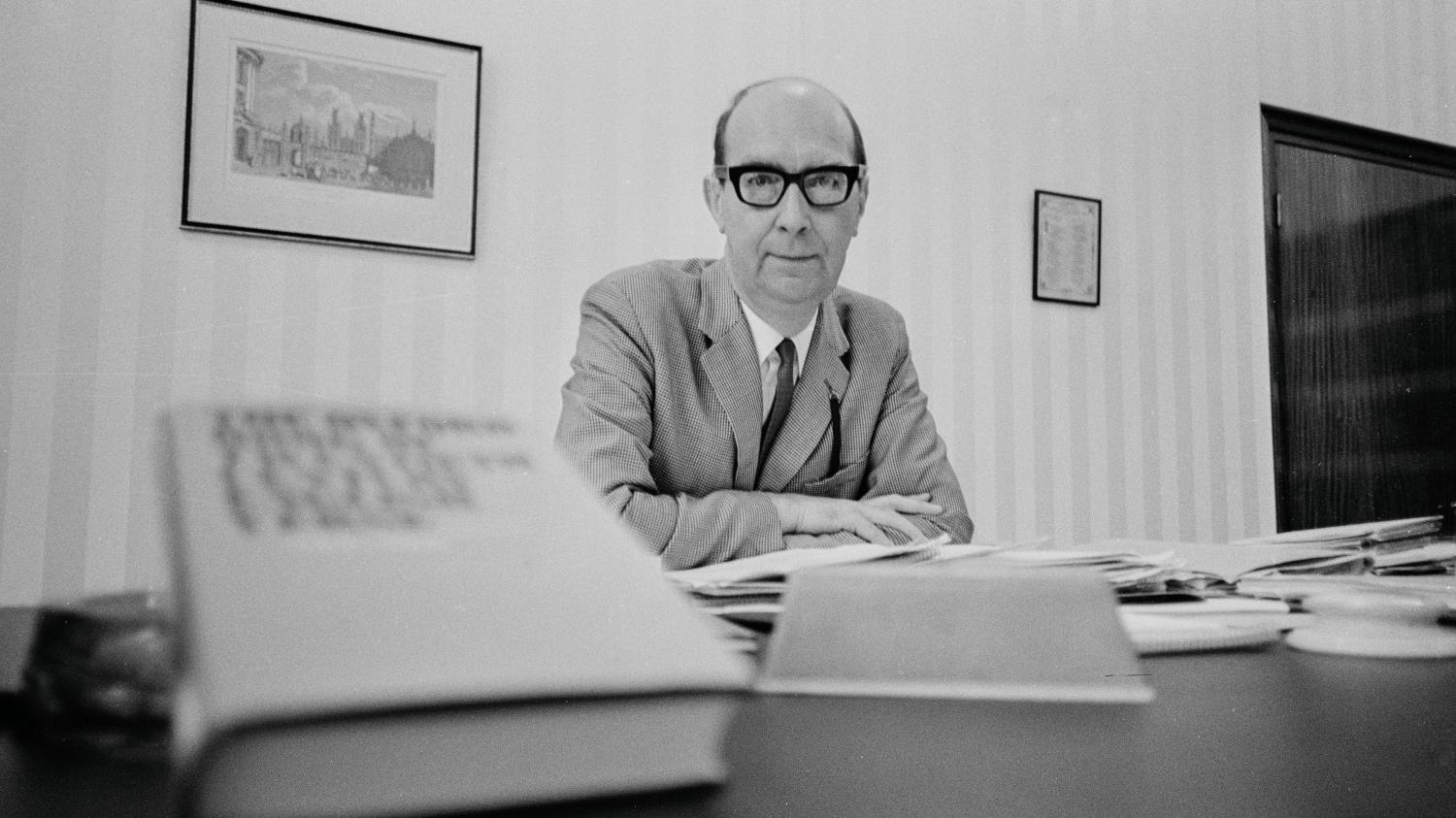
The cover photograph comes from the University of Hull Archives and shows Larkin behind the office desk associated with that institutional work.[4] It is deliberately not a video still. A still could reinforce the programme’s chosen atmosphere; the office photograph widens the archive by asking what the televised portrait leaves at its edges.
Provenance: a short extract from a designed portrait
The original film was Monitor: Down Cemetery Road, produced by Patrick Garland and presented by Betjeman. It was broadcast on BBC2 on 15 December 1964 and ran for just under twenty-five minutes. Six Larkin poems were read in full, occupying a little more than half the programme.[2] That proportion is crucial: the production was not merely a celebrity interview decorated with quotations. It tried to make the poems themselves television, placing voices, faces, rooms, streets, parkland, shops, churches, and graves beside complete readings.
The embedded BBC Archive upload is an official eight-minute extract, not the whole programme.[1] It preserves the central encounter between Larkin and Betjeman, but any interpretation should remember the larger editorial design from which it has been cut. The online clip is already an archive within an archive: a present-day selection from a 1964 selection of a life and body of work.
Its scarcity gives every shot added force. Alexander Hugh Balfour’s history of poetry on BBC television identifies Down Cemetery Road as the only occasion on which Larkin allowed himself to be filmed in this way. Its eight surviving sequences were repeatedly reused in later television biographies, becoming the stock moving images through which viewers encountered him: in the study, cemetery, church, library, and landscape around Hull.[2] Repetition made a few staged hours look like the natural visual vocabulary of an entire life.
The camera makes place look like destiny
Watch how readily the film turns setting into explanation. In the interior, Larkin sits contained by a patterned chair and domestic walls. In the cemetery, he remains formally dressed while vegetation and monuments crowd the frame. The same glasses, dark suit, narrow tie, and controlled posture pass from room to burial ground. Editing makes those spaces rhyme. What could be two arranged interview sites begins to feel like a map of one sensibility.
Betjeman is not a neutral interrogator in this construction. He is a champion of Larkin’s poetry and a gifted broadcaster with his own intense attachment to place. In the longer programme, he praises the way Larkin describes his surroundings and the feelings of a detached observer.[2] The compliment offers an interpretation before the audience has to make one: local scene becomes poetic source, and the poet becomes the man best fitted to stand apart and record it.
Larkin partly accepts that account, but his speech makes acceptance unstable. Asked about hostile criticism, he begins with comic self-caricature, pauses, qualifies, and eventually says, “One writes the kind of poetry one has to write, or can write.”[2] The sentence sounds definitive when isolated. Heard in context, it arrives through uncertainty. “Has to” suggests necessity; “can” lowers that claim to capacity or limitation. He does not announce a grand programme. He describes authorship as a negotiation with the person and circumstances already available.
That hesitation matters because it is also a feature of the poems. The Poetry Archive describes Larkin’s written voice as full of qualifications that create the sensation of thought occurring in real time; his understated delivery strengthens the colloquial effect.[5] On camera, the stammers and revisions make reflection visible. They can feel more truthful than a polished answer. Yet this apparent candour is still framed by Betjeman’s question, Garland’s edit, and the chosen settings. Spontaneity is one of the materials from which the portrait is built.
The cemetery sequence makes the process especially clear. Two living poets sit together among memorial stones and discuss work that often confronts time, failure, and death. It is an irresistible visual arrangement, but it is also an arrangement. The graveyard does not prove that Larkin’s poems are encrypted autobiography any more than the wallpaper proves they are domestic. It gives abstract preoccupations a legible television location.
Balfour distinguishes the early Monitor films as portraits rather than biographies: they showed artists working, writing, and living in the present, and treated life as context rather than a simple cause of art.[2] Down Cemetery Road nevertheless contains the seed of a causal story. Once the same few images are excerpted and reused, “poet in a cemetery” can harden into “cemetery poet.” Archive scarcity encourages metaphor to masquerade as evidence.
The desk refuses the solitary-poet story
This is why the library deserves more attention than the graves. Its presence does not cancel solitude; writing still requires private labor, and Larkin carefully protected his privacy. But the library reveals a second mode of making. Buildings require consultation. Collections require budgets and systems. Staff require decisions. Readers require access. Larkin worked with administrators and an architect on the postwar library’s layout, including its reading rooms, lighting, and relationship between students and book stacks.[4]
The office desk therefore changes the meaning of “ordinary work.” In a shallow reading of Larkin, employment is the toad that burdens the poet or a refuge that keeps literary ambition respectably hidden. In the institutional record, the job has consequences independent of the poems. A university library grew, modernized, and served many more people. The administrator was not merely waiting for the poet to come home.
The film knows this and nearly knows what to do with it. It shows Larkin’s workplace, but Betjeman’s admiring frame can turn librarianship into a charming eccentricity or dependable fallback. A later account in The Paris Review catches the oddness of that moment: the programme is a carefully orchestrated literary portrait, yet Betjeman envies Larkin for having the library “to fall back on.”[6] The remark reverses the real scale of the work. A three-decade career becomes secondary support for the literary identity television came to celebrate.
Reading the archive against that hierarchy produces a fuller Larkin without pretending to produce a final one. The cemetery and the study illuminate how Monitor translated poems into pictures. The library shows where that translation becomes selective. It reminds us that a public persona can be factually composed—every location is real—and still be radically incomplete.
What eight minutes can inherit
The clip’s afterlife is part of its meaning. Later producers returned to these images because no equivalent footage existed, and the same visual fragments accumulated authority through reuse.[2] Today, the official online extract performs another act of concentration. It makes rare material accessible while narrowing the already selective original. For many viewers, eight minutes will stand for the twenty-five-minute film, and the film will stand for the camera-shy poet.
That does not make the footage deceptive. It makes it authored. Sadie Stein’s description of the original as a deliberate and carefully orchestrated portrait is useful because “orchestrated” preserves both artifice and achievement.[6] Betjeman’s warmth elicits an unusually rich conversation. Garland’s locations give intellectual questions visual pressure. Larkin’s pauses let viewers hear a mind refusing the smoothness of a manifesto. The collaboration creates insight precisely because it creates a form.
The best way to watch, then, is with double attention. Notice the remarkable historical presence of Larkin’s voice, face, timing, and unease. At the same time, notice the machinery that makes those qualities signify: the admirer’s prompts, the cut between room and cemetery, the absent hours, and the working library that will not remain mere background. The camera made a compelling solitary-poet myth. Fortunately, it left the desk in frame.
Sources
- BBC Archive, “1964: Philip LARKIN and John BETJEMAN on Poetry,” YouTube video.
- Alexander Hugh Balfour, Poetry on BBC Television 1936–2009, University of East Anglia doctoral thesis, 2023.
- Historic England, “32 Pearson Park,” National Heritage List for England entry 1444505.
- Brynmor Jones Library Blog, “‘A Lifted Study-Storehouse’: Philip Larkin and the Brynmor Jones Library,” University of Hull.
- Poetry Archive, “Philip Larkin” (biography and recording notes).
- Sadie Stein, “Another Evening Gone,” The Paris Review, 19 November 2014.