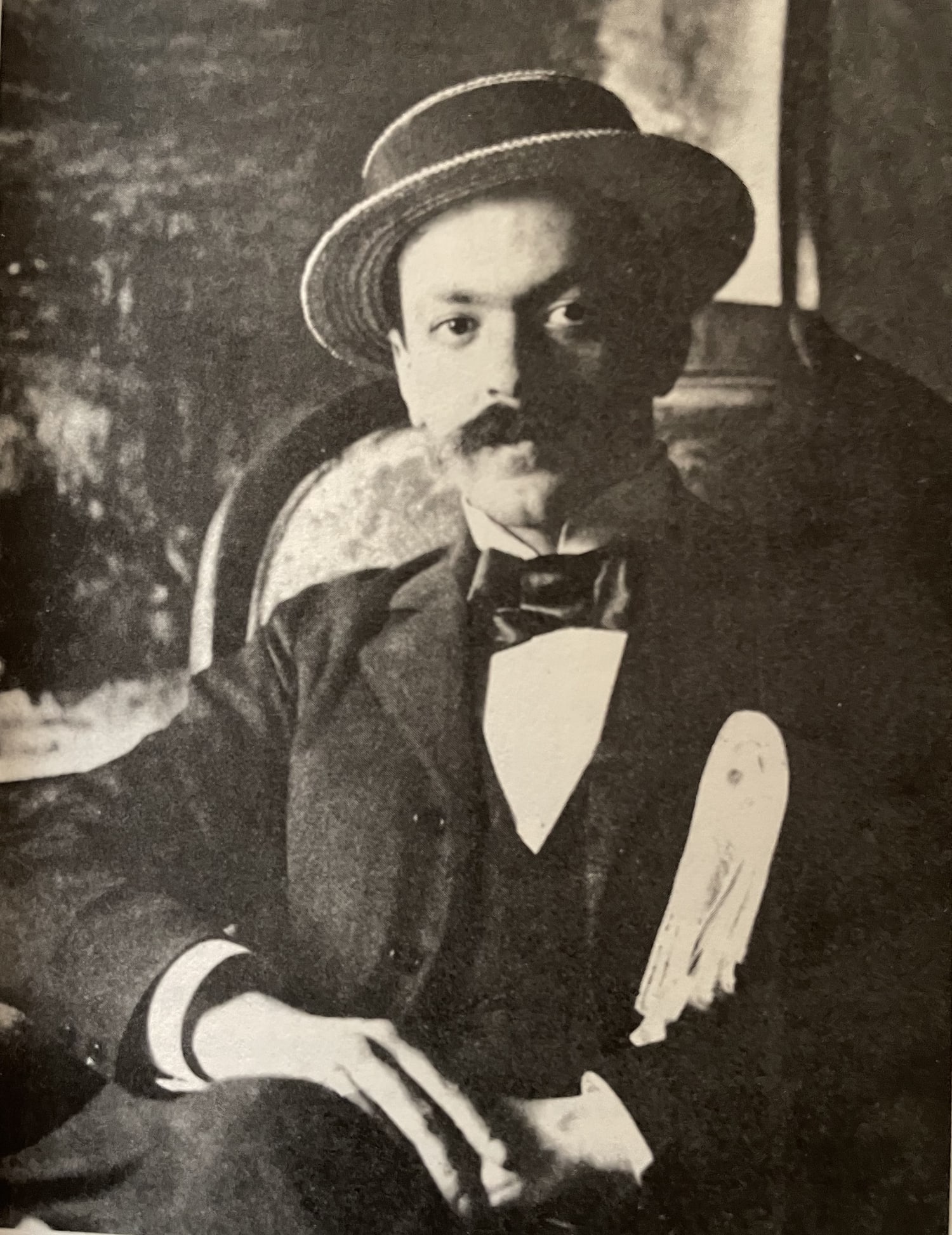
Before Zeno Cosini speaks, somebody has already called him a liar. The tiny preface to Italo Svevo's Zeno's Conscience belongs to Doctor S., the psychoanalyst who says he is publishing his former patient's memoirs “for revenge.” Zeno abandoned treatment; the doctor has answered by exposing the manuscript and teasing the “many truths and lies” gathered inside it.[1] The diagnosis arrives before the patient.
That warning can make the novel sound like a puzzle with a clean solution: find the lies, subtract them, and recover the true Zeno. Svevo has designed something more entertaining and more unsettling. Zeno does not usually protect himself by withholding the incriminating fact. He supplies it, worries it, adds an explanation, notices the weakness of that explanation, and offers another. His candor and his evasions share a voice.
The result is one of modernism's great comic performances. Zeno's sentences behave like appeals filed against judgments that have not yet been delivered. A cigarette is always about to be the last. A dying father's gesture is punishment, accident, and reconciliation in turn. A disastrous courtship becomes a fortunate marriage; a missed funeral becomes proof of business loyalty. Confession does not close the case. It keeps the case open long enough for Zeno to live inside it.
The doctor is not an impartial judge
The frame gives us two compromised interpreters, not one reliable doctor standing outside an unreliable patient. Doctor S. admits that autobiography is his own experimental prelude to analysis. He violates confidence out of spite, expects “handsome proceeds” from publication, and offers to share them if Zeno returns to treatment.[1] Even before the main narrative begins, diagnosis, authorship, revenge, and profit have become difficult to separate.
Zeno's memoir then refuses ordinary chronology. After a preamble, he groups his life under subjects: smoking, his father's death, marriage, wife and mistress, a business partnership, and psychoanalysis. The sequence resembles a set of symptoms laid out for a clinician, but each chapter also behaves like a defense brief. Zeno chooses the evidence, controls its order, and narrates from a later vantage point whose interests keep changing.[1]
That arrangement matters more than catching him in isolated falsehoods. Saskia Elizabeth Ziolkowski argues that the novel plays with unstable perspective: Doctor S.'s preface sends readers into private narratives that were never meant for publication and cannot be treated as neutral testimony.[3] Yet instability does not mean that every version is equally persuasive. Svevo lets us hear the defense being assembled. The little hesitations, reversals, and excess explanations disclose what the finished alibi wants to smooth over.
Zeno can therefore be perceptive without becoming dependable. Often he is the first person to expose his own trick. That self-knowledge earns a fresh hearing, which he immediately uses to complicate the charge.
Every last cigarette buys another future
The chapter on smoking gives this voice its perfect prop. Zeno dates his resolutions on books and walls, choosing numerical patterns grand enough to inaugurate a new life. Each “last cigarette” promises health, strength, work, and a decisive future self. But the adjective last also makes the cigarette taste better. As Zeno observes, it gains intensity from the feeling of victory over oneself; an ordinary cigarette merely postpones that victorious future.[1]
This is not just a joke about weak will. The ritual protects an ideal Zeno from being tested. So long as he is about to quit, his strength remains latent rather than disproved. Smoking supplies both the failure and the explanation for every other failure. He even wonders whether he loves the habit because it lets him blame the cigarette for his incapacity—and then declines to settle the question.[1]
One verbal correction contains the whole method. Recalling how he stole money from his father's waistcoat, Zeno says his father's laughter at the innocence he no longer possessed stopped him from stealing forever. Then comes the pivot: Cioè... rubai ancora, ma senza saperlo—“That is … I stole again, but without knowing it.”[1] The correction looks scrupulously honest while moving responsibility into the phrase “without knowing.” He confesses and mitigates in the same breath.
The ellipsis is Zeno's natural habitat. A firm statement creates an edge; the revision blurs it. His voice repeatedly converts moral failure into an interesting psychological hypothesis. Because the hypothesis may be true, the reader cannot dismiss it. Because it arrives exactly when blame sharpens, the reader cannot accept it innocently either.
The slap keeps changing after the hand is still
The death of Zeno's father gives the comedy a more painful test. As the old man rises in his final struggle, he lifts one hand high and lets its weight fall on Zeno's cheek. The son experiences the gesture as a deliberate slap. He cries that it is not his fault and blames the doctor who had ordered the dying man kept in bed. The older Zeno, recounting this, immediately identifies that excuse as a lie.[1]
But admission does not end the movement. At the funeral he convinces himself that his father did not intend the blow. Later he returns to the “religion” of childhood and imagines a reconciliation in which father and son both understand everything, so the lie no longer matters.[1] The memory passes through guilt, acquittal, and communion without acquiring new evidence. The only witness who could resolve intention is dead.
Svevo keeps the scene bounded by that unknowability. It would be too easy to declare that Zeno invented the slap, or that he knowingly falsified an accident. The novel's sharper question is what retrospective language does when fact cannot decide meaning. Zeno wants the gesture to explain his guilt and release him from it. Each version answers an emotional need that the preceding version exposed.
His unreliability is therefore temporal as well as factual. The man at the bedside, the mourner at the funeral, and the patient writing years later are not interchangeable witnesses. Zeno collapses them into one fluent “I,” then lets their motives quarrel inside the sentence.
Too many explanations tell the truth
In the marriage chapter, Zeno turns humiliation into destiny with similar agility. He enters the Malfenti household intending to marry the beautiful Ada. Rejected by Ada and then by her sister Alberta, he proposes to Augusta, the sister he has conspicuously failed to desire. Augusta accepts, and the marriage becomes unexpectedly durable.[1][2]
Zeno's narration alternates between contempt for his earlier choice and gratitude for its outcome. Accident begins to look like buried wisdom; selfishness is redescribed as helpless confusion; Augusta's steadiness retroactively makes him a man who chose well. None of those readings fully cancels the others. The happy marriage is real, but it cannot make the proposal generous.
On the wedding morning, Zeno lies in bed considering flight and arrives late. He gives Augusta three explanations for the delay. Their abundance reveals more than one plausible excuse would have hidden. At the altar, while saying yes, he is mentally composing a fourth.[1] This is Svevo's characteristic joke about language: the defense becomes most legible at the moment it tries hardest to be complete.
The pattern darkens around Guido, Zeno's brother-in-law and business partner. After Guido's death, Zeno follows the wrong funeral procession. Once he discovers the mistake, he decides that recovering the dead man's losses on the stock exchange is a higher duty than attending the burial. He walks away feeling healthy and victorious, briefly forgetting that he has missed his closest friend's funeral.[1]
Asked to account for himself, he adds what the Italian text calls qualche cosa di meno vero in appendice della verità—“something less true appended to the truth.”[1] No phrase better captures his style. The lie is not a sealed alternative to fact. It is an appendix: a small narrative addition that changes the moral balance of everything before it.
Psychoanalysis does not get the last word
Svevo began the novel in 1919 and published it in 1923, making psychoanalysis both a historical presence and a comic literary apparatus. Annunziata Rossi notes that Svevo treated Freud with fascination but distrusted psychoanalysis as therapy; the method offered him a powerful pretext for fiction about self-interpretation.[4] Doctor S. wants Zeno's recurring stories to reveal a curable pattern. Zeno learns instead how readily a pattern can become one more story about himself.
In the final chapter, dated entries replace the long retrospective sections. Zeno rejects treatment, disputes the doctor's account of his desires, and eventually declares himself healthy because wartime trading has made him commercially successful. This “cure” is deliberately unstable. Profit may show that the supposedly inept patient can act, but it also makes catastrophe look like evidence of personal fitness.
Then the scale suddenly expands. Zeno says that life itself resembles a disease—always mortal, moving through crises and recoveries. “Life today is polluted at the roots,” he writes, before imagining an ordinary man inventing an incomparable explosive and a slightly sicker man using it to return Earth to a lifeless nebula.[1] The vision reaches beyond an individual diagnosis toward industrial war and a species whose tools magnify its illness.
It may also be Zeno's grandest change of subject. Private guilt disappears into universal pathology; if everybody and all of modern life are sick, the single patient no longer looks exceptional. The ending does not force us to choose between social insight and self-exoneration. Its power comes from their coexistence. Zeno can see something terrifyingly true at the exact moment he finds the largest possible alibi.
Read the revision, not just the verdict
The novel was slow to secure the audience it now enjoys. Svevo had published earlier fiction with little success and spent years in business; Zeno's Conscience gained wider European attention through James Joyce's advocacy and Italian recognition through Eugenio Montale.[2][4] The Svevo Museum in Trieste now preserves the material counterlife of this compulsively revisionary author: annotated editions, correspondence, family photographs, and personal objects.[5]
That afterlife has made “unreliable narrator” an irresistible label for Zeno, but the label is only useful if it directs us back to the sound of his prose. Do not merely ask whether the last explanation is true. Notice when it arrives. Watch for the correction after the boast, the parenthesis after the confession, the fourth cause after three excuses, the appendix that is only “less true.”
Zeno is not compelling because a vigilant reader can finally outsmart him. He is compelling because his revisions imitate a familiar form of self-knowledge: we recognize the evidence against us, describe the mechanism lucidly, and hope that lucidity itself will count in our favor. Every account promises to be the final one. Then, like another last cigarette, it creates the appetite for a new beginning.
Sources
- Italo Svevo, La coscienza di Zeno (1923), Wikisource edition used for the preface and close readings of “Il fumo,” “La morte di mio padre,” “Matrimonio,” “Un'associazione,” and “Psico-analisi”; all English renderings from the Italian are literal translations made for this essay.
- Penguin Random House, Zeno's Conscience, translated by William Weaver, for the English edition, publication details, synopsis, and reception record.
- Saskia Elizabeth Ziolkowski, “Who's Afraid of Italo Svevo? Routes of European Modernism between Trieste and Virginia Woolf's London,” Modern Language Quarterly 85, no. 1 (2024), DOI 10.1215/00267929-10929018, for unstable perspective and the novel's English-language reception.
- Annunziata Rossi, “Italo Svevo y La conciencia de Zeno,” Acta Poética 29, no. 2 (2008), 87–99, for composition history, psychoanalytic context, and the roles of Joyce and Montale in the novel's reception.
- Italian Ministry of Culture, “Museo sveviano,” collection description for Svevo's manuscripts, annotated editions, correspondence, photographs, and personal objects in Trieste.
- Wikimedia Commons, “File:ItaloSvevo.jpg,” source page for the circa-1920 archival portrait used as the article image.