George du Maurier's Trilby has performed a peculiar disappearing act. One of the great publishing sensations of the 1890s is now more familiar through two common nouns than as a novel. A trilby is a felt hat. A Svengali is a controlling manipulator. The heroine survives as something worn; the villain survives as someone who takes command.[5][7][8]
That division is so neat that it falsifies the book. Trilby is not simply the story of an innocent singer captured by an evil hypnotist. It is a baggy, illustrated memory of bohemian Paris; a comedy about three British art students; a sentimental tragedy about class and sexual respectability; and, late in its long movement, a Gothic fantasy about a woman's magnificent voice being used without her conscious will.[1] Its adaptations did more than shorten all this. They transferred the story's center of gravity. Svengali became the plot, while Trilby became the object around which the plot closed.
The result is an unusually visible lesson in what adaptation can do. A story does not need to vanish to be forgotten. Sometimes it survives by exporting its most portable pieces until those pieces replace it.
Before Svengali owns the story
The first Trilby we meet is socially and physically uncontained. She enters the artists' studio in Part First, kicks off her slippers, talks freely, poses for painters, and joins the young men's rough fellowship. She is also spectacularly unable to carry a tune. Her performance of “Ben Bolt” wanders between notes with such consistency that the narrator calls her “absolutely tone-deaf,” although her breathing, range, and raw vocal power are extraordinary.[1]
This comic scene plants the mechanism of the later horror: Trilby possesses the instrument but cannot direct it. Svengali hears the possibility that everyone else treats as a joke. Through hypnosis, he will split capacity from consciousness and make a career out of the gap.
Yet Svengali is not the only man who turns Trilby into material. The artists adore her, sketch her famous foot, judge her sexual history, and imagine domestic futures for her. Their affection is genuine, but it is hardly neutral. Little Billee's mother supplies a more respectable form of coercion when she persuades Trilby that marrying her son would ruin him. Trilby leaves because she accepts that social verdict, not because Svengali commands the decision.[1]
This distinction is the novel's untidy moral pressure. One man imposes himself through mesmerism, but an entire circle converts Trilby into model, muse, fallen woman, suitable or unsuitable wife, miraculous voice, and object of rescue. The hypnotist is the most violent controller, not the only one.
The stage tightens the web into a leash
Paul M. Potter's stage adaptation opened in Boston on March 4, 1895, only months after the novel's book publication. It reached New York in April; the London staging with Dorothea Baird and Herbert Beerbohm Tree followed later that year. By 1896, the Delaware Art Museum's exhibition records, twenty-four American productions were running at once.[2][3]
Speed forced selection. Du Maurier's leisurely sequence of studio jokes, digressions, friendships, separations, concerts, and retrospective explanation had to become a playable chain of entrances and reversals. The contemporary reception pamphlet Trilbyana diagnosed the cost almost immediately. It said the book's “chief charm is one of manner,” something the stage could not simply carry across. More consequentially, Potter made mesmeric suggestion cause Trilby's flight from Little Billee. A choice produced by shame, love, and class pressure became another action by Svengali.[2]
That alteration makes excellent melodrama. It gives the audience one visible source of danger and one villain whose death can break the spell. It also “infinitely belittles the character of the girl,” as the 1895 critic put it, because it takes even her painful act of refusal away from her.[2] Adaptation clarifies the line of force by erasing the surrounding field.
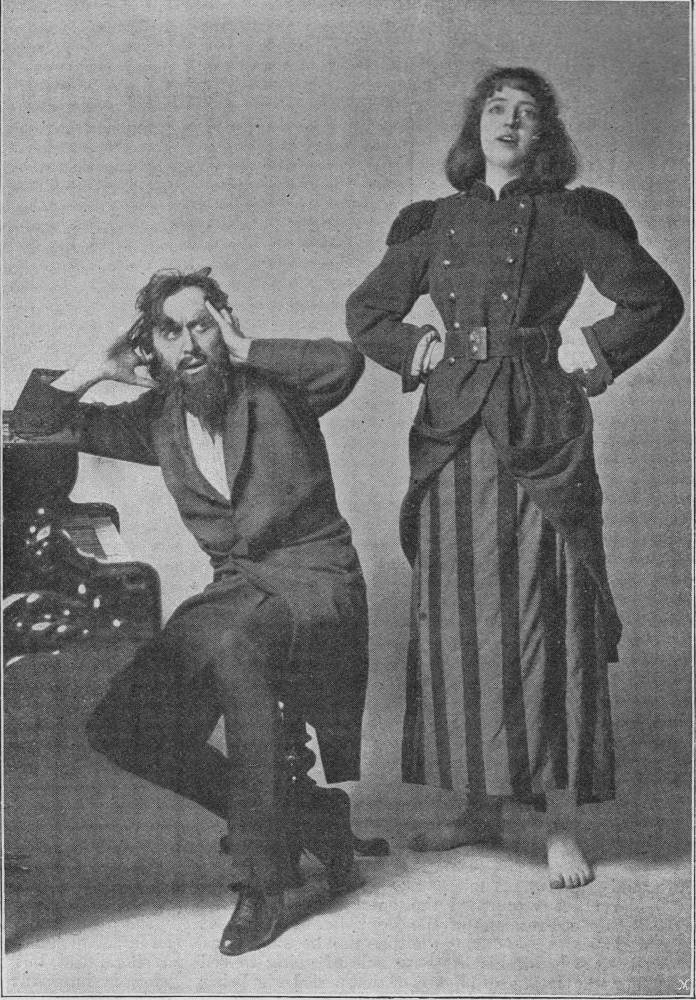
The surviving photograph of Tree and Baird catches the theatrical economy before it fully inverts. Baird towers barefoot, hands on hips and mouth open in song; Tree crouches at the piano with his hands clamped over his ears. The image advertises the comic kernel—an enormous voice with no command of pitch—rather than the later hypnosis. That makes it especially revealing. In this frame, Trilby still occupies the scene through something she does, while Svengali reacts. The stage plot and its later publicity would discover how easily that relation could be reversed.[3][9]
The villain takes the marquee
Once the story became reproducible spectacle, its titles began to confess where the attention had moved. Later screen versions repeatedly promoted the controller: the 1931 John Barrymore film was Svengali, and the 1954 British adaptation took the same name.[4][6] The heroine still supplies the voice, beauty, danger, and suffering, but the villain supplies the marketable concept.
The novel itself anticipates this theft of authorship. In Part Eighth, after both Trilby and Svengali have died, the violinist Gecko finally explains the missing years. “There were two Trilbys,” he says. One was the woman her friends knew; the other was a “singing-machine,” the unconscious voice through which Svengali effectively sang.[1] It is the book's most chilling account of artistic exploitation because it refuses the comforting fiction of collaboration. Her talent is real. His direction is real. The performance is magnificent. Her consent is absent.
Stage and film make that relation easier to see, but also easier to simplify. They turn distributed pressures—class shame, the male gaze, professional manufacture, spectatorship—into one man's supernatural grip. The simplification then escapes the theater. The Online Etymology Dictionary records “Svengali” as a term for someone who exerts a controlling or mesmeric influence and traces it to du Maurier's character.[7] A proper name has become a mechanism.
But the clean modern definition can hide a dirty inheritance. Du Maurier constructs Svengali through emphatically antisemitic description: foreignness, Jewishness, bodily disgust, occult power, and predatory artistic genius are made to reinforce one another.[1] Michèle Mendelssohn argues that the novel's ideas about art, degeneration, and antisemitism are intimately connected—and that the connection shaped not only the fiction but its reception.[6] Using “Svengali” as a frictionless synonym for control can therefore preserve the stereotype's work while forgetting where the figure acquired his menace.
The heroine becomes a hat
Trilby's name travels in the opposite direction. Rather than becoming a type of person, it becomes a thing. The Online Etymology Dictionary traces the felt hat to the one worn in the London stage version of Trilby.[8] The novel's heroine, already famous for a foot drawn, measured, displayed, and merchandised, enters language through costume.
This was not a minor side effect of the craze. The Delaware Art Museum documents a market crowded with Trilby shoes, bicycle clothes, household objects, ice cream, sausages, and other novelties. Trilbyana exists because contemporary readers wanted an index to the frenzy: reviews, performances, personalities, parodies, and products circulating around the book.[2][3] Adaptation here includes more than stage and screen. It means the conversion of narrative into poses, goods, catchwords, and repeatable jokes.
The hat and the hypnotist make a brutal pair. His name retains agency so completely that it describes taking another person's agency. Her name loses personhood so completely that it labels an accessory. This is an interpretation of the afterlife, not evidence of a coordinated plan. Yet the asymmetry matters because it extends the novel's own problem: who gets to act, who gets displayed, and whose name remains attached to the performance.
Nancy Glazener's account of postbellum print culture describes Trilby as a runaway bestseller whose main residues were precisely the epithet “Svengali” and the style of hat.[5] That summary sounds almost comic until one remembers the story's central split. Culture has treated the whole novel as Svengali treats Trilby's voice: extracting the useful effect and discarding the consciousness that made it human.
Fidelity means restoring the field
A faithful new adaptation would not need to reproduce every studio anecdote or every turn in du Maurier's wandering narration. It would need to restore the field of pressure around the obvious villain. Trilby should be more than the passive endpoint of hypnosis; Little Billee and his friends should be more than uncomplicated rescuers; respectability should appear as a coercive force rather than a safe world waiting outside Svengali's spell.
That does not make the novel a morally pure original betrayed by crude adaptations. Its sympathy for Trilby coexists with voyeurism. Its critique of control depends on an antisemitic caricature of the controlling Jew. Its final explanation still lets men define the two Trilbys for us.[1][6] Returning to the text is valuable not because the book resolves these contradictions, but because it makes the simplifications harder to miss.
The afterlife of Trilby is therefore larger than a roll call of productions. It is the story of attention changing owners. The novel gives its heroine a voice she cannot govern. The stage gives the villain more of her decisions. The screen gives him her marquee. The dictionary gives him a human type, while it gives her a hat.
Read the forgotten bestseller now and the two familiar words start to look less like charming survivals. They look like the final adaptation: Svengali still directing, Trilby still on display, and the woman between them asking to be heard as more than either name allows.
Sources
- George du Maurier, Trilby, Project Gutenberg text used for close reading, especially Parts First, Fourth, Sixth, and Eighth.
- Joseph Benson Gilder and Jeannette Leonard Gilder, Trilbyana: The Rise and Progress of a Popular Novel (1895), Project Gutenberg edition used for contemporary reception and the first-stage-adaptation critique.
- Delaware Art Museum, Helen Farr Sloan Library & Archives, “The World at His Feet: George du Maurier's Trilby and Its Foot-Focused Farces,” online exhibition; see the Introduction, Trilby Boom, Stage, and Conclusion sections.
- Philip V. Allingham, “George du Maurier, Illustrator and Novelist,” The Victorian Web, for publication context and the stage-and-screen afterlife.
- Nancy Glazener, “The Novel in Postbellum Print Culture,” in The Cambridge History of the American Novel, for Trilby as mass-culture event and the survival of the Svengali epithet and felt hat.
- Michèle Mendelssohn, “Beautiful Souls Mixed Up with Hooked Noses: Art, Degeneration, and Anti-Semitism in The Master and Trilby,” Victorian Literature and Culture 40, no. 1 (2012).
- Online Etymology Dictionary, “Svengali,” meaning and origin in du Maurier's novel and its stage representations.
- Online Etymology Dictionary, “trilby,” origin of the hat name in the 1895 stage adaptation.
- Wikimedia Commons, “File:Svengali-Trilby-1895.jpg,” source page for the September 21, 1895 archival production photograph used as the article image.