Most readings of Wuthering Heights start from character psychology: obsession, cruelty, desire, revenge. That is useful, but it can flatten the novel into a single emotional axis. A stronger way to read it is to track recurring motifs as operating signals. Emily Brontë does not only narrate a destructive love story; she builds a system where weather, thresholds, names, and property records keep translating feeling into social force.[1][2]
If you map those motifs, the novel stops looking like “chaos on the moor” and starts looking like a machine for intergenerational control.
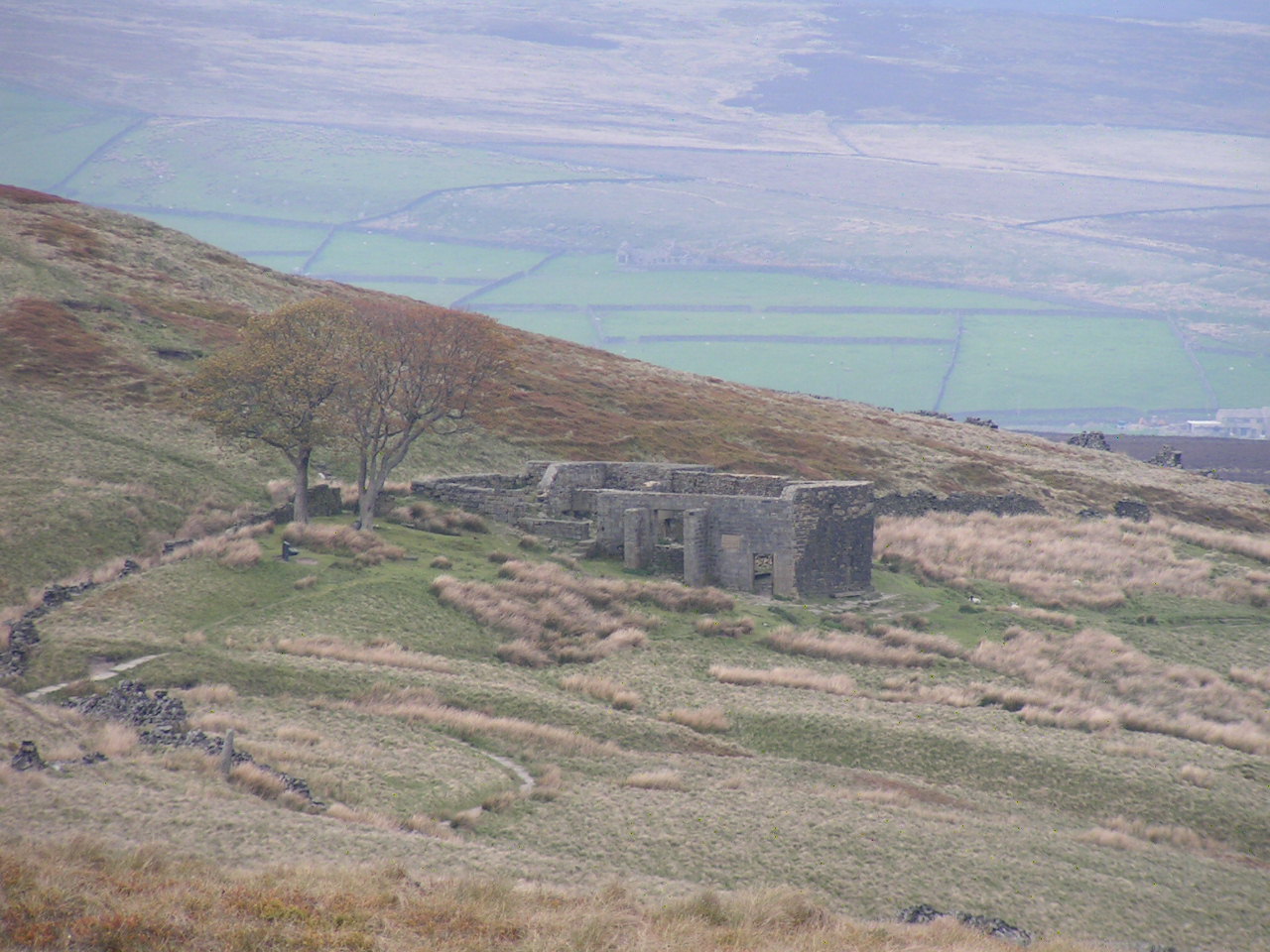
Image context: the cover image shows the exposed moorland associated with Top Withens near Haworth, a landscape often linked to the novel’s atmospheric logic of isolation, wind pressure, and distance from civic mediation.
1) Wind is not background; it is the first governance signal
The book explains its own title in architectural terms. Lockwood notes that “Wuthering” is a local adjective for “atmospheric tumult,” then immediately describes defensive building choices: deeply set windows, jutting stones, wind-bent trees.[1] This is already a political setup. The house is engineered as a weather response, and that weather response shapes behavior inside.
In other words, storm exposure is not decorative Gothic weather. It is a condition of governance. Life at the Heights is organized under pressure: physical, emotional, and social. The outside climate enters as an inside rule.
That is why the opening line’s “A perfect misanthropist’s Heaven” lands as more than character wit.[1] The setting is structurally anti-social. Isolation is built into topography before any revenge plot accelerates.
2) Windows and thresholds: the novel’s control interface
One of the most famous scenes in English fiction is a threshold event: Lockwood at the window, the scratching branch, the voice crying “Let me in—let me in!”[1] It reads like a ghost episode, but as a motif it performs a larger function. Entry is always contested in this book. Doors, windows, gates, and room assignments are never neutral; they are mechanisms of permission, refusal, and surveillance.
Track how often power is exercised through access control:
- who can cross from Wuthering Heights to Thrushcross Grange,
- who is physically confined,
- who reads whose letters,
- who is allowed to speak privately and who is overheard.
Brontë turns architecture into social grammar. Characters do not only argue about love; they fight over the right to cross boundaries.
3) Identity motifs: Catherine’s language collapses self/other boundaries
The novel’s most cited declaration—“Whatever our souls are made of, his and mine are the same” and “I am Heathcliff”—is not romantic ornament.[1] It is an identity claim that destabilizes legal and social categories.
If one person’s self-description absorbs another person as “my own being,” then later conflicts about marriage, class position, and inheritance are no longer only interpersonal disputes. They become collisions between two incompatible identity systems:
- Institutional identity (name, marriage, estate, legitimacy).
- Affective identity (fusion, possession, irreducible attachment).
This motif explains why normal Victorian reconciliation logic fails here. The plot cannot “settle down” through proper pairing because the language of selfhood has already broken institutional boundaries.
4) Names and temporal recursion: memory as a trap, not a cure
The novel’s timeline is famously nested through Lockwood and Nelly Dean, with events relayed across years and households.[2][4] Naming patterns reinforce that recursion: Catherine Earnshaw, Catherine Linton, Catherine Heathcliff; Hareton’s name echoing earlier family inscription at the house front.[1]
Names in Wuthering Heights do not stabilize identity the way legal records hope they will. They generate recursive memory pressure. The same names return, but with shifted class positions and damaged relational context. Readers experience this as disorientation; the novel uses that disorientation deliberately to show how unresolved violence repeats through form.
So the naming motif does double work:
- it preserves continuity across generations,
- while proving continuity alone does not produce moral repair.
5) Property and document control: passion becomes durable only when it is ledger-backed
By the time readers summarize Heathcliff as “revenge,” Brontë has already shown the more technical mechanism: control over tenancy, guardianship, marriage pathways, and estate succession.[1][2] Emotional force survives because it captures legal infrastructure.
This is the key motif-level transition in the novel:
- first phase: intense feeling appears ungovernable,
- second phase: that feeling is routed into property outcomes.
Seen this way, Wuthering Heights is not anti-material; it is acutely material. Love and hatred become historically effective only when translated into ownership arrangements and domestic labor hierarchies.
6) Why this motif map still matters in 2026 reading
Reception history moved from early moral shock to canonical status, but the novel remains difficult precisely because its motifs refuse clean moral accounting.[2][4] Brontë does not offer a stable narrator who can close the case. Instead, she distributes evidence across voices, buildings, weather, and documents.
That is why the book feels modern: it reads like a system where private language, environmental constraint, and institutional mechanism keep feeding each other.
A practical rereading method is simple: do one pass only for scenes of entry/exit and one pass only for property transfer and naming recursions. The plot will look less like melodrama and more like infrastructure.
Sources
- Emily Brontë, Wuthering Heights (Project Gutenberg text)
- Encyclopaedia Britannica, “Wuthering Heights” overview and reception context
- Encyclopaedia Britannica, “Emily Brontë” biography context
- Wikipedia, “Wuthering Heights” (publication and narrative-structure overview)
- Wikipedia, “Top Withens” (moorland location associated with the novel’s setting memory)
- The British Library (Works), “Emily Brontë’s Wuthering Heights”
- Image source (Wikimedia Commons, TopWithens.jpg)