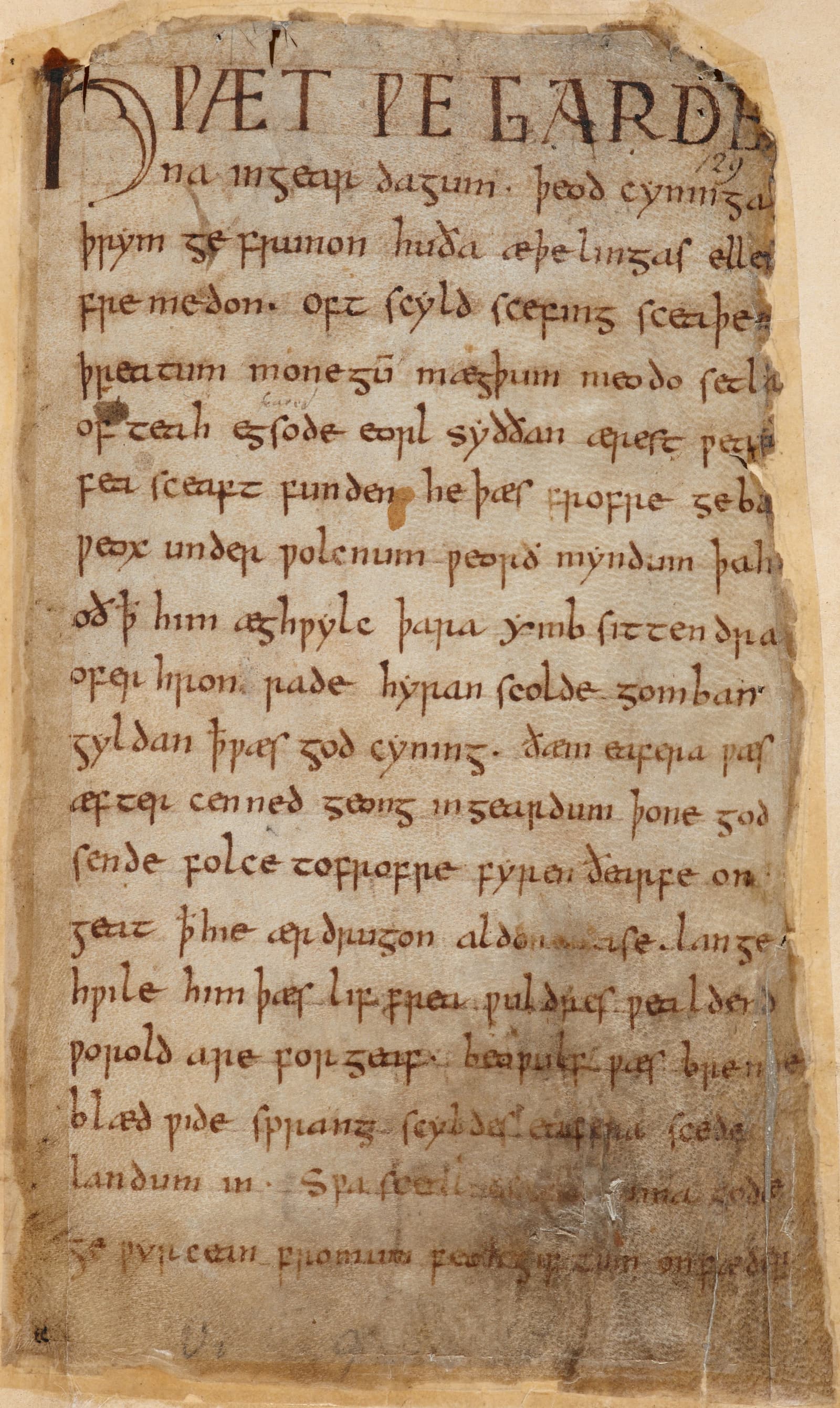
Most debates about Beowulf translation start with monsters, kennings, or meter. A cleaner way in is line 1. Before Scyld, before Grendel, before any blood-debt, the poem gives a single pressure word: Hwæt.
That one word decides the poem’s social temperature. If you render it as “Lo,” you open in ceremonial archive mode. If you render it as “Listen!,” you open in performance mode. If you modernize harder, you can push it toward swagger, challenge, or even ironic distance. In other words, line 1 is not just lexical; it is an audience contract.
Start with the Old English evidence
The University of Texas Old English lesson on the prologue places hwæt at the head of the line and glosses it as “Lo,” while also laying out the rest of the syntax as a collective remembering act: “we … have heard.”[1] The sequence matters:
- a call to attention,
- then communal memory,
- then heroic reputation.
That structure already tells you what kind of poem this is trying to be. It is not a private diary voice. It is a public retelling that asks listeners to join a shared memory field.
Oxford’s line note reinforces this reading: Hwæt is a characteristic Old English poetic opening, likely outside regular meter, functioning as attention-calling discourse rather than normal lexical payload.[2] That means translators who treat it as a pure dictionary item can miss its performative job.
Why “Lo!” and “Listen!” are not equivalent
Compare two influential public-domain renderings:
- J. Lesslie Hall: “Lo! the Spear-Danes’ glory through splendid achievements…”[3]
- Francis B. Gummere: “LO, praise of the prowess of people-kings…”[4]
Both preserve elevated register. Both signal tradition and distance. But they do slightly different things in English ear-space:
- “Lo!” feels biblically antique and textual; it points to a received artifact.
- “Listen!” (as in multiple modern classroom translations) feels oral and immediate; it points to a live performance situation.[5]
Neither is wrong. Each tunes narrator posture differently. “Lo!” makes the speaker sound curator-like; “Listen!” makes the speaker sound situated among bodies in a room.
The hidden variable is social stance, not just literality
The opening triad in Old English—Hwæt / wē…gefrūnon / þrym—does three things at once:[1]
- Secures attention.
- Establishes a collective “we have heard” frame.
- Moves quickly to prestige and martial reputation.
If your English opening underplays (1), the poem loses launch energy. If it underplays (2), the poem can feel like omniscient narration rather than transmitted memory. If it overstates (3), it risks parodying heroics before the narrative earns it.
So the real translator’s problem is a three-way balance: performative force, social collectivity, and tonal credibility for contemporary readers.
Why modern idiom experiments are controversial (and useful)
Recent high-visibility rewrites push this tension into the open. NPR’s review of Maria Dahvana Headley’s version highlights the famous “Bro!” opening move and reads it as importing modern boast-culture energy back into an epic that was always partly about performative masculine status.[6]
Whether one likes that register or not, it proves an important translation-notes point: there is no neutral opening. Every choice front-loads a theory of who is speaking, to whom, and in what social space.
This is where many “fidelity” debates get stuck. They pretend only one axis exists (word-level equivalence), when line 1 forces at least four axes:
- lexical correspondence (hwæt as item),
- discourse function (attention call),
- sociolinguistic register (courtly, oral, colloquial),
- reception strategy (museum distance vs present-tense urgency).
Manuscript reality also matters for translation rhetoric
The British Library’s manuscript note reminds us that the surviving Beowulf codex (Cotton Vitellius A XV) was written around the year 1000 and preserves an older story-world with deep oral and scribal layering.[7] That historical fact should cool simplistic claims that one modern English line can be “the original vibe” without mediation.
Translation here is less like unlocking a sealed chamber and more like managing historical interfaces:
- oral formula → scribal fixation,
- Old English poetics → modern language expectations,
- heroic memory culture → modern literary marketplace.
Line 1 is where those interfaces become audible immediately.
A practical rule for reading and translating line 1
When you compare versions, evaluate the opening in this order:
- Attention force: does the first word actually gather listeners/readers?
- Collective memory frame: does “we have heard” still feel socially active?
- Register fit: does the diction support the poem’s scale without sounding dead on arrival?
- Narrative runway: does the opening give enough momentum into Scyld’s rise?
Under this rubric, “Lo!” versions often win on scale but can lose modern immediacy; “Listen!” versions often win on performative clarity; hyper-modern idiom can recover social aggression but may narrow interpretive range if the slang timestamps too quickly.
The goal is not to crown a single permanent answer. The goal is to make explicit what each answer buys and what it costs.
Why this one word keeps the whole poem alive
Beowulf survives because it tolerates re-voicing without losing structural gravity. Hwæt is the proof-point. A one-word opening has carried archive diction, classroom diction, performance diction, and contemporary slang, yet still performs the same deep task: gathering a community before a story about fame, violence, succession, and memory.
That is exactly why translation notes belong at line 1. If you get the social physics of the first word wrong, every later monster will arrive in the wrong light.
Sources
- University of Texas at Austin, Old English Online: Beowulf Prologue (line-by-line gloss and grammar)
- University of Oxford, Line 1 Hwæt (Old English poetic opening note)
- Project Gutenberg, Beowulf: An Anglo-Saxon Epic Poem (trans. J. Lesslie Hall)
- Project Gutenberg, Beowulf (trans. Francis B. Gummere)
- Rutgers University–Camden, Old English Poetry Project: Beowulf (modern rendering of opening lines)
- NPR, “Bro, This Is Not The 'Beowulf' You Think You Know” (discussion of modern opening register)
- British Library Medieval Manuscripts Blog, “Hwæt! Beowulf online” (manuscript context and dating)
- Image source (Wikimedia Commons, Cotton MS Vitellius A XV f.132r)