Henry James's late novels are often described as difficult because the sentences keep bending around what people cannot yet say openly.[1][2][3] That description is fair, but it can be too abstract. In The Wings of the Dove (1902) and The Golden Bowl (1904), James is doing something sharper. He is asking what knowledge costs once money enters the moral field with full force. One novel turns delay into damage: lovers persuade themselves they can "privately cherish" their attachment and yet "pay no price" for allowing fortune to contaminate it.[1] The other places its whole marriage system under the sign of a polished object with "a crack," then asks how long a rich household can live by acting as if polish were enough.[3]
The pairing matters because these books stand close together in James's late phase and belong to the same Lamb House period. Library of America lists them among his major works, and the National Trust's Lamb House material ties both novels to the Green Parlour writing room in Rye.[4][5] Read together, they make late James easier to see. He is not simply making consciousness dense for its own sake. He is building fiction in which innocence, once money and desire have begun to circulate together, can survive only as a costly arrangement.
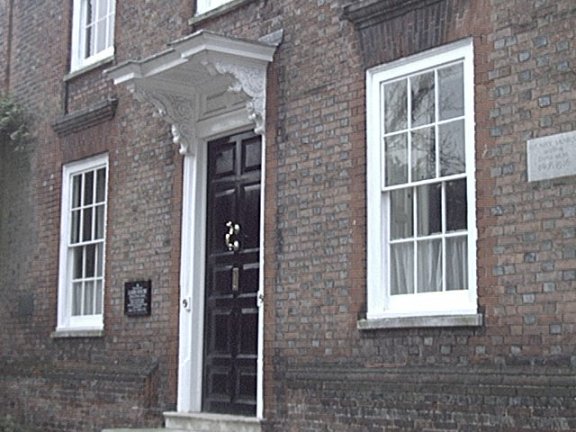
Image context: the cover uses a real photograph of Lamb House in Rye from Wikimedia Commons. That choice fits this essay because Lamb House is not decorative author atmosphere here. It is the documented working site where James wrote these late novels, and the house helps keep the comparison anchored in one concrete period of composition rather than in a vague idea of "late style."[5][6]
1) The Wings of the Dove imagines that love and calculation might share one secret room
The violence of The Wings of the Dove lies in how long it lets Kate Croy and Merton Densher believe that feeling can remain inwardly pure while circumstance does the dirty work outside them.[1][2] Kate knows what she wants: love without poverty, intensity without social collapse, a future that can somehow pass through Milly Theale's wealth without becoming identical with greed. James gives that wish its cruelest short formula when he writes that Kate acts as if she and Densher might preserve their relation and yet, "as regards the rigour of it, pay no price."[1] The line is devastating because it is not the language of villainy. It is the language of simplification.
That is what makes the novel harder than a moral fable about fortune-hunting. Kate and Densher do not begin by hating Milly. Milly's radiance, appetite for experience, and increasing vulnerability make the plot morally unstable from the inside.[1][2] James keeps showing that everyone sees only part of what the arrangement means at any given moment. Kate sees strategy more clearly than Densher. Densher sees the wound more clearly than Kate. Milly, in Venice, comes closest to understanding the emotional weather without ever being granted the whole administrative truth.[2]
The result is that knowledge in The Wings of the Dove always arrives belatedly. It does not enter the novel as a single revelation that cleans things up. It arrives as pressure: suspicions, tact, half-spoken permissions, a will, a bequest, a death, and then the unbearable fact that money has learned too much about feeling.[2] By the end, Milly's inheritance is less a reward than a moral residue. Densher cannot simply spend it into a future with Kate because the money has become the visible form of what their secrecy did. In this novel, innocence is lost not because characters desired too much, but because they tried to keep desire inwardly untouched while letting circumstance carry its price for them.[1][2]
2) The Golden Bowl begins where polish has already learned how to hide the damage
If The Wings of the Dove is organized around delayed recognition, The Golden Bowl is organized around overprotected recognition.[3] The famous object in the antique shop is not subtle about its job. It is beautiful, precious, coated, and damaged. The dealer finally says the bowl has "a crack"; the damage does not abolish the object's value, but it changes what ownership means.[3] James then extends that logic into the whole social architecture of Maggie Verver, Prince Amerigo, Charlotte Stant, and Adam Verver. Everyone is surrounded by wealth, taste, tact, and rooms arranged to prevent vulgar collision. The question is how long these refinements can keep knowledge from becoming visible form.
James makes the moral mechanism even plainer in the Assinghams' talk about Maggie. She "wasn't born to know evil. She must never know it."[3] That sentence is not simply affectionate. It is diagnostic. Maggie's circle treats innocence as something that can be protected by management: by timing, by deference, by not naming what one suspects, by moving relations through the proper rooms in the proper sequence. The whole novel then demonstrates the opposite truth. Once desire, betrayal, and money are embedded in the same household, innocence does not remain safe because nobody speaks crudely. It becomes the thing most expensively staged.
This is why The Golden Bowl feels less tragic in surface tone than The Wings of the Dove and more suffocating in structure.[2][3] Nobody needs to wait for a posthumous bequest to reveal what has happened. The knowledge is already in circulation, only unevenly distributed and carefully managed. Maggie's greatness lies in how she learns to read under those conditions. She does not smash the room with public denunciation. She becomes more exact than the room. She learns that control in James is rarely direct; it is exercised through placement, objects, visits, departures, and the quiet rearrangement of what can be seen together.
3) One novel fears knowing too late; the other fears letting knowledge become common property
That is the clearest comparative distinction between the two books. The Wings of the Dove fears the moment when knowledge arrives after a fatal moral economy has already been set in motion.[1][2] The lovers act first, interpret later, and discover that the interval between those two acts cannot be made innocent again. The Golden Bowl fears the opposite pressure. It imagines a world in which the relevant knowledge exists almost from the start, but is trapped inside elaborate forms of discretion, family tenderness, and expensive taste.[3]
James's late style serves these different ends with remarkable precision. In Wings, the prose keeps moral comprehension suspended so that readers feel how tempting it is to let affection and calculation occupy the same inward chamber.[1][2] In Golden Bowl, the prose becomes a medium for surveillance, arrangement, and the management of exposure. People are always reading each other's tone, place, knowledge, and capacity to bear more knowledge.[3] One novel is pierced by belated conscience; the other is tightened by distributed consciousness.
This is also why the endings diverge. The Wings of the Dove leaves love damaged by the very fortune that was supposed to save it.[2] The Golden Bowl leaves marriage standing, but only after innocence has been converted into a more controlled and knowledgeable form of power.[3] The first novel breaks on what cannot be unsullied after the fact. The second survives by conceding that innocence, once cracked, will not be restored; it can only be reorganized.
4) Why these two late novels still belong together
Read together, the novels show James refusing two sentimental consolations at once. He does not believe that love remains pure merely because it feels sincere in private, and he does not believe that civilization remains harmless merely because it speaks softly and hangs gold over the fracture.[1][2][3] Wealth in these books is never background. It alters the speed at which people know, the forms in which they conceal, and the moral texture of every attempt to spare another person the full truth.
That is why the Lamb House context matters beyond biography. The National Trust's account of the Green Parlour identifies it as the room in which James wrote these major late novels.[5] Seen from that angle, the comparison is almost architectural. James keeps building interiors in which money, tenderness, secrecy, and perception circulate until some small formal defect carries the whole moral pressure: a bequest no one can innocently accept, a bowl no one can honestly call whole.
So the gain of pairing The Wings of the Dove with The Golden Bowl is not simply that both are late and both are difficult. It is that together they reveal James's most durable late question: once love and wealth begin to interpret each other, what can innocence still mean? The Wings of the Dove answers that it may survive in feeling and fail in act. The Golden Bowl answers that it may survive in appearance and harden into management. Put side by side, the two novels make late James look less like a master of vagueness than like an exact accountant of moral knowledge.
Sources
- Henry James, The Wings of the Dove, Vol. I. Project Gutenberg HTML text.
- Henry James, The Wings of the Dove, Vol. II. Project Gutenberg HTML text.
- Henry James, The Golden Bowl. Project Gutenberg HTML text.
- Library of America, "Henry James" writer page, including major works list.
- National Trust, "Explore inside Lamb House" (Green Parlour writing room context for James's major late novels).
- Wikimedia Commons, "File:Lamb House, Rye.jpg" (source page for the lead photograph).