The agricultural fair in Madame Bovary is one of those scenes that readers remember even if they have forgotten the chapter number, because Flaubert solves several problems at once inside it.[1][2] He needs to move Emma closer to Rodolphe, to satirize official rhetoric, to keep the provincial square crowded and material, and to show how desire in this novel never arrives in pure lyrical isolation. So he does something more exact than simple irony. He lets two kinds of speech occupy the same air. At one window, Rodolphe murmurs destiny, passion, and special recognition to Emma. Down below, the councillor and then the president praise agriculture, progress, duty, drainage, prizes, and the state.[1] The scene works because neither layer cancels the other. Each makes the other more revealing.
That is why the episode deserves to be read as more than a famous satirical set piece or a convenient adultery set-up.[1][2] Flaubert's novel was serialized in 1856, then published in book form in 1857 after the obscenity trial that helped fix its public notoriety.[2][3] By then he had spent years refining the controlled, cadenced realism for which the book became famous.[2][4] In the fair scene, that stylistic discipline becomes audible. Flaubert does not merely tell us that public language is pompous and romantic language is dangerous. He cross-cuts them so tightly that each begins to sound like a variation on the other.
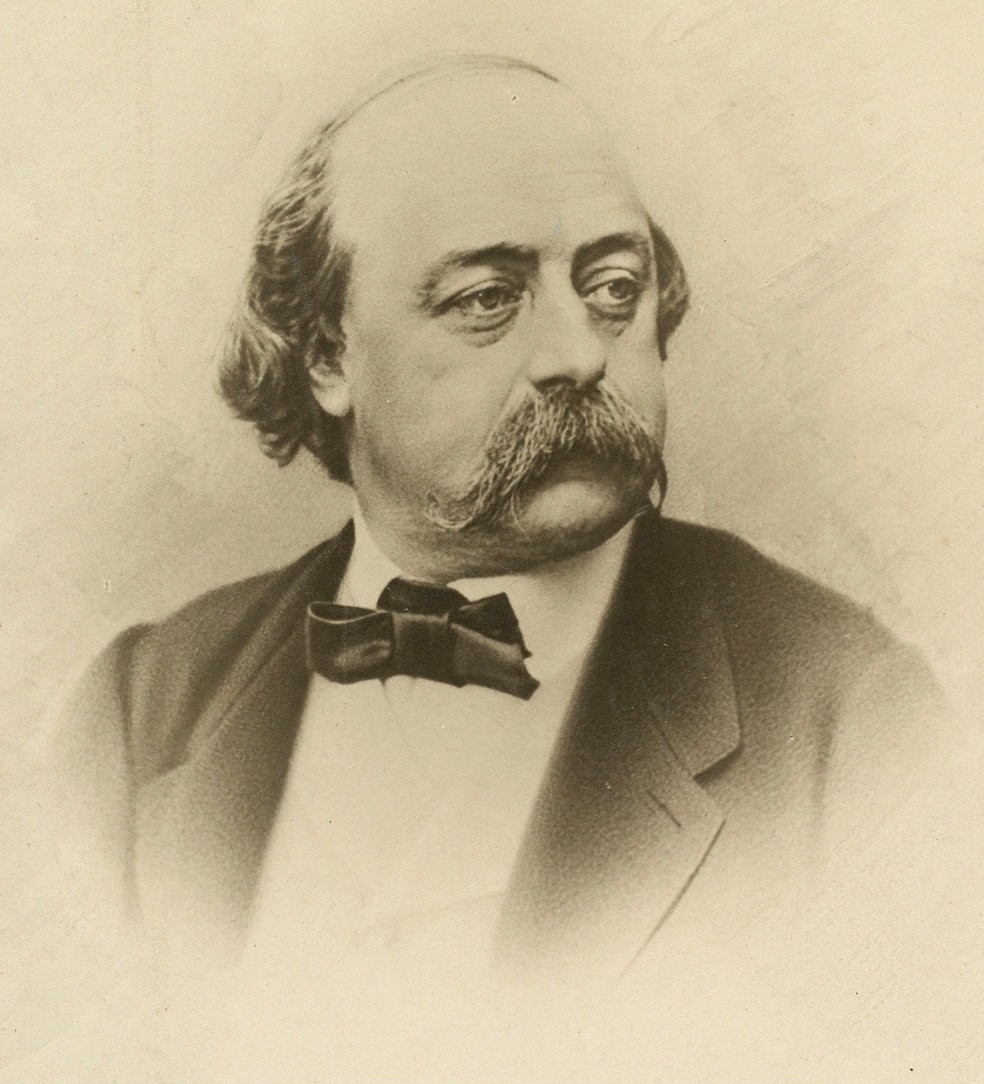
Image context: the cover uses Nadar's archival photograph of Flaubert, preserved via Wikimedia Commons from the Gallica source page.[5] That choice suits this article because the fair sequence is less about one great confession than about arrangement. Flaubert positions speeches, noises, bodies, and prize calls with almost theatrical precision, then lets the reader hear the whole provincial order vibrating behind Emma's thrill.
The window creates a split scene rather than a private refuge
The seduction begins when Rodolphe gets Emma up to the first floor of the town hall and seats them at the window.[1] At first glance this looks like removal. He has found altitude, shade, and a little privacy. Yet Flaubert refuses to let the room become a sealed chamber. The whole point of the scene is that the public ceremony keeps flooding upward. Lieuvain's speech arrives in grand official periods about monarchy, commerce, religion, and social peace; Rodolphe's answers slide in between those sentences, trying to convert the same occasion into private fate.[1]
That spatial arrangement matters. Emma is not being carried away from Yonville's civic life. She is being courted in the middle of it, with the provincial order still fully audible.[1][2] The fair is the condition of possibility for the seduction. Rodolphe can sound singular because the town below is sounding so generic. The more the councillor praises "progress and morality," the easier it is for Rodolphe to present himself as the one man speaking from a deeper register.[1]
But Flaubert is too sharp to let readers take that contrast at face value. Rodolphe's language is less an escape from cliche than a more glamorous deployment of it. He talks about "souls constantly tormented," about happiness arriving suddenly, about two beings who have already "seen each other in dreams."[1] The diction feels elevated because it flatters Emma's hunger for exception. Yet it is still prefabricated language. Rodolphe is not discovering Emma's interior life from the ground up; he is fitting her into a script she has been waiting to overhear.
Rodolphe wins ground by turning abstraction into intimacy
This is the scene's central technical trick. The official orator uses abstraction to celebrate the state; Rodolphe uses abstraction to promise transcendence.[1] The difference is not that one speech is abstract and the other concrete. The difference is only one of emotional temperature. Lieuvain praises "public welfare," "useful objects," and "the practice of duty." Rodolphe denounces "duty, duty!" and counters with "the beautiful," "the passions," and "the eternal."[1] But both men are speaking in large, ready-made nouns. Flaubert lays that parallel bare without forcing it into a thesis statement.
Emma partly hears this and partly does not. When she says one must bow to the opinion of the world "to some extent," she is not yet gone.[1] She still voices the social grammar of restraint. But the scene is built to wear that grammar down. Rodolphe keeps recoding her dissatisfaction as destiny, while the speechifying below turns duty into such inflated public noise that rebellion begins to feel not only tempting but tasteful. The fair supplies the bad music against which Rodolphe can pose as truth.
That is a major reason the episode still feels modern.[1][2][4] Seduction here does not proceed through intimate knowledge alone. It proceeds through rhetorical timing. Rodolphe senses the exact moment when official language has become bloated enough to make emotional counter-language sound pure. He sells Emma a private absolute by borrowing energy from a public ceremony already drunk on self-importance.
Flaubert keeps puncturing the lyric rise with animals, prizes, and fragments
If the chapter were only a duel between civic pomposity and adulterous charm, it would be clever but thin. Flaubert makes it richer by refusing smooth transitions.[1] The speeches break apart in the air. The crowd creaks. An ox bellows. Lambs answer from the street corners. Pieces of agricultural terminology drift up in odd little bursts. Prize calls interrupt declarations of eternal union.[1] One of the scene's great comic cruelties is the way public fragments keep cutting across Rodolphe's romance: "Manures!" "A gold medal!" "For a merino ram!" "Porcine race; prizes equal..."[1]
Those interruptions do more than make the scene funny. They restore material life every time language threatens to become intoxicated with itself. Emma may be floating toward a dream, but the square below remains thick with animals, weather, cloth, sweat, and local administration.[1][2] Even the grand agricultural rhetoric sinks toward comic utility: flour, poultry-yards, eggs, flax.[1] Flaubert lets the noble and the banal share one rhythm until the reader can no longer pretend that romance belongs to a separate sphere.
This is where the novel's realism becomes more interesting than a mere doctrine of detail.[2][4] The point is not simply that "real life interrupts fantasy." The point is that fantasy itself is assembled out of the same social language that governs medals, speeches, and reputations. Rodolphe's supposedly higher speech is surrounded by proof that public life already runs on formulas. He does not escape the fair's script. He parasitizes it.
Catherine Leroux is the hard floor beneath Emma's enchantment
The sequence reaches its harshest brilliance when Flaubert brings in Catherine Leroux just after Emma and Rodolphe's fingers have finally intertwined.[1] A medal is announced for her "fifty-four years of service at the same farm."[1] The timing is devastating. At the very moment Emma is being invited to imagine herself as singular and fate-chosen, the fair produces another female life altogether: one marked not by exception, but by duration, labor, and near-erasure.
That juxtaposition is not a detachable social comment. It is the scene's moral floor.[1][2] Emma's romantic hunger does not unfold in a vacuum; it unfolds in a world organized by service, use, and recognition doled out from above. Catherine Leroux appears as the fair's most compressed image of that order. She is old, obscure, and publicly rewarded only in the thin currency of ceremonial acknowledgment.[1] Her presence keeps the chapter from becoming merely a stylish exposure of seduction. It makes the scene answerable to labor as well as desire.
Read that way, the agricultural fair becomes one of Flaubert's purest demonstrations of how Madame Bovary works.[1][2][3] Emma is not ruined because romance descends from some realm outside society. She is ruined because society has already filled the air with exhausted formulas, and Rodolphe knows how to turn those formulas into a private invitation. The speeches below and the whispers above belong to one acoustic system. That is why the chapter lasts. It does not simply contrast public nonsense with private feeling. It shows public nonsense preparing the ear for private delusion.
Sources
- Gustave Flaubert, Madame Bovary (Project Gutenberg; Part II, Chapter 8 contains the agricultural-fair scene in the Eleanor Marx-Aveling translation).
- Encyclopaedia Britannica, "Madame Bovary" (serialization, trial, realism, and style context).
- Bibliotheque nationale de France catalog record for Madame Bovary (stable bibliographic record for the 1857 publication history).
- Encyclopaedia Britannica, "Gustave Flaubert" (realism, style, and the novel's trial context).
- Wikimedia Commons, "File:Gustave Flaubert.jpg" (Nadar portrait source page used for the lead image).