The easiest way to misread Wide Sargasso Sea is to call it the missing backstory of the madwoman in Jane Eyre and stop there. That description is useful as an address label, but it makes Jean Rhys's achievement sound smaller than it is. Rhys does not simply explain how Charlotte Bronte's Bertha Mason became a problem in Rochester's attic. She asks what kind of violence has already happened when a person can be made legible only as another novel's obstacle.[1][2][4]
Britannica's plot summary gives the hinge cleanly: Rhys's 1966 novel takes its theme and main character from Jane Eyre, gives Antoinette Mason's West Indian life its own narrative space, and then lets the reader recognize the unnamed husband as Rochester.[2] Penguin's current edition page frames the same pressure through betrayal, colonial society, and Antoinette's precarious belonging.[1] Those summaries matter because they show the novel's double contract. It must answer to Jane Eyre, but its deeper work is to show why answering is already dangerous.
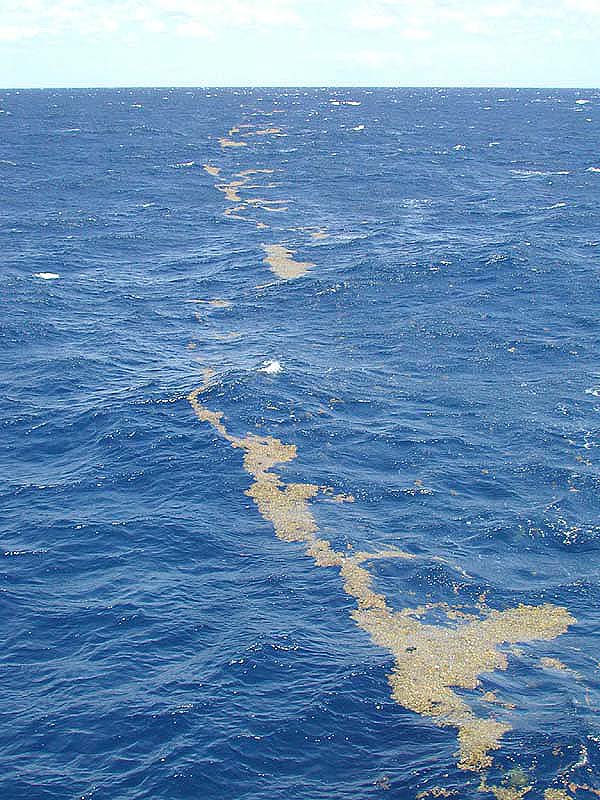
Image context: the cover uses a real photograph of sargassum lines made through NOAA Ocean Explorer and preserved on Wikimedia Commons.[6] It is not a decorative ocean view. The image's long floating bands match the novel's philosophical problem: identity is not a stable island here, but a surface pattern produced by currents, winds, histories, and names that keep moving around the person who is forced to carry them.
The prequel form is a trap Rhys uses against itself
Prequels often promise restoration. They imply that if readers move backward far enough, a later mystery will become whole. Wide Sargasso Sea does something colder. It moves backward and finds not origin but fracture. Antoinette's story begins in a post-emancipation Caribbean world where family inheritance, racial hierarchy, plantation decline, and European fantasy have already made belonging almost impossible.[1][2][5] The first philosophical pressure is therefore not madness. It is misplacement.
That matters because Jane Eyre gives Bertha Mason enormous narrative force while keeping her inner life almost entirely inaccessible. In Bronte's novel, she is the hidden wife whose presence blocks Jane and Rochester's marriage, and whose confinement at Thornfield is gradually exposed as the secret fact behind the house's disturbances.[4] Rhys accepts that plot destination, but she refuses its moral geometry. If Jane Eyre turns Bertha into a locked fact, Wide Sargasso Sea asks what it takes to manufacture such a fact.
So the book is not simply corrective in the polite sense. It does not say: here is the same story, now with background. It says: the background changes what the story was. Once Antoinette has childhood, landscape, fear, desire, inheritance, and a voice divided between self-defense and bewilderment, the attic can no longer remain a Gothic convenience. It becomes the end point of a long process by which colonial and marital systems narrow a person until a name like "Bertha" can replace her.
Naming is possession before it is description
Rhys makes naming the novel's most intimate form of power. The issue is not only that Antoinette becomes associated with Bertha, the name under which Jane Eyre remembers Rochester's wife.[2][4] It is that naming in the novel repeatedly behaves like a seizure of interpretive rights. To name someone is to decide which history will count, which version will travel, and which inconvenient remainder can be treated as illness, excess, or superstition.
This is why the unnamed husband matters. Rhys does not need to print "Rochester" on him from the start. The reader's recognition arrives through literary memory, not through an official label.[2] That delay reverses the old hierarchy. In Jane Eyre, Bertha is the obscure presence to be identified and contained; in Rhys, the English husband becomes the one whose name is withheld, while his habits of classification become painfully visible. The result is not a simple role reversal. It is a study of how names work when backed by money, gender, law, and empire.
Antoinette's instability is therefore not detachable from the world that names her. A weaker novel would turn identity into a private psychological riddle. Rhys keeps making it social. Antoinette is too Caribbean for English security, too white and inheriting for uncomplicated local belonging, too vulnerable within marriage to control her own public meaning.[1][3][5] She is not "between" worlds in the romantic sense of having two homes. She is between systems that each know how to reject her.
Belonging is not a feeling if the institutions refuse it
The book's hardest idea is that belonging cannot be secured by intensity of feeling alone. Antoinette can know a landscape sensuously, fearfully, and lovingly, but that knowledge does not guarantee a political or social place inside it. The husband's Englishness does not give him true understanding either, but it does give him instruments: property assumptions, marital authority, racial presumption, and the right to translate confusion into judgment.[1][2][5]
This is where Rhys's own biography becomes relevant without becoming a key that unlocks everything. Britannica notes that Rhys was born in Roseau, Dominica, lived and was educated there before going to London at sixteen, and later returned to literary prominence after decades of silence with Wide Sargasso Sea.[3] The novel should not be flattened into autobiography, but Rhys knew from inside her career that displacement was not an abstract theme. Her fiction repeatedly studies women whose social location is fragile, contingent, and easily misread.[3][5]
The Caribbean setting is therefore not atmosphere pasted behind a familiar Victorian plot. It is the philosophical ground of the novel. The West Indies sections force the reader to encounter a world shaped by slavery's aftermath, plantation ruin, racialized resentment, and the uneasy position of white Creole identity.[1][2][5] The point is not to ask whether Antoinette deserves perfect innocence. Rhys is more severe than that. She asks what kinds of guilt, fear, and vulnerability are produced by a colonial order that leaves everyone speaking from damaged arrangements.
Enclosure begins before the attic
Because Jane Eyre makes the attic so memorable, readers can treat confinement as the final shocking condition. Rhys shows that enclosure starts earlier and in less theatrical forms. It starts when a place becomes unreadable to the person who claims authority over it. It starts when marriage turns a woman's history into her husband's problem to solve. It starts when rumors, documents, money transfers, and diagnoses begin to speak louder than the person described by them.[1][2][4]
That is why the movement toward England is not a rescue from Caribbean instability. It is a change in the architecture of containment. Thornfield's attic is physically narrower, but the logic that makes it possible has already been rehearsed through naming, distrust, and legal possession.[2][4] Rhys's novel makes the Gothic room answerable to colonial and domestic procedure. The locked door is the last image of a system that has been closing for a long time.
Read this way, Wide Sargasso Sea becomes a philosophical argument about legibility. Who gets to be understood as complex? Who gets reduced to symptom? Who is allowed to narrate disorder, and who is only allowed to embody it? Bronte's Jane Eyre remains a great novel partly because Jane's first-person voice insists so fiercely on moral agency.[4] Rhys's intervention is to ask what happens to the woman whose agency that earlier plot cannot afford to hear.
The book's afterlife depends on its refusal to settle
The novel's continuing force comes from its refusal to become a neat supplement. It does not let readers exit with the comfort that Bertha has been explained and the older novel repaired. Explanation itself is part of the problem. Once Antoinette has been fully explained by husband, household, legal status, and later literary memory, she has also been trapped. Rhys's form keeps resisting that trap by letting voice, place, and identity remain unsettled.
That unsettledness is why the novel still matters beyond its relation to Jane Eyre. It belongs to postcolonial and feminist reading histories, but it is not only a position statement.[1][2][5] It is a short, concentrated book about the price of being forced into another person's system of meaning. The prequel form promises that the past will clarify the future. Rhys uses it to show the opposite: once the past is finally heard, the future we thought we knew becomes morally unstable.
That is the enduring ache of Wide Sargasso Sea. It gives Antoinette enough voice to make her confinement intolerable, but not enough power to prevent it. It lets the reader see how a name becomes a room, how a marriage becomes a jurisdiction, and how a famous story can carry a silence so large that another novel has to be written inside it.
Sources
- Penguin Books, Wide Sargasso Sea by Jean Rhys (edition page describing the novel's Caribbean setting, betrayal plot, and postcolonial significance).
- Encyclopaedia Britannica, "Wide Sargasso Sea" (work overview, publication year, relation to Jane Eyre, and narrative structure).
- Encyclopaedia Britannica, "Jean Rhys" (biographical overview, Dominica background, career silence, and 1966 return with Wide Sargasso Sea).
- Charlotte Bronte, Jane Eyre (Project Gutenberg HTML text, used for the source novel's Thornfield and Bertha Mason frame).
- Encyclopedia.com, "Wide Sargasso Sea" (publication context, Rhys career background, and post-emancipation setting summary).
- Wikimedia Commons, "File:Lines of sargassum Sargasso Sea.jpg" (NOAA Ocean Explorer photograph used as the article image).