Christina Rossetti is too often softened by the surfaces that make her memorable: song forms, flowers, deathbed address, devotional patience, nursery-rhyme clarity. Those surfaces are real, but they are not mild. Her poems repeatedly place a speaker at a threshold, then make that threshold almost unbearable: remembered or forgotten, married or withheld, alive or dead, childlike or theologically severe, desiring or renouncing. The pressure comes from how little the poem needs to say before the whole room changes.
That is why Rossetti remains stranger and sharper than the usual Victorian lyric label suggests. Britannica's account places her inside a Pre-Raphaelite family circle, a High Anglican religious life, and a publishing career that runs from The Germ through the major 1862 volume and later devotional works.[2] The Victorian Web bibliography shows the range of that career: poems, prose, children's verse, devotional books, and posthumous editions rather than one detachable anthology image.[3] Read across that range, Rossetti's defining gift is not fragility. It is compression. She can put the drama of a life into a turn of syntax, a seasonal image, or a single refusal to dramatize refusal.
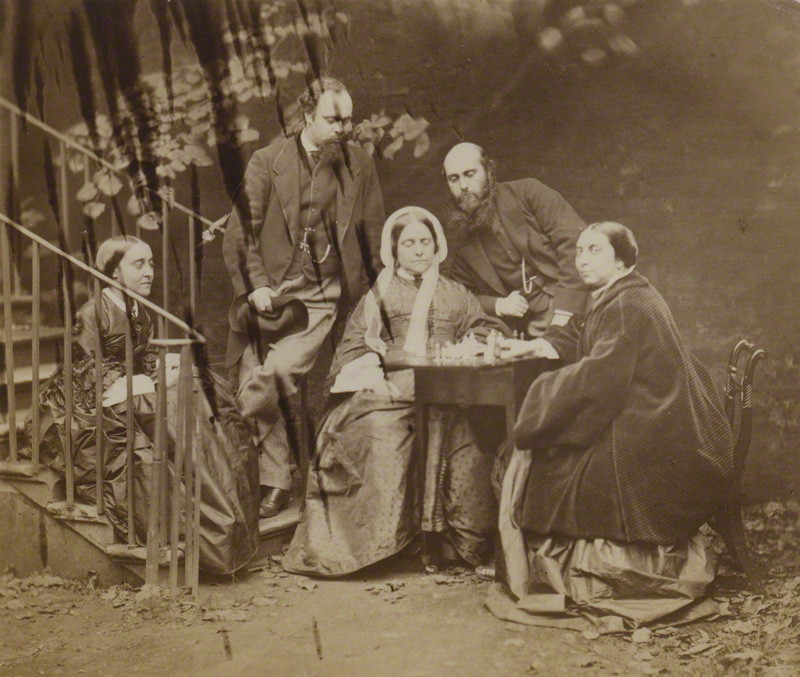
Image context: the lead image is not a generic author portrait. It is Lewis Carroll's 1863 albumen photograph of the Rossetti family, taken at 16 Cheyne Walk, with Christina Rossetti at the left side of the frame.[5] The photograph matters because Rossetti's poems often work by placement. A figure stands near the edge of a scene, apparently quiet, while the arrangement around her becomes legible as pressure.
The lyric that refuses to over-explain
Rossetti's short lyrics are built on radical economy. "Remember" begins with a direct imperative, then slowly withdraws from the claim that memory must be owed.[1] The opening phrase, "Remember me," sounds simple enough to be engraved, but the poem's movement is more unsettled. It starts from a desire to remain in another person's mind and ends by imagining a kinder future in which forgetting may be better than sorrow. The poem does not cancel love; it changes love's demand.
That turn is typical. Rossetti often makes renunciation feel less like absence than like a higher form of attention. The speaker who asks not to be overmourned, the speaker who imagines being unseen after death, the speaker who lets a desire pass without theatrical self-display: all of them inhabit a style where pressure increases as explanation decreases. Even "Song," with its famous death-facing poise, depends on restraint. The phrase "no more" carries both release and deprivation.[1] It is a small hinge that can open toward peace or toward loss depending on how the reader hears the line.
The result is not evasiveness. It is a discipline of emotional proportion. Rossetti does not need to argue that grief, memory, and desire are unstable. She lets a lyric situation make them unstable in the reader's mouth. A command becomes a permission. A farewell becomes a test of love's generosity. A grave becomes a place where speech continues to negotiate with silence.
Refusal as active form
Rossetti's refusals are sometimes misread as passive piety. The poems are more exact than that. They understand refusal as an action performed under pressure. In "No, Thank You, John," the speaker's rejection has comic brightness, but the deeper achievement is formal control.[1] She refuses to become the emotional property of another person's persistence. The poem's social surface is light; its ethical structure is firm.
This matters because Rossetti's era offered many scripts for female responsiveness: patience, availability, moral influence, sacred resignation. Rossetti can use those scripts while making them harder. A speaker may sound gentle and still set a boundary. A devotional poem may sound submissive and still arrange a demanding interior drama. Anthony H. Harrison's account of Rossetti's devotional and Pre-Raphaelite inheritance is useful here because it shows how her religious poetics and aesthetic poetics reinforce one another rather than occupying separate shelves.[4] Beauty, renunciation, typology, seasonal recurrence, and sacramental feeling all become ways of making visible life answer to invisible pressure.
In that context, refusal is not merely a biographical attitude. It is a craft principle. Rossetti withholds narrative excess, sentimental explanation, and too-easy consolation. She often places the reader before a beautifully clear lyric object, then denies the relief of reducing it to one mood. The poem seems small until its refusal to expand becomes the source of force.
Nursery-rhyme clarity with adult weather inside it
Rossetti's children's verse shows the same intelligence from another angle. The lines can be transparent enough for repetition, but transparency does not mean thinness. "Who has seen the wind?" is a child's question that also behaves like a theological and phenomenological problem: how do invisible forces become known through visible effects?[1] The answer is not a lecture. It is movement through leaves, trees, and perception. The poem teaches attention before it teaches doctrine.
That is one reason her nursery-rhyme mode does not feel like a retreat from seriousness. It condenses seriousness into pattern. Rhyme, repetition, and balanced syntax become instruments for training the ear to notice change. A child can receive the poem as sound and scene; an adult can hear its larger logic. Rossetti's gift is to keep both readings alive without turning the poem into a puzzle box.
This same double register appears in the poems that sound like songs for ordinary occasions but keep carrying metaphysical weather. "A Birthday" begins in joy, with "a full heart," yet the images are almost liturgical in their layering of birds, fruit, carved work, and ceremonial preparation.[1] The poem's happiness does not sprawl. It builds an interior chapel for itself. Rossetti's best celebratory poems are therefore as controlled as her elegies. Joy is not looseness; joy is arrangement.
Devotion without decorative haze
Rossetti's devotional poems can look, from a distance, like a settled religious world. Up close, they are full of crossings. Roads wind upward. Time becomes a corridor. The speaker asks whether shelter, food, rest, judgment, and reunion will arrive. In "Up-Hill," the question "Does the road wind up-hill all the way?" turns pilgrimage into dialogue rather than proclamation.[1] The poem's theology is clear enough, but its force comes from how the questions keep mattering. Faith is staged as a cadence of asking and answering.
Harrison's reading of Rossetti's devotionalist ideology helps explain why these poems resist soft devotional blur.[4] Her religious imagination is material: seasons, bodies, thresholds, meals, lamps, roads, doors, and bridal imagery carry doctrinal weight. The visible world does not decorate the invisible one. It bears pressure from it. That is also why her devotional poems can sit beside the more openly erotic or renunciatory poems without contradiction. They share a grammar of desire under discipline.
Rossetti's art is strongest when the reader feels that discipline as music rather than doctrine alone. Her poems can be severe, but they are rarely merely stern. They know the sweetness of sound, the pull of color, the ache of wanting to be remembered, the comedy of unwanted courtship, the fear of spiritual inadequacy, and the tenderness of release. The severity matters because the sweetness is so real.
Why Rossetti still feels near
Rossetti remains near because she understands emotional life as a sequence of thresholds rather than a flood of confession. Much modern reading rewards disclosure, expansion, and psychological explanation. Rossetti often moves in the opposite direction. She trims the scene until one small act of speech has to carry everything: remember, forget, wait, refuse, ask, answer, sing.
That economy can make her seem modest until the after-sound arrives. A Rossetti poem often leaves the reader holding two truths at once. Love may ask to be remembered and then release the beloved from remembering. Renunciation may look like yielding and still contain decision. Childlike meter may carry adult metaphysics. Devotion may sound serene while remaining full of questions. Death may quiet the body without ending address.
The work-centered profile, then, should begin with craft rather than legend. Rossetti's life matters: the family, the Anglican commitments, the Pre-Raphaelite circle, the publishing history, the late devotional labor.[2][3][4] But the poems survive because they turn those contexts into durable verbal pressure. Her art does not ask to be admired for delicacy. It asks to be reread for the exact moment when delicacy becomes force.
Sources
- Christina G. Rossetti, Poems, Project Gutenberg HTML text.
- Encyclopaedia Britannica, "Christina Rossetti" biography.
- Victorian Web, "Works by Christina Rossetti" bibliography.
- Anthony H. Harrison, "Pre-Raphaelite Aestheticism and Pre-Raphaelite Sacramentalism in the Poetry of Christina Rossetti," Victorian Web.
- Wikimedia Commons, "File:Mw128425.jpg" source page for Lewis Carroll's 1863 albumen photograph of the Rossetti family.