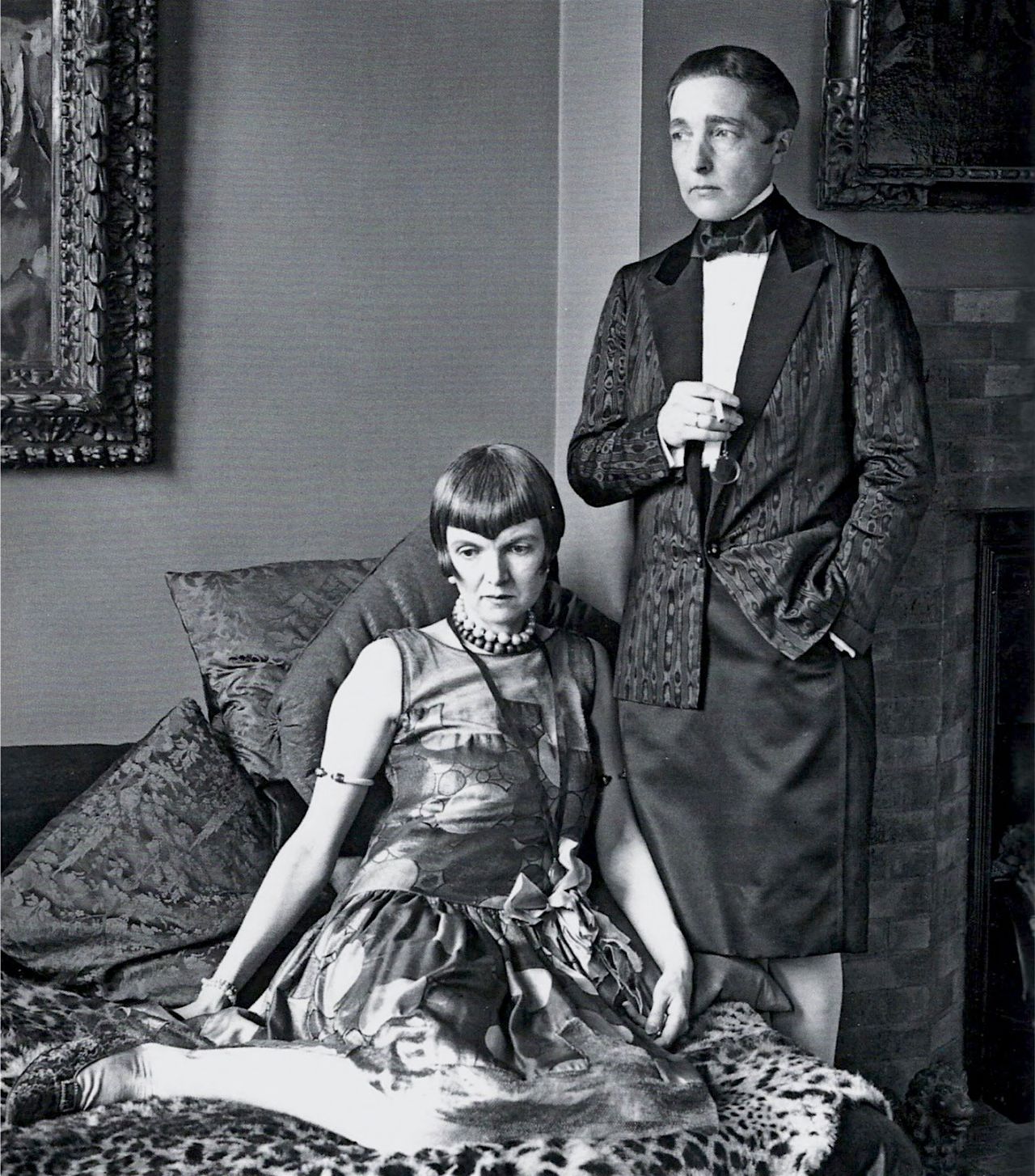
The strangest thing about the British ban on The Well of Loneliness is not that it failed to erase the book. Censors often make contraband more desirable. The stranger result is that the prosecution helped turn Radclyffe Hall's novel into the kind of public evidence it already wanted to be: evidence that women could love women, build households, suffer social exclusion, and recognize themselves as a group with a claim on ordinary life.
Published in 1928, the novel follows Stephen Gordon from a landed English childhood through wartime ambulance service and a relationship with Mary Llewellyn. It ends not in privacy but in an appeal addressed to God and the world: “Give us also the right to our existence!”[1] That sentence has always been larger than the plot. It also explains why the book's reception cannot be reduced to a victory over censorship. Hall made visibility sound like deliverance, but she bound it to medical classification, loneliness, sacrifice, and a heroine who gives up love so that someone else may have a socially easier life.
The book has therefore survived in two incompatible ways. It has been a shelter for readers who had never before encountered an unambiguous, sympathetic lesbian protagonist.[2][4] It has also felt like an enclosure: a story in which queer recognition arrives through diagnosis and queer love through suffering. The current international “100 Years of The Well of Loneliness” research project describes precisely that divided inheritance—affirmation beside alienation, canonical status beside continuing argument.[4] Its research frame also includes trans and non-binary readers, a reminder that Stephen's masculine self-description and the novel's afterlife do not fit inside one uncontested modern label.[4] The ban did not settle what the novel meant. It ensured that meaning would be fought over in public.
A public case disguised as a family novel
Hall did not hide Stephen inside an experimental puzzle. She used the broad, familiar machinery of a family chronicle and a Bildungsroman: country house, disappointed parents, childhood attachments, horses, inheritance, war service, vocation, exile, and love. As a child, Stephen dresses as the boy in a painting and insists, “I must be a boy, ’cause I feel exactly like one.”[1] Later, searching her dead father's library, she finds Krafft-Ebing's sexological writing with her own name recorded in his notes. A private feeling becomes a printed category.
That library scene is the novel's hinge. Stephen does not discover desire for the first time; she discovers that desire has already been observed, named, and filed. The book offers relief because the category proves she is not singular. It also introduces a lifelong problem: recognition reaches her through somebody else's diagnostic vocabulary.
Havelock Ellis's commentary at the front of the novel makes the bargain explicit. He calls the book a work of “notable psychological and sociological significance” and presents its subject as an inborn variation rather than a vice.[1] In 1928, that claim could oppose the censor's moral accusation. Yet the same language turns a life into a case. The term invert gives Stephen a community and a defense, but it also carries the authority of doctors, typologies, and a sharp division between normal and abnormal.[1][2]
This is why the novel's old-fashioned shape matters. Hannah Roche argues that Hall's appropriation of a familiar, conventionally heterosexual genre was not merely a failure to keep pace with modernism. By placing lesbian life inside an “ordinary” novel form, Hall asserted that it belonged in the central house of fiction, not in a coded subplot or aesthetic curiosity.[3] The prose invites recognition by making Stephen's world legible. That directness was the source of both its popular force and its legal vulnerability.
The censor supplied the publicity
The prosecution did not uncover explicit sexual description. Hall's love scenes are restrained; one consummation ends with the decorous sentence that Stephen and Mary “were not divided.”[1] What alarmed the campaign against the book was its refusal to condemn the relationship. Stephen is neither comic monster nor cautionary footnote. The narrative asks readers to consider her honorable, serious, wounded, and entitled to sympathy.[2]
James Douglas of the Sunday Express led the press attack, framing the novel as a danger to children, Christianity, and the exhausted moral order of postwar Britain. Within months, it faced an obscenity proceeding. Sympathetic writers and experts—including Virginia and Leonard Woolf, Vita Sackville-West, and Ellis—were approached as possible witnesses, though many disliked Hall's art even while opposing suppression. Magistrate Sir Chartres Biron declined to hear that literary defense, ruled the book obscene under the Hicklin standard, and the decision survived appeal.[2]
The campaign had already driven Jonathan Cape to stop British publication and privately lease the rights to the Paris-based Pegasus Press before the trial. Biron's ruling made suppression official, but it could not prevent the book's circulation abroad. In the United States, Covici-Friede published the novel and successfully resisted a similar obscenity case. The Harry Ransom Center's teaching archive preserves the paper route: a Pegasus announcement, legal briefs from New York, a Louisiana lawyer's report that he had prevented suppression there, and Hall's own correspondence about the British trial.[2]
Suppression thus produced circulation of another kind. The book moved through foreign printers, courtrooms, newspaper columns, private orders, and reader letters. A censor trying to classify one novel as corrupting helped establish that the novel described a recognizable constituency. The trial made lesbianism newly speakable in the hostile vocabulary of obscenity; readers answered by treating the book as testimony.
Modernists and private readers found different books
The most revealing split in the early reception was not simply conservative versus liberal. It ran between literary prestige and reader use. The Woolfs could defend publication while privately judging the novel lumbering and polemical. Hall's conventional narration looked especially plain beside Orlando, published in the same year with fantasy, biography, and gender metamorphosis in play.[2][3]
Private readers did not require the book to win that contest. Many wrote to Hall because Stephen's life felt familiar and because the novel asked for sympathy without disguise.[2] Their standard of value was not novelty of form. It was the shock of finding an experience treated at full narrative scale. What looked aesthetically belated to one audience could feel socially unprecedented to another.
That difference helps explain why arguments over the prose have never been merely technical. Calling the book a bad modernist novel misses the use Hall made of recognition: the family estate, the war record, the serious vocation, and the love plot transfer the authority of respectable fiction to a life that respectability excluded. But calling it only a brave landmark also misses the cost of that transfer. Stephen must be noble almost without respite. Her difference is authenticated by suffering, and the narrative turns her into an advocate for a whole category of people.
The familiar form is therefore neither accidental packaging nor a complete political solution. It is the instrument by which the novel enters the culture that rejects its heroine. Hall does not smash the house of the ordinary novel. She insists that Stephen has always had a room in it.
The ending gives visibility the shape of sacrifice
The final movement remains the hardest part of the book's legacy. Stephen persuades herself that Mary would be happier with Martin Hallam and engineers their separation. Alone, she imagines a multitude of persecuted people pressing through her consciousness and demanding speech. The private love story expands into a collective plea, culminating in that demand for “the right to our existence.”[1]
The scene is rhetorically powerful because it changes grammatical number. Stephen's I becomes us. The lonely individual discovers a public, and the novel turns from romance into petition. Readers who lacked a visible community could experience that collective voice as recognition.
But the petition is purchased with the couple's future. Stephen becomes most representative when she is most alone. The plot cannot imagine public belonging and sustained romantic happiness at the same time; it makes sacrifice the proof of seriousness. That structure is one reason later readers can honor the book's historical work and still resist the emotional script it offers. A community should not have to keep reenacting misery in order to prove that earlier misery was real.
The international centenary project now gathering the novel's reception history treats that discomfort as evidence rather than noise. Its description acknowledges a book called a “Lesbian Bible” that has also offended and divided its readers.[4] Such disagreement is not a failure of recovery. It is the mature form of reception: readers can inherit the visibility without accepting every term on which Hall secured it.
The archive is the book's unwritten sequel
The physical afterlife makes the paradox visible. The Harry Ransom Center holds handwritten chapters, notebooks on Paris and sexual inversion, multiple typescript copies, court-case materials from 1928–1934, a suppression scrapbook, publishing contracts, and a 96-page account titled Scotland Yard and The Well of Loneliness.[5] A copy sent in 1946 to the Home Secretary carries Hall's handwritten list of people who opposed suppression; the accompanying correspondence warned that republication might invite fresh proceedings.[5]
Those objects show that the reception was never outside the work. Draft, diagnosis, publisher, censor, advocate, and reader became parts of one material history. Even the ban survived because somebody clipped it, annotated it, filed it, and kept the contested book beside the documents intended to destroy its reach.
That is the fullest meaning of the title's “well.” It names isolation, but a well is also a place to which people return and from which they draw. The Well of Loneliness no longer has to be either sacred text or embarrassing ancestor. It can be read as a novel that made a politically consequential bargain with its moment: familiar form for radical visibility, medical certainty for moral defense, martyrdom for collective voice.
The ban failed, but not because the book slipped untouched past power. It survived by carrying the marks of that power into its identity. Court files made it public, letters made it intimate, archives made it durable, and divided readers kept it alive. Nearly a century later, the right to existence no longer belongs to the censor to grant. The harder right is the reader's: to recognize what this book opened without pretending that the doorway was wide enough.
Sources
- Radclyffe Hall, The Well of Loneliness (1928), with Havelock Ellis's commentary, Project Gutenberg ebook 73042 — primary text used for scene references and short quotations.
- Harry Ransom Center, “Indecent Behavior: Sexuality, Gender, and Transgression” — archival teaching guide to the British and American obscenity cases, the Pegasus Press edition, expert witnesses, sexology, and early reader response.
- Hannah Roche, “An ‘ordinary novel’: genre trouble in Radclyffe Hall's The Well of Loneliness,” Textual Practice 32, no. 1 (2018) — accepted-manuscript record and argument about familiar genre, modernism, and lesbian literary legitimacy.
- University of Exeter, “International project launched to recover the hidden history of once-banned LGBTQ+ novel The Well of Loneliness” (April 11, 2025) — overview of the novel's affirming, alienating, and contested reception ahead of its centenary.
- Harry Ransom Center, “Radclyffe Hall and Una Vincenzo, Lady Troubridge: An Inventory of Their Papers” — notebooks, typescripts, court records, suppression scrapbook, 1946 Home Office correspondence, and Hall's list of opponents of the ban.
- Harry Ransom Center Digital Collections, “Radclyffe Hall and Una Vincenzo, Lady Troubridge” — source page for the Fox Photos archival photograph dated August 1, 1927, used as the article image.