When Septimus Harding finally stands up to his lawyer, his hands are playing an instrument that is not there. One arm sweeps across his body; the fingers of the other race along invisible strings. Sir Abraham Haphazard watches in astonishment. The small, hesitant clergyman has become emphatic without becoming anyone else.[1]
This is the peculiar pleasure of Harding in Anthony Trollope's The Warden: courage arrives through a habit that previously made him look helpless. His imaginary cello accompanies both his difficulty speaking and his eventual refusal to be talked out of what he believes. The character grows firmer while remaining recognizably awkward.
Published in 1855, the novel centers on a charitable almshouse whose comfortable warden receives far more from its endowment than the elderly men it supports.[4] Harding must decide whether he can continue taking that income. The question becomes harder when the lawsuit against the arrangement disappears. His defenders think the danger has passed. He discovers that the person still demanding an answer is himself.
This essay discusses the ending.
A kindness that leaves the accounts alone
In chapter I, Harding receives £800 a year from the wardenship, together with a pleasant house. His separate position as the cathedral's precentor, responsible for its music, brings him £80. The contrast establishes how much of his comfort rests on the charity. He has also voluntarily added twopence a day to each resident's allowance, despite his son-in-law Archdeacon Grantly's objections.[1]
The gift matters. Harding is neither secretly cruel nor merely acting generous for an audience. But Trollope carefully distinguishes the additional payment from an entitlement: Harding promises it for his own tenure and cannot bind his successors. The men benefit from a good man's presence while their claim on the institution remains unsettled.
That distinction gives his benevolence an uncomfortable edge. Personal generosity has made an arrangement feel tolerable without answering whether it is fair. When the reformer John Bold raises the accounts in chapter III, Harding directs him to the steward and tries to change the subject to whether Mary Jones will regain the use of her limb.[1] The turn is revealing: he knows how to care about a particular sufferer, and he would rather do that than inspect the system paying his salary.
Yet he does not treat disagreement as betrayal. Once Bold explains his intentions, Harding accepts his right to investigate honestly. Affection and opposition can coexist. This early courtesy contains the capacity he will later need against his own friends: he can distinguish a person's motives from the convenience of their conclusions.
The tune nobody else can hear
Harding's music is an accomplishment before it becomes a nervous gesture. In chapter III, he plays his actual cello in the garden with the old men gathered around him. When Bold draws him away for their uncomfortable conversation, Harding still holds the bow and begins playing an imaginary instrument.[1]
The movement carries something of the interrupted scene into the argument. At the cello, he has fluency and an audience with whom he can share it. Faced with a challenge to his income, he loses verbal ease. His hands continue doing what they know.
My reading is that this habit gives Trollope a way to show distress without letting distress exhaust the character. Harding can look absurd and still possess an inward life that his more forceful companions fail to understand. His gestures invite a smile; they also ask us to attend to someone whose meaning exceeds his social performance.
That becomes decisive in chapter XVII. In Haphazard's chambers, the imaginary playing starts slowly. By the end of the interview, it has expanded into vigorous sweeps. Nothing audible fills the room. The narrator supplies the musical energy that the lawyer cannot interpret. What has changed is Harding's willingness to let his conviction occupy space.[1]
The answer his lawyer cannot give
Haphazard's good news is that Bold's attorneys have withdrawn the suit. Costs will be manageable; further trouble seems unnecessary. For the lawyer, the collapse of the opposing case supplies an adequate ending.[1]
Harding asks a different question: is he actually entitled to the money? Haphazard does not unequivocally say yes. He advises against reopening an issue that no longer threatens his client. The scene therefore offers no court judgment establishing Harding's right. It gives him the practical security of an abandoned challenge.
When Haphazard insists that there is no further question to raise, Harding answers, “I can resign.”[1] The brevity changes the conversation. He has found an action available to him even if his lawyer considers the matter closed. A man accustomed to accepting other people's management of his affairs discovers a decision they cannot make for him.
Trollope keeps this moment from becoming a flawless moral performance. Harding is deeply wounded by the newspaper The Jupiter. He wants relief from shame and sleeplessness. His independence emerges through those injuries rather than above them. Crucially, he admits that the paper's attacks have awakened doubts he should have examined earlier.[1]
The phrase “I question it myself” answers Haphazard's assurance that nobody now disputes the income.[1] The lawyer counts external opponents; Harding includes himself among the witnesses. Public criticism has become a private obligation that withdrawing a legal action cannot cancel.
He also has support. His daughter Eleanor agrees with him, and he retains other clerical work. Resignation means a severe reduction in comfort, not the literal destitution he imagines in argument. His courage is costly enough without our making its cost larger than Trollope does.
Leaving is not the same as putting things right
Harding's departure brings him relief. In chapter XXI, he walks to his modest new lodgings with an “elastic step.” But the narrative then returns to the hospital. The bishop appoints no successor; vacancies among the residents go unfilled; the remaining men quarrel. The steward maintains the building and banks the rents, while the grounds and the community deteriorate.[1]
Harding continues visiting. He has not stopped caring about the men, yet occasional kindness cannot replace a neighbor's daily presence. Nor has relinquishing his own income established a better distribution of the charity's money. The men lose his personal supplement along with the household life he sustained.
There is a limit inside his decision, too. In chapter XIX, his resignation letter explicitly leaves room for another person to accept the position without condemnation.[1] Harding can say what he will no longer do. He cannot offer the institution a settled rule for what should happen next.
The narrator's affection for the old household makes this aftermath pointedly skeptical of reform. We need not accept that skepticism as a universal verdict. The ending supports a narrower, more uncomfortable recognition: removing one's own participation in an injustice and repairing its arrangements require different kinds of work.
Trollope's retrospective account helps explain the divided sympathy. In chapter V of An Autobiography, he says he wanted to expose both the diversion of charitable funds into clerical incomes and the excessive cruelty of attacks on their recipients. He judged that double advocacy unsuccessful, while finding lasting merit in the characters he had drawn.[2] The Trollope Society's account of his early career records a similarly modest initial reception: the publisher's reader anticipated strong sales, but the book achieved only moderate success.[3]
Harding survives that uncertainty because the novel lets gentleness acquire a backbone without pretending it supplies every answer. By the close, his real cello has moved to Eleanor's house. He still has music, companionship, and useful work.[1] His life has found a smaller, happier shape. The hospital remains an unfinished responsibility beyond it.
Sources
- Anthony Trollope, The Warden (1855), chapters I, III, XVII, and XIX–XXI—primary text for the income dispute, imaginary cello, resignation, and aftermath. Project Gutenberg.
- Anthony Trollope, An Autobiography (1883), chapter V, “My First Success, 1849–1855”—the novel's competing purposes and Trollope's assessment of its characterization. Project Gutenberg.
- Trollope Society, “Early career,” reproducing the BBC's 1974 The Pallisers Radio Times Special—the publisher's reader and the novel's initial reception.
- Trollope Society, “The Warden”—1855 publication details and the central almshouse dispute.
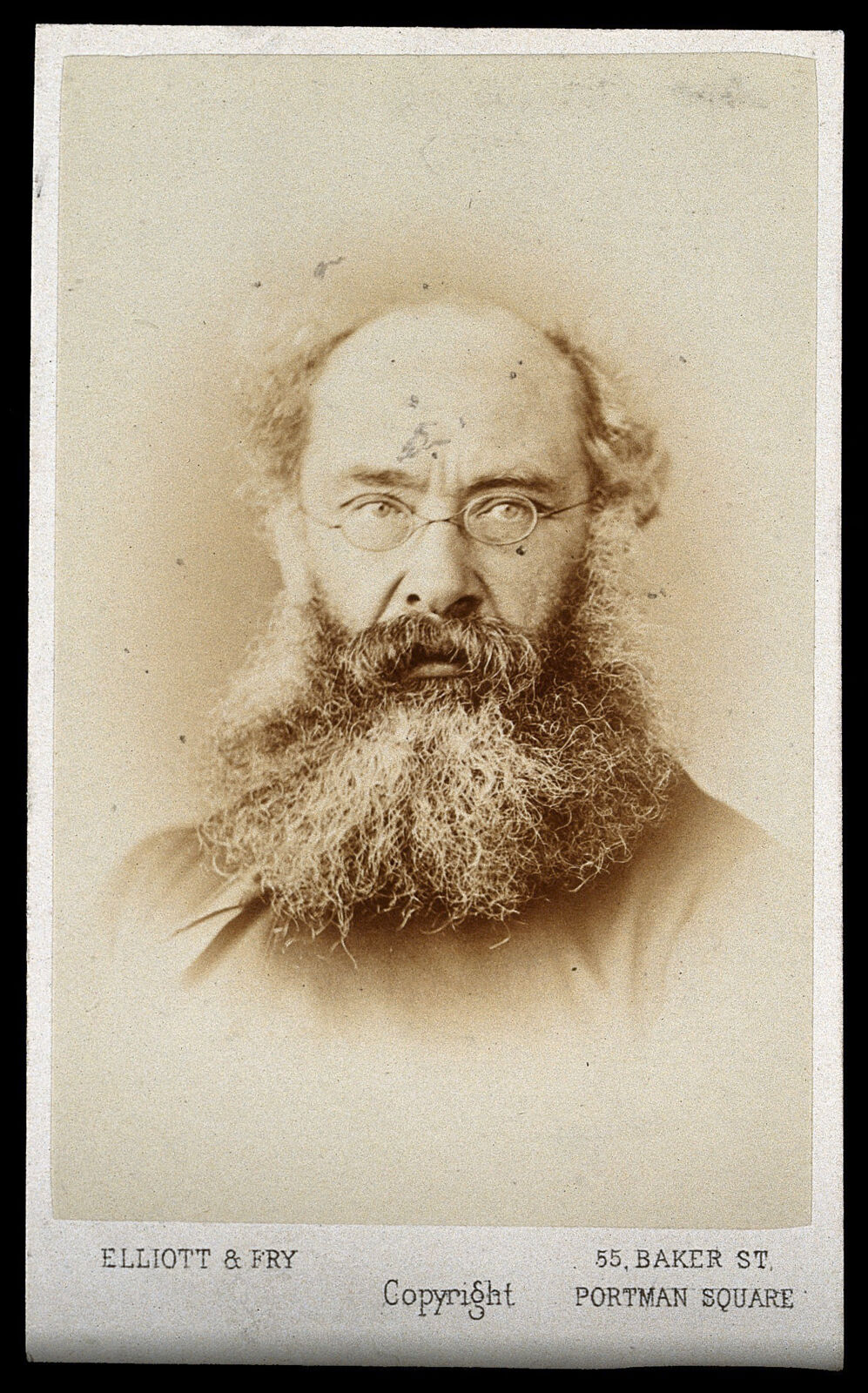
- Wellcome Collection, “Anthony Trollope. Photograph by Elliott & Fry,” reference 15284i—public catalogue record and image metadata for the archival photograph.