The sea arrives in the last line. Until then, Giacomo Leopardi’s speaker has been sitting beside a hedge, thinking and listening. No boat has appeared; nobody has walked down to the shore. Yet the closing words of “L’infinito” place us in questo mare: “this sea.” The little word makes an imagined immensity feel close enough to enter.[1]
English translators have to decide how that arrival happens. Does thought sink or drift? Is the speaker frightened or soothed? And how insistently should a translation point to what is here, what lies beyond, and what has become present through imagining? These decisions give a fifteen-line poem remarkably different emotional weather.
Written in 1819, “L’infinito” survives in autograph versions associated with Naples and Visso; Francesco Moroncini’s critical edition records their differences.[1] The manuscript reproduced here is the Visso copy. Its compact block of handwriting is a useful companion to a poem whose enormous destination fits inside a very small space.[5]
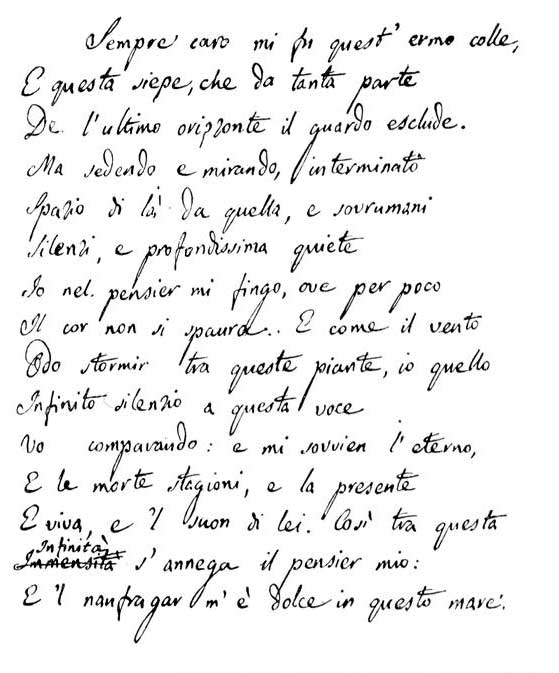
A hedge that gives the imagination work
The opening loves a particular hill and questa siepe, this hedge. The hedge excludes much of the horizon from sight. Then, in lines 4–7, the speaker supplies what vision cannot: spaces without end and a silence beyond the human scale. The verb phrase mi fingo makes this an activity of the mind.[1]
A. S. Kline’s 2003 version chooses “I create.”[3] That verb gives the seated figure an unexpected occupation. He is making an experience, and the obstruction helps him make it. An English version that let him simply survey an endless landscape would remove the poem’s most interesting piece of equipment: something he cannot see through.
This is also why the hedge deserves more attention than its humble appearance promises. In a study of Romanian translations, Otilia Ștefania Damian makes its wording central to the poem’s relation between limit and infinity.[4] Her subject is a different translation tradition, but the problem travels well. A translator must preserve the usefulness of the obstacle. The reader needs to feel how a boundary can solicit thought instead of merely stopping it.
Kline reinforces the speaker’s position by adding “here” to both sitting and watching.[3] To my ear, the repetition steadies the body while the sentence opens outward. It is a small interpretive addition, making explicit the location from which the imagination departs. We can admire the effect while noticing that it is a choice.
Almost afraid is a precarious place to rest
At the turn between lines 7 and 8, the Italian reads “ove per poco / Il cor non si spaura”: roughly, where the heart almost takes fright.[1] This is the essay’s own prose gloss, not a proposed verse translation. The phrase brings the speaker near an emotional threshold; the apparent negative belongs to an expression of something narrowly avoided.
Frederick Townsend’s 1887 translation instead gives us “for a moment I am calm.”[2] The difference reaches beyond vocabulary. His speaker receives a brief interval of relief. The Italian speaker approaches an experience capable of frightening him. Both can eventually find sweetness, but they reach it by different routes.
Kline retains the fear, although his “the heart barely fails to terrify” is awkward English.[3] A heart that terrifies sounds like a heart frightening somebody else. The Italian reflexive construction puts the danger within the heart’s own response. Here a translation can stay close to the source’s negative shape while making the direction of the feeling harder to understand.
I would favor the plainness of “almost takes fright” in a reading gloss. Its loss is audible: it has little of the Italian’s suspension across the line break. Its gain is that a reader knows what almost happens. Translation asks us to make that kind of trade openly, rather than assume that greater verbal similarity always produces greater clarity.
Townsend’s choice also has a larger tonal setting. His wind has a “plaintive” voice, and the living season utters a “complaint.”[2] These words lend the audible world an explicit sadness. Read alongside his momentary calm, they suggest a temporary refuge from a sorrowful present. That is my reading of the English version’s effect; it is not a claim about what motivated the translator.
When the distant becomes this
The wind does more than interrupt. It gives the speaker something audible to compare with the silence he has imagined. In lines 9–11, distance and proximity occupy the same act of attention: that infinite silence, this voice.[1] Neither side needs to disappear. The movement between them carries the poem onward.
Kline preserves that pairing and later keeps the closing “in this sea.” Townsend ends “on this sea.”[2][3] Neither preposition should bear an entire verdict on a translation, but the difference is worth hearing. “On” suggests a surface on which a wreck might occur; “in” places the experience within its element. For an ending concerned with thought losing its bearings, I prefer the immersion of “in.”
The demonstrative matters still more. A sea imagined as remote has become available to the word this. My reading is that the poem has changed the speaker’s relation to distance without requiring his body to travel. Its final nearness has been made by attention: an obstruction, an imagined expanse, a sound, a comparison.
The English afterlife offers no simple progress from an old translation to a superior modern one. Townsend’s edition presents a calming turn but a forceful shipwreck; Kline gives the imaginative act energy while leaving the fear clause tangled. Reading them together makes each version’s decisions visible.[2][3]
For this poem, I would keep the obstruction useful, the fear possible, and the final sea near. Those choices leave the ending pleasantly unstable. The mind that has done all this making can enjoy being overwhelmed by what it made. The speaker is still beside the hedge. The language has brought the sea to him.
Sources
- Giacomo Leopardi, “L’infinito,” in Francesco Moroncini’s critical edition of the Canti (1927), poem XII. Italian text, line numbering, composition date, and notes distinguishing the Naples and Visso manuscripts; digitized transcription on Wikisource.
- Giacomo Leopardi, The Poems of Giacomo Leopardi, translated by Frederick Townsend (G. P. Putnam’s Sons, 1887), “The Infinite.” Complete edition at Project Gutenberg; source for the calm, complaint, and closing shipwreck comparisons.
- Giacomo Leopardi, The Canti, translated by A. S. Kline (2003), section 2, “The Infinite (XII).” Translator’s published text at Poetry in Translation.
- Otilia Ștefania Damian, “Questa siepe. Sull’ Infinito di Leopardi tra traduzione e interpretazione,” Studia Universitatis Babeș-Bolyai Philologia 67, no. 3 (2022). Research article on the hedge, limit, and infinity in Romanian translations; argument summarized in the abstract.
- “Infinito.jpg,” Wikimedia Commons. Archival reproduction identified as Leopardi’s second autograph manuscript, Visso municipal archive; source of the article image.