Edward Thomas's “Adlestrop” begins as if someone has asked a question we cannot hear. “Yes.” is not scene-setting but an answer, complete with its own full stop. Then memory supplies a place—“I remember Adlestrop— / The name”—and narrows the claim within the same sentence.[2][5] Before the poem gives us a platform, a train, a plant, or a bird, it gives us the sound of a word retrieved in conversation.
That order matters. “Adlestrop” is often cherished as a crystal of lost English summer, a brief railway halt preserved just before the First World War. The chronology invites the reading: Thomas recorded the stop in a field notebook in late June 1914, returned to it after he began writing poetry that winter, and the poem was published posthumously in 1917.[1][2][3][5] Yet the poem is more interesting than a photograph of innocence before catastrophe. It does not know the future. It shows how attention builds a world when ordinary movement is interrupted.
Its sixteen lines keep changing the scale of what “Adlestrop” can mean. First it is a remembered name. Then it is a bare platform and the vegetation around it. Finally it becomes an acoustic field extending across two counties. The train stops once; the grammar continues to travel.
The first halt is a full stop
Thomas makes stopping audible before he describes it. This essay follows the full stop printed in the poem's 1917 appearance and in the Faber text displayed by the Poetry Archive: the opening sentence is a single syllable, “Yes.” The 1920 Collected Poems text reproduced by Representative Poetry Online instead prints “Yes, I remember,” a small but consequential variant.[1][2][5] In the full-stop text, a second sentence begins confidently—“I remember Adlestrop”—but the dash checks it, and the appositive phrase “The name, because one afternoon” narrows memory from place to language without ending the sentence. The express will draw up “unwontedly”; the syntax has already made the stop feel like a departure from routine.
“Unwontedly” is a conspicuous word in a poem built mostly from plain speech. It slows the mouth, puts stress on an event that barely qualifies as an event, and receives another hard full stop in the middle of the line: “Unwontedly. It was late June.”[1] Thomas does not let the syntax glide with the express. His punctuation keeps braking inside the verse.
The quatrain's loose abcb rhyme offers order without a jingle: “afternoon” is answered by “June,” while the other line endings remain free.[1] That is the poem's first balance between schedule and felt deviation. It has a stanzaic timetable, but the speaker presents the halt as outside habit. The distinction is literary, not necessarily operational: a National Archives reading of the Great Western Railway's June 1914 public and working timetables finds the train due at Adlestrop at 12:48, close to the field notebook's recorded time.[7] The poem makes a scheduled stop feel unwonted because, for this passenger, it interrupts forward motion without producing an arrival or departure on the platform.
This is why the poem's first-person claim is so modest. The speaker does not say that he remembers Adlestrop completely. He remembers the name because the train stopped. Memory begins not in mastery but in a snag.
Nothing happens on the platform
The second stanza substitutes tiny sounds for action: “The steam hissed. Someone cleared his throat.”[1] Both are releases of pressure. One belongs to the engine, the other to an unidentified body. Neither sound becomes speech. The person does not acquire a face, and the machine does not depart.
Then Thomas gives the station the two actions it normally exists to enable and cancels both: “No one left and no one came.”[1] The line is stronger than saying the platform was empty. Left and came imply a system of exchange—passengers, meetings, separations—while the repeated “no one” records zero traffic. The express has stopped at a place where, for this minute, the railway performs no social transaction at all.
The platform is “bare,” but the scene is not vacant. Steam, throat, heat, willows, grasses, flowers, hay, clouds, and birds will accumulate around it. Thomas keeps human absence distinct from sensory scarcity. The station offers almost nothing to railway narrative and almost too much to attention.
That distinction was already present in the field note behind the poem. The note, preserved in the Berg Collection and quoted by the University of Toronto's Representative Poetry Online, records willows, willow-herb, meadowsweet, the engine's hiss, birdsong, and no visible man.[1] Thomas did not invent the poem's materials later. He changed their relations.
“Only the name” opens into a landscape
The strangest grammatical turn comes at the stanza boundary:
What I saw
Was Adlestrop—only the name
And willows, willow-herb, and grass …[1]
At first, “only the name” appears to close perception down. Perhaps the station sign is all the speaker truly sees. But and refuses closure. The sentence crosses into a new stanza and begins attaching vegetation to the name: willows, willow-herb, grass, meadowsweet, dry haycocks. “Adlestrop” expands from lettering on a sign into whatever can be gathered under that lettering.
The list does not offer a panoramic description. It proceeds by conjunction, one local thing beside another. “Willows” generates “willow-herb” through sound as well as sight; the repeated word-root makes botany feel like verbal growth. “Grass” broadens into meadowsweet and cut hay. A proper noun that initially seemed arbitrary starts drawing a material neighborhood around itself.
The stanza still resists possession. Thomas names species and farm work, but he does not tell us that the landscape belongs to him or exists for him. Even the oddly elevated phrase “no whit less still and lonely fair” is comparative: the platform-side growth is no less fair than the high cloudlets.[1] Earth is not promoted by diminishing sky. The line holds the near and far in equivalence.
The image is therefore not a postcard assembled at a glance. It is a sentence discovering how much can follow one and. The station name becomes meaningful because syntax lets the world accrue beside it.
The notebook's chain becomes the poem's circles
Thomas's field note heard a “chain” of blackbird songs and also a thrush. In the finished poem he chose one nearby blackbird, then imagined sound radiating around it.[1] That revision turns an inventory into a spatial design.
The final stanza begins by restoring the duration of the stop: “And for that minute a blackbird sang / Close by.”[1] That minute is both exact and elastic. It limits the event, yet the poem has spent four stanzas enlarging it. The bird is close enough to locate, a single dark point in the acoustic foreground.
Then certainty diffuses. Around the blackbird, the other birds become “mistier, / Farther and farther.”[1] Mistier is a visual word applied to sound. It does not tell us that literal mist covers the fields; it gives distant birdsong the thinning definition of a receding view. Hearing borrows sight's depth cues.
The last phrase makes the largest leap: “all the birds / Of Oxfordshire and Gloucestershire.”[1] No passenger can audit every bird in two counties from one platform. The claim is not documentary in that sense. It is the shape attention takes once a close sound has opened a radius. One blackbird becomes the audible center from which the mind supplies a larger, continuous countryside.
The poem's motion has therefore reversed the train's. An express compresses geography into a line between named stops. “Adlestrop” pauses that system and lets geography spread outward: sign, platform, plants, cloudlets, nearby bird, remote birds, counties. The railway name no longer marks a point to pass through. It becomes the center of an expanding map.
The poem remembers before readers mourn
Later readers have good reasons to hear loss in this summer interval. Thomas wrote all his poetry between 1914 and 1917; the war concentrated his thinking about England, and he died on 9 April 1917 during the Battle of Arras.[2][3] The New Statesman, which first published “Adlestrop” that year, presented it to readers after his death.[5] Retrospection was built into the poem's earliest public life.
The Poetry Archive goes so far as to call it “a war poem without mentioning war,” an influential description of how its late-June scene has come to sound.[2] Bloodaxe's description of Edna Longley's annotated edition stresses the prose, letters, and notebooks behind the poetry while warning that the familiar labels “war poet” and “nature poet” are both incomplete.[4] Both frames illuminate “Adlestrop”; neither explains away its craft.
To call every detail a symbol of the world about to vanish is to give the poem knowledge it does not claim. The blackbird is not secretly an artillery shell's opposite, and the stopped train is not a coded mobilization order. War changes the emotional pressure under which Thomas revisited the note and under which readers received the poem. But the poem's internal drama remains an act of perception: a break in transit, a name, a chain of additions, a sound moving beyond what can be verified.
That boundary makes the elegiac response stronger, not weaker. Readers know what the speaker at the station does not. We bring historical loss to a poem that refuses prophecy. Its summer minute stays ordinary enough to be irrecoverable.
A place made portable
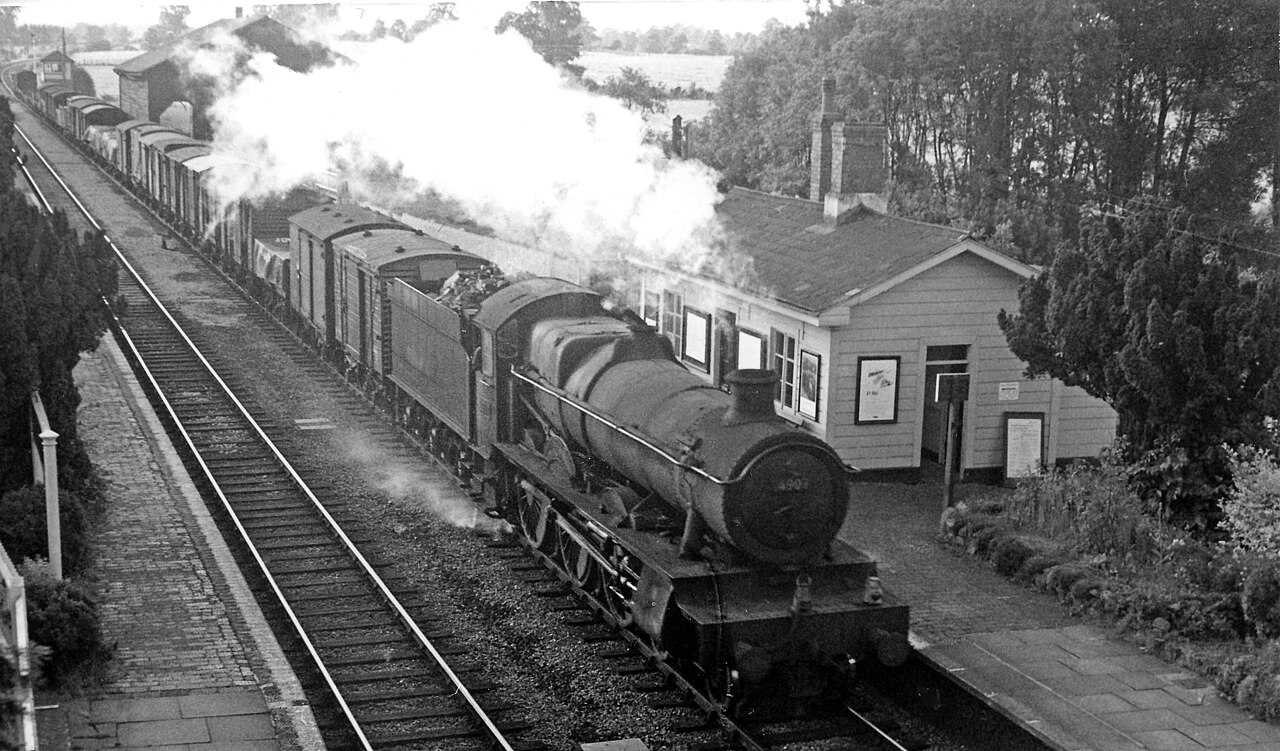
The archival photograph shows that Adlestrop was never only the hushed platform readers may imagine. In Ben Brooksbank's 1961 view, a freight locomotive occupies the track, railway buildings line the platform, and the station is emphatically part of a working system.[6] The photograph corrects any temptation to turn the place into pure pastoral silence.
Thomas's poem performs a different kind of preservation. It does not freeze the station as a complete scene. It saves a sequence of attention: answer, name, interruption, hiss, throat, absence, plants, sky, blackbird, distance. Because that sequence can happen again in a reader's voice, the place becomes portable without becoming generic.
“Adlestrop” finally means more than what the speaker saw and less than a total history of the village. It is the name under which one stationary minute learned to widen. The express moves on outside the poem. Inside it, the birds are still carrying the map beyond the platform.
Sources
- University of Toronto Libraries, Representative Poetry Online, “Adlestrop”—the poem text, publication record, rhyme scheme, and the earlier field-note wording preserved in the Berg Collection.
- Poetry Archive, “Edward Thomas” and “Adlestrop”—biographical context, reception framing, poem text, and James Fenton's recorded reading.
- University of Oxford, First World War Poetry Digital Archive, “Edward Thomas”—career chronology, wartime context, and guide to the manuscript collection.
- Bloodaxe Books, Edward Thomas, The Annotated Collected Poems, edited by Edna Longley (2008)—publisher record describing the edition's archival and textual apparatus.
- New Statesman, “Edward Thomas: Adlestrop, first published in the New Statesman in 1917” (9 April 2013)—the magazine's republication and note on the poem's original appearance after Thomas's death.
- Wikimedia Commons, Ben Brooksbank, “Adlestrop railway station” (28 July 1961)—source record for the archival photograph, including date, scene description, dimensions, and attribution.
- The National Archives, Bruno Derrick, “Adlestrop: railways, poetry and the myths of 1914” (23 November 2012)—transcript and timetable analysis comparing the poem's “unwontedly” with the scheduled stop.