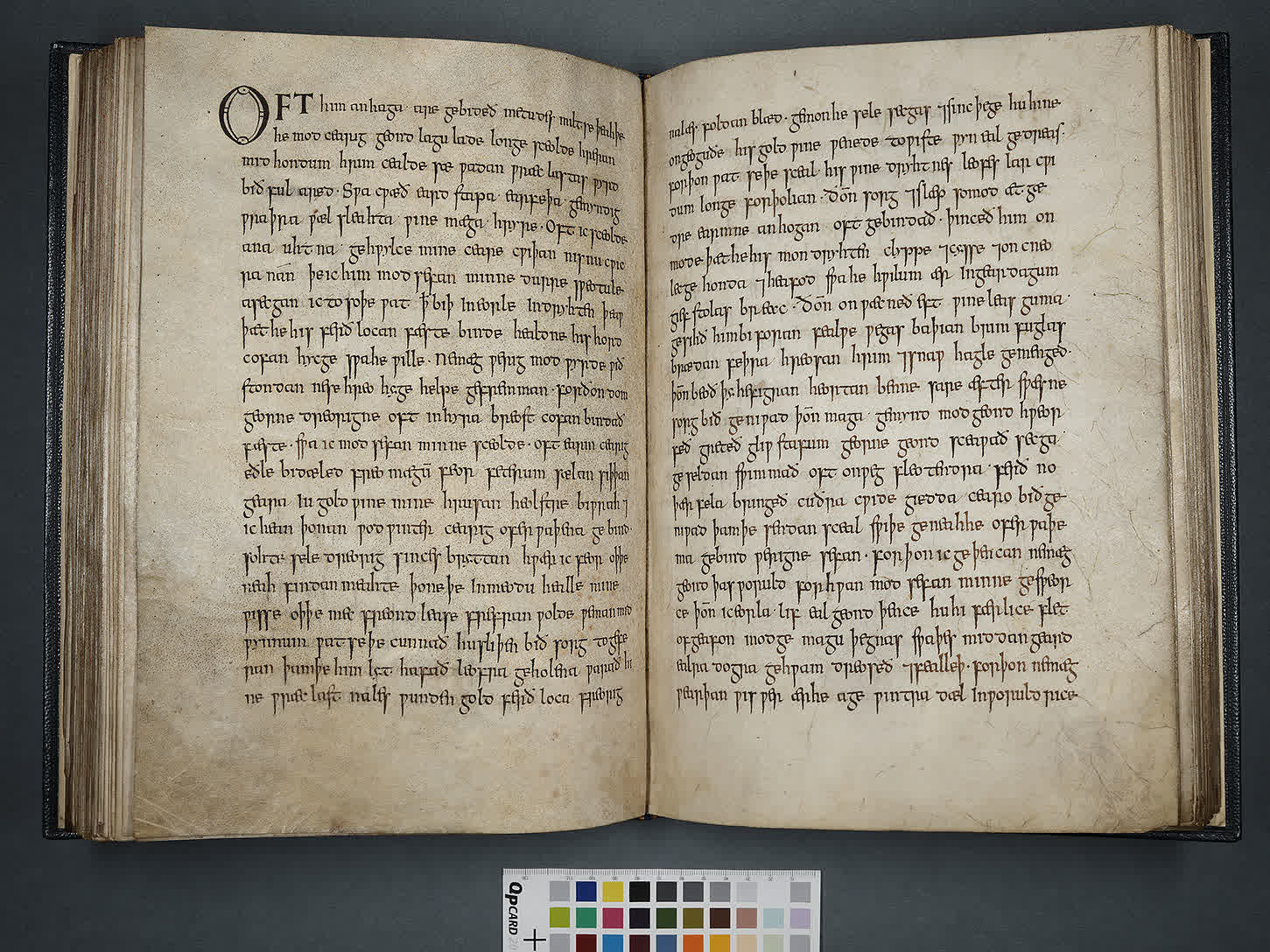
The first trap in translating The Wanderer is to make it too smoothly sad. The poem is certainly a meditation on loss, exile, dead companions, ruined halls, winter seas, and the instability of earthly life. But its opening pressure is not only emotional. It is kinetic. Before the speaker becomes a figure of grief, he is a person forced into bad motion: stepping the earth, crossing sea-lanes, walking exile-paths, holding thought inside the locked chamber of the self.[1][3][4]
That is why the title can mislead. "Wanderer" sounds almost voluntary in modern English, with a faint romance of roaming attached to it. The Old English poem is harsher. The figure called the eardstapa is not a tourist of sorrow. He is an earth-stepper, a land-strider, a man whose movement marks dispossession rather than freedom.[3][4] A good translation has to keep that difference alive. If the English line lets him drift, the poem loses its force. He should step, trudge, pass, cross, and endure.
The manuscript context sharpens the point. The Wanderer survives in the Exeter Book, a tenth-century anthology of Old English poetry held by Exeter Cathedral Library and digitized by the Exeter Book Project.[2] The official project describes the book as one of the four known poetic manuscripts in Old English and notes that elegies such as The Wanderer and The Seafarer are among its best-known contents.[2] The poem's modern title is an editorial convenience, not a label written by the medieval scribe. Translation begins in that gap: a text with no manuscript title, now known by a word that risks softening the very exile it names.
"Anhaga" is lonelier than "alone"
The poem opens with the solitary figure: Oft him anhaga....[1][4] "Often the solitary one" is accurate enough, but it does not quite solve the word. Anhaga presses "one" and "enclosure" together. It is not simply a person without company. It is a person shut into singleness. The loneliness has architecture.
That matters because the poem repeatedly turns inwardness into a physical container. The speaker must bind his thoughts in the ferðloca, often rendered as the mind's enclosure, breast-locker, or spirit-chamber.[1][3][4] "Heart" alone is too soft. "Mind" alone is too abstract. "Breast-locker" sounds strange, but the strangeness is useful because it makes feeling spatial. The poem does not imagine grief as loose atmosphere. It imagines grief as something held under pressure in a body.
Modern English tends to prize confession. The poem prizes restraint before confession. The speaker says that a weary mind cannot withstand fate and that the sorrowful heart gives little help; therefore the glory-seeking bind dreary thoughts fast in the breast.[1][3] A translator who makes this simply "I was sad and could tell no one" has reduced the social code. The poem belongs to a world in which speech, lordship, loyalty, and self-command are bound together. Silence is not only repression. It is a damaged form of discipline after the community that once gave discipline meaning has vanished.
"Wræclastas" should hurt the feet
The most important movement word may be wræclastas: exile-paths.[1][4] "Paths of exile" is clear and dignified, but it can sound like a metaphor. The Old English compound is more bodily. It gives exile a track underfoot. A person does not merely "experience alienation." He walks it.
That is why I would resist translating the poem's travel language as vague wandering whenever possible. The speaker crosses the cold sea with his hands, stirs icy water, and seeks a new giver in distant halls.[1][3] These are not decorative settings for grief. They are the mechanics by which grief becomes daily life. The loss of the lord is not only a private bereavement; it changes where the body can stand, eat, speak, receive treasure, and be recognized.
UCL's overview of the Exeter Book elegies places The Wanderer at folios 76b-78a, identifies it as a 115-line poem, and names exile, longing, melancholy, and winter description among its central devices and themes.[6] That catalogue is useful because it shows how much of the poem is built from recurrence. Sea, path, storm, hall-memory, ruined wall, vanished companions: translation should let that recurrence feel tiring. A clean synonym every time may be elegant, but too much elegance can make the exile oddly comfortable.
"Wyrd" is not just fate, and not just doom
No translation note on The Wanderer can avoid wyrd. The famous early statement, Wyrd bið ful aræd, is often rendered as "Fate is fully fixed" or "Fate is inexorable."[1][4] Both have force. But each narrows the word differently. "Fate" sounds classical and abstract. "Doom" sounds final and dark. "What happens" is too flat. The Old English word carries the pressure of event, becoming, and necessity.
The translation problem is that wyrd in this poem is not only an idea the speaker discusses. It is the weather of his experience. It has already happened to him as death, lord-loss, displacement, and social unhousing. When the poem says wyrd is fixed, the line should not sound like a proverb detached from the body of the speaker. It should sound like a verdict learned by walking.
This is where Harriet Soper's recent article on "pathetic fallacy" in The Wanderer is valuable. Soper argues that the old habit of reading the stormy land- and seascape mainly as a projection of the wanderer's psychology can obscure the poem's material world and its spiritual stakes.[5] That caution matters for translation. The icy sea is not merely a mood-board for sadness. The world itself resists human security. If a translation makes the weather only symbolic, it weakens the poem's sense that human life is exposed to an order larger and colder than feeling.
The hall is a grammar of belonging
The poem's most painful memories gather around the hall: the giver, the comrades, the treasure, the feast, the familiar social arrangement in which a retainer's life made sense.[1][3][4] Here again, translation should avoid over-modern psychology. The wanderer is not simply nostalgic for good times. He is remembering a grammar of belonging.
"Gold-friend" for the lord can sound quaint, but it helps if handled carefully. It names an economy of loyalty, gift, and protection. A lord gives rings and treasure; retainers give service and martial faith. When that structure breaks, the speaker loses more than affection. He loses the institution that made his courage socially legible. In modern English, "friend" can sound private and equal. In this poem, friendship is political, material, and hierarchical.
That is why the remembered hall-dream is so devastating. The speaker imagines embracing and kissing his lord, laying hands and head on his knee, then waking to seabirds and frost.[1][3] A weak translation will turn the dream into sentimental longing. A stronger one keeps the bodily gestures and social asymmetry. The loss is intimate because lordship was intimate. The loss is political because intimacy depended on a public order that no longer exists.
Wisdom arrives late, and translation should let it
The ending turns toward wisdom and heavenly consolation, but it should not retroactively tidy the poem. The wise person must be patient, not too hot-hearted, not too quick with speech, and must seek mercy from the Father in heaven.[1][3] These lines matter. They also arrive after the poem has made earthly instability nearly unbearable.
If the ending is translated too serenely, it can make the whole poem feel like a sermon with winter scenery. That is a mistake. The poem earns its religious conclusion by passing through the body's knowledge of exposure. The speaker has felt the cold, remembered the hall, lost the lord, walked the exile-paths, and watched stone walls stand where social warmth used to live. Wisdom does not cancel that experience. It is what can still be said after that experience has done its work.
This is why The Wanderer remains such a strong translation test. Its Old English compounds make feeling concrete without making it simple. Anhaga encloses loneliness. Eardstapa puts exile into the foot. Wræclastas turns displacement into a road. Ferðloca locks thought inside the body. Wyrd names necessity after it has already broken the world.
The best English version, then, is not the one that makes the poem easiest to admire. It is the one that keeps the reader slightly off balance: walking with a man whose wandering is not freedom, whose silence is not emptiness, whose weather is not merely metaphor, and whose final wisdom has been reached the hard way, step by step.
Sources
- Old English Poetry in Facsimile Project, "The Wanderer" digital edition and translation, using Exeter Book manuscript images and editorial notes.
- The Exeter Book Project, official digitization and manuscript context for Exeter Cathedral Library MS 3501, including the cover image source at folios 76v-77r.
- Old English Poetry Project, Rutgers University, "The Wanderer" modern translation and line references.
- Siân Echard, "The Wanderer" teaching page with Old English text, manuscript placement at Exeter Cathedral Chapter Library MS 3501, and translation notes.
- Harriet Soper, "The Wanderer and the Legacy of Pathetic Fallacy," Neophilologus 107 (2023), open-access article on landscape, speaker, and inherited critical terminology.
- UCL Social & Historical Sciences, "Old English Anxieties in the Elegies of the 10th Century Exeter Book," overview of the Exeter Book elegies, folio placement, line count, and themes of The Wanderer.