
Margaret Atwood's Louisiana Channel interview is useful because it refuses the lazy argument that speculative fiction is prediction dressed as entertainment. Speaking with Synne Rifbjerg at the Louisiana Literature festival in Denmark in August 2014, Atwood describes a practice built from recognizable pressures: science, reproductive politics, ecological anxiety, surveillance, market appetite, old stories, and the stubborn human wish to survive inside bad systems.[1][2]
The video was published in 2015, but it belongs beside the books rather than behind them as author publicity. Atwood is not offering a brand definition. She is explaining a craft contract. Her version of speculative fiction starts with things that could plausibly happen and leaves "first prize dragons" to other kinds of fantasy.[2] The line is funny, but the distinction is serious. It shifts attention away from novelty and toward evidence: what has a society already invented, normalized, sold, renamed, ritualized, or half-forgotten?
That is why the interview works as a literature object. It lets us hear Atwood explain the pressure gauge behind novels such as The Handmaid's Tale and Oryx and Crake. These books do not ask readers to admire a futuristic surface. They ask readers to notice how close a future can feel when its ingredients have already entered the room.[3][4][5]
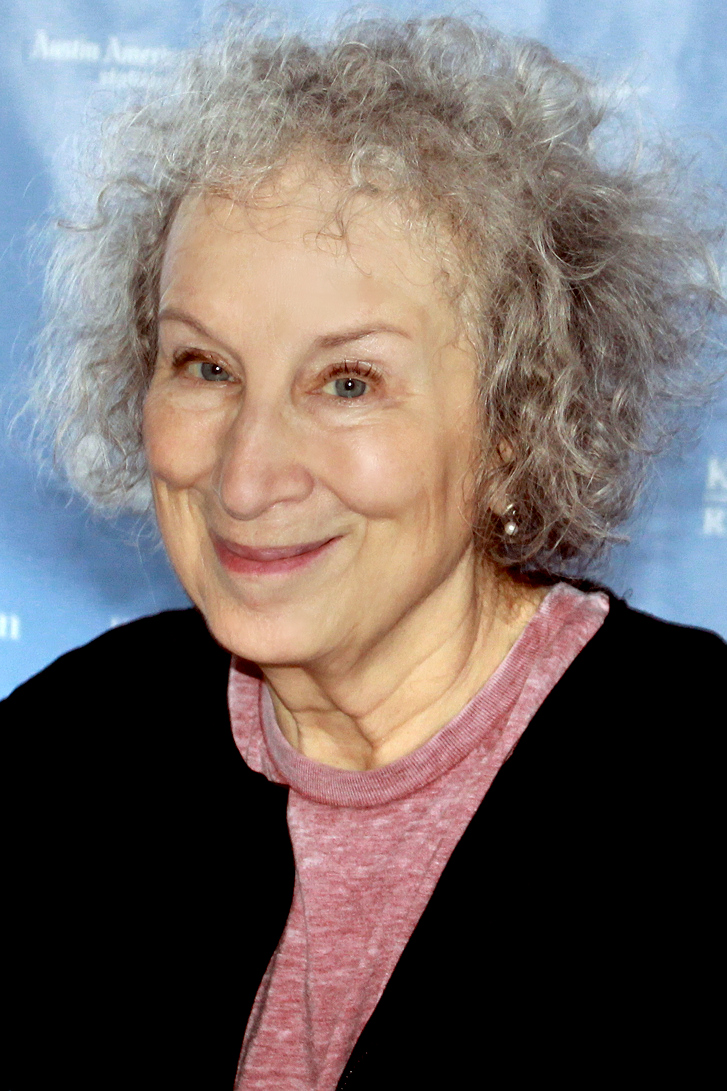
Image context: the cover photograph shows Atwood at a book festival, not inside a staged dystopian set. That matters here. The article is about a writer's public account of method: how she turns research, genre memory, political observation, and comic timing into a way of reading possible futures.[6]
The Boundary Is a Craft Rule
Atwood's distinction between speculative fiction and other fantastical modes can sound like taxonomy, but in the interview it behaves more like a rule for composition. She is not narrowing imagination. She is deciding where the charge of a story should come from. If a fiction uses elements that are already scientifically, politically, or socially imaginable, the reader cannot dismiss the book as pure elsewhere. The book keeps pointing back to the present that made it plausible.[1][2]
That is the first thing to watch for in the video: Atwood's humor does not soften the argument so much as sharpen it. The jokes make the category memorable, then the examples bring it back to mechanism. She keeps framing speculative fiction as a way to ask what humans might do with capacities they already have or are close to having. The future is not a magic country. It is a stress test for habits that exist now.
This also explains why her genre boundary is not a snub of fantasy. It is an ethical and aesthetic choice. Dragons can be powerful because they let a writer externalize fear, grandeur, violence, or wonder. Atwood's preferred pressure is different. She wants the reader to ask: who built this institution, who benefits from this ritual, which technology made this control easier, and which old myth gave the new system a respectable costume?
Gilead Is Built from Stored Evidence
The Handmaid's Tale remains the obvious test case because it has become both novel and public shorthand. Penguin Random House's retail page frames the book through environmental disasters, declining birthrates, civil conflict, and the Republic of Gilead's reproductive regime.[3] Those ingredients matter because the novel's terror is not only that women are oppressed in an invented theocracy. It is that the oppression is made administratively, ceremonially, and linguistically legible.
Atwood's interview helps clarify the method. The book's power depends on a grim inventory: old religious language, state violence, household hierarchy, fertility panic, clothing codes, public punishment, forbidden reading, and the conversion of bodies into offices. None of those elements needs to be impossible for the fiction to feel extreme. The extremity comes from arrangement. The novel takes scattered historical and social materials and locks them into one coherent system.
That is why the book is often misread when treated only as a forecast. A forecast asks whether the future happened. A speculative novel asks which pressures a culture already contains, and what form they might take if counterforces failed. Gilead is frightening because its most artificial features are made from recognizably human materials: fear of disorder, appetite for control, the prestige of sacred language, and the bureaucratic talent for making cruelty seem procedural.[2][3]
The MaddAddam World Moves the Same Method into Biology
Oryx and Crake extends the same craft logic into biotechnology, corporate language, ecological collapse, and engineered life. Penguin Random House presents it as the first volume of the MaddAddam trilogy and as both a love story and a future vision; the series page describes a near future devastated by genetic engineering and plague.[4] The Encyclopedia of Science Fiction likewise places Atwood's work in a long argument about how near-future fiction handles scientific and social change.[5]
The novel's invented world feels wild, but its engine is again inventory rather than random invention. Atwood looks at laboratories, markets, sex, childhood, brand culture, entertainment, medical desire, and environmental damage, then asks what kind of story emerges when those forces no longer remain politely separate. The result is not a gadget parade. It is a satire of systems that treat bodies as markets and language as packaging.
The Louisiana Channel interview is especially helpful here because Atwood speaks about speculative fiction as a form that can be funny and alarming at once.[1][2] That tonal mix is essential to the MaddAddam books. The jokes are not decorative. They show how people domesticate catastrophe through slogans, products, acronyms, and habits. A reader laughs, then notices that the laugh came from a world whose logic is not as distant as it first appeared.
How to Watch the Interview
The most rewarding way to watch is to track how often Atwood turns a genre question into a reader question. She is not merely asking what counts as science fiction, fantasy, or literary fiction. She is asking what kinds of possibility readers are willing to recognize. The word "possible" in her account is not narrow. It includes what technology can do, what institutions can authorize, what markets can reward, what myths can excuse, and what people can learn to tolerate.
That is why the video should not be consumed as a miniature lecture on labels. Its best moments show a writer defending attentiveness. Atwood's speculative fiction asks readers to take the present seriously enough to imagine its consequences without pretending those consequences are inevitable. The novels are bleak in patches, but their form is not fatalistic. If a future is assembled from identifiable pressures, then those pressures can still be named, resisted, redirected, or at least understood before they harden.
The interview also gives a useful corrective to the prestige habit of treating genre as a lower shelf. Atwood's category work is part of her literary intelligence. She uses speculative premises to reveal hidden grammar: how law turns into ceremony, how consumer language coats violence, how reproduction becomes politics, how ecological damage becomes plot, and how old stories survive by changing costume. The future setting is the lens. The real subject is the present under magnification.[2][3][4][5]
Atwood's most durable lesson here is that speculative fiction is not a prediction machine. It is a disciplined inventory of what a culture has already made available. The writer gathers pressures, arranges them, intensifies them, and asks the reader to notice the chain. By the time the imagined future arrives on the page, it carries the fingerprints of the world that claimed it was still safely elsewhere.
Sources
- Louisiana Channel, "Margaret Atwood Interview: On the Planet of Speculative Fiction," YouTube video.
- Louisiana Channel, "Margaret Atwood: Planet of Speculative Fiction" (video page, interview context, festival provenance, and publication note).
- Penguin Random House Retail, The Handmaid's Tale by Margaret Atwood (publisher retail page and synopsis).
- Penguin Random House, Oryx and Crake by Margaret Atwood (publisher page for the first MaddAddam volume).
- The Encyclopedia of Science Fiction, "Atwood, Margaret" (genre context and bibliography).
- Wikimedia Commons, "File:Margaret Atwood 2015.jpg" (source page for the lead photograph).