Helga Crane is one of American modernism's great restless characters because she does not simply want a better place. She wants a place that will stop turning her into an explanation. In Nella Larsen's Quicksand, first published in 1928, Helga moves from the Southern school of Naxos to Chicago, Harlem, Copenhagen, Harlem again, and finally a rural Black church marriage. Each move looks like an exit. Each becomes another room where other people decide what her body, manners, color, clothes, desire, or faith are supposed to mean.[1][2][3]
That is why a character study of Helga has to begin with movement but cannot end there. The plot travels, yet the deeper drama is repetitive: Helga senses a setting becoming false, leaves it, feels a rush of self-possession, then discovers that the next setting has its own script ready for her. Library of America calls Quicksand a Harlem Renaissance masterwork that turns naturalism toward race, gender, and class; Penguin stresses the novel's international dimension and its portrait of a biracial woman's inner life.[2][3] Both descriptions are useful, but Helga's particular force lies in how quickly her intelligence detects a trap and how slowly she notices that motion alone is not freedom.
The first room is already a performance chamber. Larsen opens with Helga alone under a shaded lamp, surrounded by books, color, fabric, flowers, and curated taste.[1] The description matters because Helga is not introduced as deprived of sensibility. She has too much sensibility for the institutional world around her. At Naxos, the rhetoric of racial uplift has hardened into discipline, gratitude, and public respectability. After a white preacher praises segregationist accommodation, Helga's disgust condenses into the blunt sentence: "Suddenly she hated them all."[1]
The hatred is not childish volatility. It is a refusal to let a system call itself noble while training people to accept constraint as destiny. Yet Helga's refusal is not pure political clarity either. She sees Naxos's falseness, but she also sees herself seeing it. Her taste, clothes, irritation, and loneliness all mingle with moral judgment. That mixture is Larsen's psychological precision. Helga is often right about the rooms she rejects; she is less reliable about what rejection can give her.
Naxos Teaches Her That Belonging Can Be a Uniform
Naxos is supposed to be a collective project, a place where education makes racial progress visible. For Helga, it becomes a machine for producing acceptable Blackness: useful, grateful, polished, deferential, and legible to white approval.[1] She cannot breathe there because the school demands more than work. It demands consent to a public style of being.
This is the first pattern in her character. Helga does not want a community if community requires self-erasure. She reacts sharply to the school's moral costume because she understands costume too well. She knows how dress, posture, diction, and interior decoration shape social reading. Her own room is full of chosen surfaces. Her complaint is not against style itself. It is against style being used as a cage.
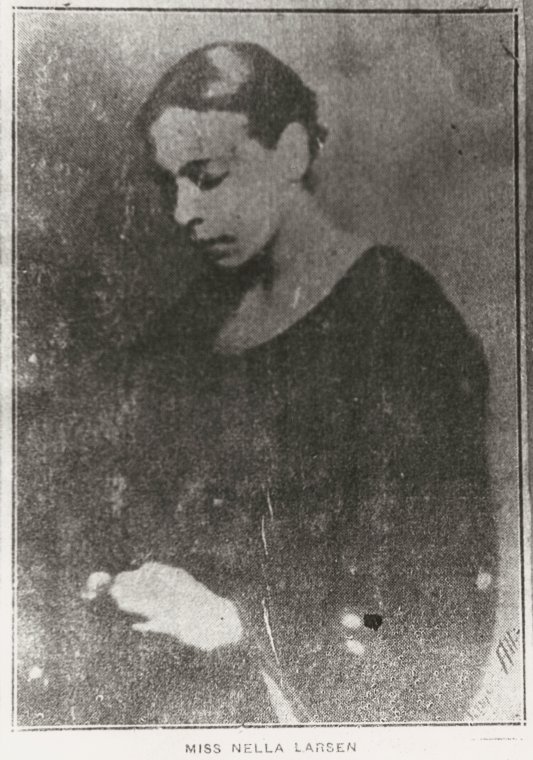
NYPL's account of Larsen's career helps ground the tension. Larsen worked at the 135th Street branch and lived near the Harlem Renaissance's cultural expansion; her fiction repeatedly follows driven women confronting race, sexuality, and gender in worlds determined to tell them who they should be.[4] Helga is one of those women, but she is not written as a clean emblem of liberation. She is prickly, proud, susceptible to beauty, easily wounded by condescension, and intensely aware of how quickly other people turn difference into a category.
Harlem Offers Fluency, Then Another Script
Harlem initially looks like the answer Naxos could not provide. It has urban speed, conversation, fashion, political seriousness, and a Black middle class not organized by Southern paternalism.[1][4] Helga can enter rooms where intelligence and style circulate together. She finds people who can read many of the codes that Naxos flattened.
But fluency is not the same as freedom. Harlem also has its expected performances: racial loyalty, social polish, correct opinions, correct alliances, the endless management of the "race problem." Helga's exhaustion changes form rather than disappearing. She has escaped the school uniform only to meet a different uniform of sophistication.
This is where Larsen makes Helga difficult in the best sense. Helga's dissatisfaction is not always generous. She can be severe toward people who are themselves managing impossible pressures. Yet the severity is part of the portrait. A character who feels chronically misread may begin to misread others defensively. Helga's judgment protects her from absorption, but it also keeps her from trust.
Copenhagen Turns Her Into an Exhibit
Copenhagen promises the most dramatic release because it removes Helga from the American color line's immediate grammar. On the ship, she enjoys a feeling of "belonging to herself alone and not to a race."[1] The phrase is crucial because it names her desire with heartbreaking clarity. She does not want to stop being herself. She wants the world to stop making race the first owner of her selfhood.
Yet Denmark does not give her that freedom. It aestheticizes her. Helga becomes exotic, dressed and displayed through other people's delight in difference.[1][3] The trap is subtler than Naxos's discipline. Copenhagen seems to admire what America regulates. But admiration can also be a form of possession. Helga is no longer asked to embody uplift; she is asked to embody decorative otherness.
Her beauty becomes legible at the cost of her autonomy. That is one of Larsen's sharpest insights about looking. To be desired, praised, painted, dressed, and socially presented is not necessarily to be known. Copenhagen gives Helga attention without recognition. The attention is warmer than contempt, but it still fixes her in place.
Religion Becomes the Last False Shelter
The final movement into religious marriage is often the hardest part of Quicksand because it feels both sudden and brutally prepared. Helga's conversion does not solve her restlessness. It gives exhaustion a language of surrender. Later, religion becomes "protective coloring," a way to endure unbearable reality by yielding to it.[1]
That phrase turns the whole character study. Helga has spent the novel resisting forms of coloring imposed from outside: racial label, social costume, exotic display, respectable femininity. At the end, coloring returns as a survival mechanism. Faith covers pain, poverty, pregnancy, bodily depletion, and disappointment. It protects by dulling perception.
Larsen does not mock religion as simply foolish. She shows why it becomes usable. For a woman exhausted by interpretation, surrender can feel like relief. For a woman whose choices have repeatedly led to new enclosures, not choosing can seem merciful. The tragedy is that relief becomes another trap, and this one is attached to marriage, childbirth, poverty, and a theology that praises submission.
The Character Is the Structure
Helga Crane endures because she is not reducible to a lesson about belonging. She is the novel's method. Every place she enters tests one proposed answer to the problem of living under racialized and gendered interpretation: institution, city, family, art, romance, nation, church. Each answer fails partly because the world is hostile and partly because Helga's hunger is too exacting to be quieted by partial recognition.[1][2][3]
The title matters here. Quicksand is not only the condition that swallows Helga at the end. It is the novel's pattern of false footing. The more urgently she tries to stand somewhere solid, the more each surface shifts: uplift becomes obedience, sophistication becomes script, admiration becomes display, faith becomes anesthesia, marriage becomes enclosure. Larsen's genius is that she makes the reader feel both the necessity of Helga's refusals and the danger of a life made only from refusal.
So Helga's tragedy is not that she moves too much. It is that the available rooms are too small for what she knows about herself. She wants beauty without objectification, community without conformity, desire without possession, race without reduction, and faith without self-erasure. Quicksand gives her none of these whole. What it gives readers instead is a character whose dissatisfaction remains morally alive, even when her choices fail her.
Sources
- Nella Larsen, Quicksand, Standard Ebooks edition of the 1928 novel used for close reading.
- Library of America, "Nella Larsen: Quicksand (LOA eBook Classic)" - Harlem Renaissance, naturalism, race, gender, class, and novel overview.
- Penguin Books, "Quicksand by Nella Larsen" - modern edition page with plot frame, international context, and author note.
- Cierra Bland, "Nella Larsen and Passing in NYPL's Collections." The New York Public Library, November 29, 2021 - Larsen's library career, Harlem Renaissance context, two novels, Guggenheim, and rediscovery.
- The New York Public Library Digital Collections, "Nella Larsen, author" (Image ID 1699950) - archival portrait used as the lead image source.