A penny comes rolling down the stairs. W. H. Davies is at the door with sheets of his poems, hoping to raise enough money to publish a book. The servant describes him as “Some man selling some paper.” Her mistress sends the coin and orders her to accept nothing in return. Davies gets a little charity; his writing never gets upstairs.[1]
The scene in The Autobiography of a Super-Tramp is a useful entrance to a poet often remembered for inviting us to slow down. Davies knew the pleasure of unhurried looking. He also knew that having something to say, getting it heard, and finding the means to keep saying it were different problems. His apparent simplicity becomes more interesting when we read it beside the trouble he took to secure it.
Born in Newport in 1871, Davies spent years traveling in North America, working and begging, before a railway accident cost him a leg. His first poetry collection, The Soul’s Destroyer and Other Poems, appeared in 1905; the autobiography followed in 1908. “Leisure,” published in Songs of Joy in 1911, eventually became his most familiar poem. The Books Council of Wales’s teaching guide notes how its popularity has narrowed the public impression of a much more various writer.[2]
A smile takes time
“Leisure” is fourteen lines long, arranged in seven rhyming couplets. Its recurring “No time” keeps interrupting the pleasures it names: standing under trees, noticing squirrels, watching light sparkle on running water. The little phrases make an audible habit of deprivation. Each new sight arrives with a reminder that the hurried passerby will miss it.[3]
Davies makes the invitation wonderfully undignified. Sheep and cows become models for human conduct because they can stand looking longer than we can. Their example lowers the social temperature of the poem. Nobody needs cultivated taste or an expensive destination to begin.
Then the scale of attention changes. In the fifth and sixth couplets, Beauty becomes a figure whose glance, dancing feet, and smile ask to be watched. The smile begins in her eyes before her mouth completes it. That tiny delay gives the poem its most exact account of leisure: enough time for an expression to unfold. The movement between the two lines of the sixth couplet makes the reader wait for the mouth to finish what the eyes have started.[3]
The closing judgment, “A poor life,” can mean a life deficient in experience, regardless of income. Read beside Davies’s memoir, however, the phrase acquires an economic pressure too. A person needs some command of time to enjoy what costs nothing. The poem does not explain how everyone can acquire that freedom. Its repeated first-person plural makes the deprivation shared without pretending to solve it.
The bird declines an audience
“The Kingfisher,” collected from Farewell to Poesy, gives the desire for withdrawal a small dramatic shape. The bird’s brilliant colors seem to qualify it for public display. In the middle six lines, the speaker imagines placing it among peacocks, polished lawns, and royal windows, where every feather could receive admiration.[3]
The commands grow extravagant. A bird beside a pool is offered the career of a court performer. Then the final six lines withdraw the invitation: this creature has no such ambition. With the words “I also,” the speaker finally admits his own wish to the poem. He wants the quiet place he has imagined for the bird.
This is a fable of artistic temperament, if we read the dazzling plumage as a talent that need not advertise itself. That analogy belongs to the reader; Davies never labels the kingfisher a poet. What the text does establish is a difference between possessing beauty and organizing one’s life around its display.
Even the retreat has feeling in it. The poem begins with a fanciful genealogy connecting the rainbow to tears, and ends beneath a tree that sighs. Solitude offers shelter for sadness. The exquisite colors do not require their possessor to be cheerful.[3]
The memoir makes this lyric wish harder to arrange. Its author needs readers, publishers, and purchases. Withdrawal can be an artistic preference while publicity remains a practical necessity.
A room, a printer, a reader
Chapter XXI of The Autobiography of a Super-Tramp, “London,” describes Davies searching for somewhere he can study. A noisy lodging house sends him toward Rowton House in Newington Butts. There he finds a library quiet enough for reading despite the presence of more than a hundred men. Books, order, and a bed at sixpence a night make a writing life imaginable on his small income.[1]
The material detail matters. The future poet of leisure has to choose accommodation, cook cheaply, and give up entertainments. He has to read. The memoir’s sentences make room for those arrangements before recounting the works he produces. His literary ambition occupies an ordinary budget.
Davies is funny about his confidence. After sending a poem to two publishers, he begins to worry that both will accept it. Both return it. The older narrator lets the younger man’s vanity expose itself through the sequence of events, while preserving the energy that made him continue.[1]
The doorstep episode turns that comedy painful. Davies has paid to print sheets he imagines selling in large quantities. Instead, the woman upstairs recognizes a request for relief where he wants her to recognize an offer of work. He gives the rolling coin a purpose, describing it as moving “as though aware of its mission.” The penny seems more certain of its role than anyone is of his poems. His final accounting is merciless: the day’s tram fare alone exceeded the money received.[1]
This confusion returns in chapter XXXII, “At Last.” Charity officials ask, “Do you ever do anything for a living?” after he has explained the book he has written. The memoir records his anger at having literary work treated as idleness. Later, purchases, correspondence, and reviews change his prospects. Recognition arrives through other people’s attention, the very resource the doorstep encounter withheld.[1]
Success brings fresh demands. In chapter XXXIII, a man taking Davies to be photographed asks him for topical verses about the war in the East. Davies dislikes being hurried into producing them and keeps turning the conversation elsewhere. The pressure to perform for an audience, so gracefully refused in “The Kingfisher,” becomes a persistent request on the way to a portrait sitting.[1]
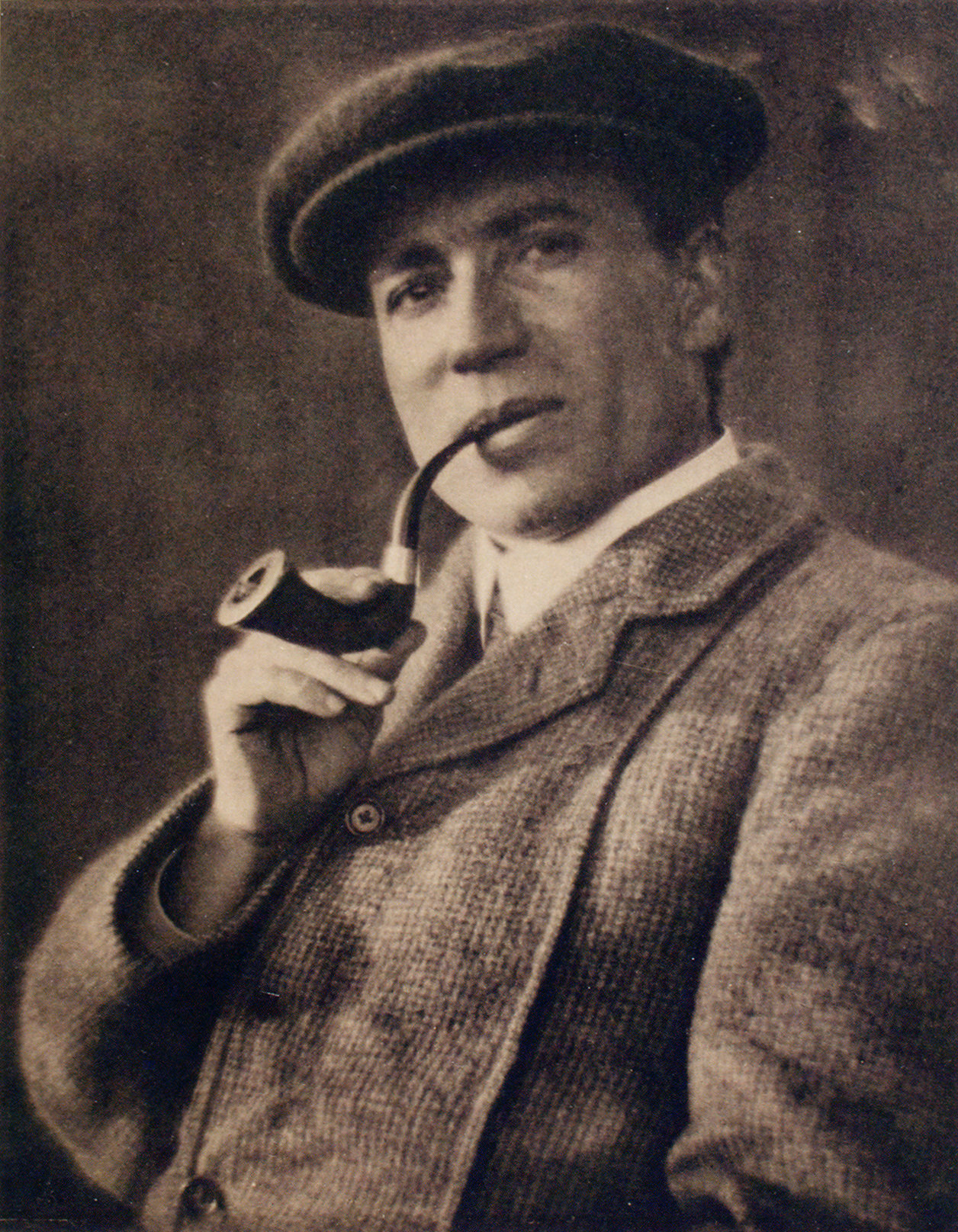
The established public poet appears in Alvin Langdon Coburn’s separate 1913 photograph, hat on, pipe in hand. Preserved in the New York Public Library’s copy of More Men of Mark, the portrait places Davies within a published gallery of notable figures.[5] It offers a useful companion to the unsuccessful salesman in the memoir: the writer has become someone an audience is invited to look at.
His subsequent reputation has contracted. Rory Waterman’s introduction to W. H. Davies: Essays on the Super-Tramp Poet describes an author once widely read across several forms, now chiefly remembered for the autobiography and a few poems.[4] Reading the prose alongside the lyrics restores some of that range. The quiet pool remains desirable, and the smile still deserves its moment. Davies’s achievement is richer when we remember the library, the printer, and the unopened sheet of paper that stand behind the invitation to look.
Sources
- W. H. Davies, The Autobiography of a Super-Tramp (first published 1908), chapters XXI, “London,” XXXII, “At Last,” and XXXIII, “Success.” Project Gutenberg transcription of the 1917 edition; lodging, literary labor, the doorstep sale, and reception.
- Books Council of Wales, “Leisure”: W. H. Davies — A Help-Sheet for Teachers, sections 1 and 3, hosted by Swansea University. Biographical and publication context, and the poem’s effect on Davies’s reputation.
- W. H. Davies, The Collected Poems of William H. Davies (New York: Alfred A. Knopf, 1916), “Leisure,” p. 18, and “The Kingfisher,” p. 20. Wikisource edition with links to the poems and digitized source pages.
- Rory Waterman, introduction to W. H. Davies: Essays on the Super-Tramp Poet. Cambridge Core abstract, published online 4 February 2022; the range of Davies’s career and the narrowing of his later reputation.
- New York Public Library, Alvin Langdon Coburn, “W. H. Davies, London, November 24th, 1913,” photogravure in More Men of Mark (1922). Collection record and photographic provenance. Wikimedia Commons, “William Henry Davies.jpg,” the downloaded reproduction of the NYPL image.