Tyltyl is certain his eyesight works. He can read the church clock at a distance that defeats his father. Yet the fairy visiting his cottage insists that he cannot see. Their disagreement gives Maurice Maeterlinck's The Blue Bird its peculiar energy: a child with perfectly serviceable eyes must learn what looking has left out.[1]
The lesson begins close to home. A diamond on a green hat reveals the lives inside ordinary things. Bread, sugar, water, fire, and the household animals acquire human forms; the cottage becomes a gathering of beings the children have been living among without recognizing them. When Maurice Tourneur adapted the play for the screen in 1918, with a scenario by Charles Maigne, he inherited a story in which the scenery already wanted to become the cast.[1][2]
That makes the adaptation especially revealing. Its magic offers a way to think about what the play asks of its spectators. We must enjoy a room becoming extraordinary, then bring some of that attention back to a room in which nothing apparently happens.
This essay discusses the play's ending and the film's central transformation scenes. References to the play follow Alexander Teixeira de Mattos's revised six-act English translation.
The view from the stool
In Act I, Tyltyl and his sister Mytyl climb onto a stool to watch the rich children celebrating Christmas across the way. Their conversation makes the window into a miniature theater. They identify toys, speculate about food, and argue over what they can see. Tyltyl claims the best position while complaining that his sister takes up all the space.[1]
The small comedy matters. Before he learns to see generously, he has trouble sharing a view. Mytyl is looking at the wall because he has left her too little room. The audience can notice a selfishness that the boy, busy describing the distant feast, misses in himself.
But Maeterlinck does not make him merely envious. When the fairy suggests that he should resent the rich children eating their cakes, Tyltyl refuses the invitation. Watching gives him pleasure. His imagination already lets him participate in another household's happiness; his attention simply travels more readily across the street than around his own room.[1]
The fairy's diamond redirects it. She promises access to the “inside of things.” Mytyl immediately wants to know about the “soul of sugar.” The grand metaphysical proposition lands in a child's appetite.[1] That interruption keeps the scene lively: an invisible world becomes interesting because it might contain something delicious.
Maeterlinck supplies exact theatrical consequences. The cottage's flints shine, the table takes on dignity, the clock smiles, and the Hours emerge to dance. These are instructions for a stage, not a vague request that readers imagine enchantment. Tourneur's camera would encounter a text already crowded with movement.[1]
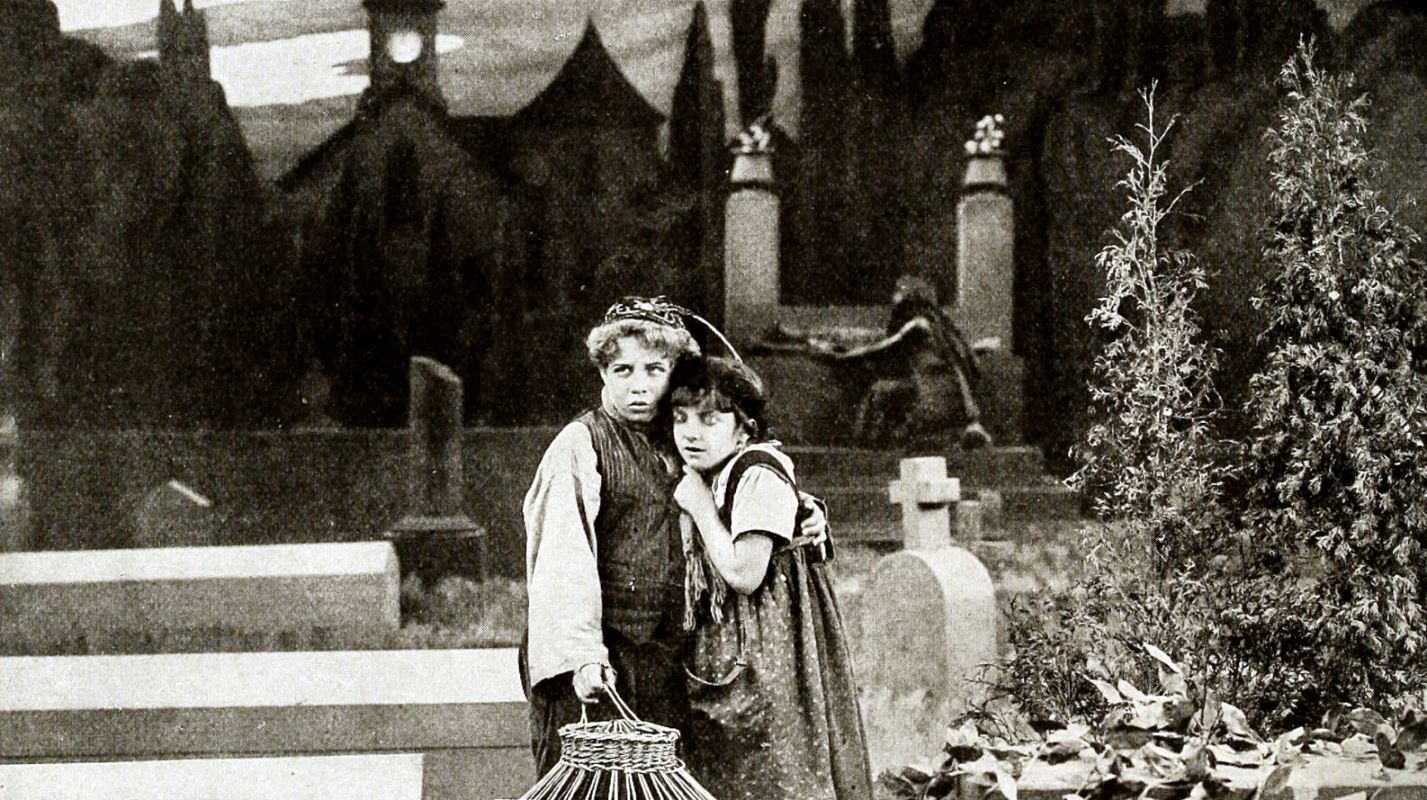
When the furniture moves for itself
Film historian Kaveh Askari describes Tourneur's stop-motion beds racing across the room and a washbasin circling a wardrobe before the household's souls appear as people. He connects these effects to designer Ben Carré's earlier work with animator Émile Cohl.[3]
A person dressed as Bread gives an abstraction a face; a moving washbasin makes an existing object seem to possess intentions. The furniture can surprise its owners before acquiring a human spokesman.
Askari also identifies superimposition in Sugar's transformation and traces Bread and Sugar's costumes to Georgette Leblanc's 1911 Théâtre Réjane production.[3] Camera effects join an inheritance of stage clothing and performance, making the household newly strange.
This was substantial studio work. The AFI catalog cites a December 1917 trade report describing enlarged crews building the film's sets at Fort Lee, New Jersey.[2] A fairy tale about the overlooked resources of a humble home required considerable resources to put on screen. That tension belongs to the pleasure: an elaborate production persuades us to look again at something as unglamorous as a washbasin.
A story that was already changing
The play itself had no single, motionless form waiting for cinema to disturb it. In his translator's note dated November 1910, Teixeira de Mattos explains that the Palace of Happiness was newly written for the Haymarket Theatre's Christmas revival. On stage it would replace the Forest scene; the printed edition retained both, expanding the work to six acts.[1]
That note changes how we read an adaptation. A difference in the itinerary need not amount to a betrayal of an immutable original. Maeterlinck had already adjusted the journey for performance. The more useful question is what a particular version enables the spectators to notice.
The film's later survival adds another material layer. Writing in 2013, historian J. B. Kaufman describes the George Eastman House restoration, with its original tinting, as derived from what was apparently the only surviving nitrate print. He notes missing main titles and visible deterioration.[4]
It also means that the fantasy reaches later audiences through preservation work. The apparent effortlessness of an enchanted room depends on people maintaining a fragile physical object. The film's afterlife gives its attention to ordinary matter an unexpectedly practical echo.
The bird must cross the threshold
The play's final scene brings the lesson back to the cottage. Tyltyl recognizes his own turtle-dove as the bird he has traveled so far to find. It seems “much bluer than when I went away.” Earlier he would not surrender it because it belonged to him. Now he carries its cage to the neighbor whose sick daughter wants it.[1]
Recognition produces an action. If the story ended with Tyltyl congratulating himself on his possessions, its homecoming would be much smaller. He learns to value the bird and gives it away in the same movement. The AFI synopsis identifies the gift to the sick girl as the film's fulfillment too.[2]
The printed play then makes happiness less secure. The girl returns with the dove. Tyltyl offers to demonstrate how it eats; as he reaches for it, she instinctively resists, and the bird escapes. This is an accident between two children who both care about it. The gift has neither abolished possessiveness nor guaranteed that something loved can be kept.[1]
Tyltyl steps forward and asks the audience to return the bird if they find it. The search passes beyond the cottage and the stage. We have been watching children learn to look; now we are asked to keep looking ourselves.
Tourneur's lively furniture gives material form to the play's demand for attention. Its quietest consequence needs no camera trick: a child takes a cage off the wall and hands it to his neighbor.
Sources
- Maurice Maeterlinck, The Blue Bird: A Fairy Play in Six Acts, translated by Alexander Teixeira de Mattos — revised English text, translator's note dated 14 November 1910, Act I, and Act VI, scene 2; Project Gutenberg.
- American Film Institute, The Blue Bird (1918), AFI Catalog — film credits, production history, and synopsis.
- Kaveh Askari, “The Blue Bird,” National Film Registry essay hosted by the Library of Congress — household animation, Ben Carré, superimposition, and the film's connections to theatrical design.
- J. B. Kaufman, “The Blue Bird (1918),” December 2013 — critical appreciation and account of the George Eastman House restoration.
- Paramount Pictures, publicity photograph for The Blue Bird, reproduced in Film Fun, May 1918 — Wikimedia Commons image record, linking to the digitized magazine at the Internet Archive.