Virginia Woolf is still too often reduced to a blur word: interiority. The reduction sounds respectful, but it misreads what makes her writing durable.[1] Woolf does not simply dissolve into consciousness. She builds conditions in which consciousness gets pressed, interrupted, staged, and measured. The British Library's overview points to the right cluster of concerns, naming the subconscious, time, the city, and modern warfare as recurring Woolf motifs.[1] What matters is how tightly those elements are engineered together.
That is why a work-centered author profile makes more sense than a biographical one. Woolf's legend can easily harden into a familiar outline of fragility, brilliance, Bloomsbury, and breakdown. The work says something sterner. Mrs Dalloway opens with a sentence so outward-facing it almost functions as a manifesto: "Mrs. Dalloway said she would buy the flowers herself."[3] To the Lighthouse opens with a domestic promise that is already shadowed by delay: "Yes, of course, if it's fine tomorrow."[4] In A Room of One's Own, Woolf turns material necessity into literary method when she says that "a woman must have money and a room of her own if she is to write fiction."[5] Across all three books, the signature is not mist. It is arrangement.
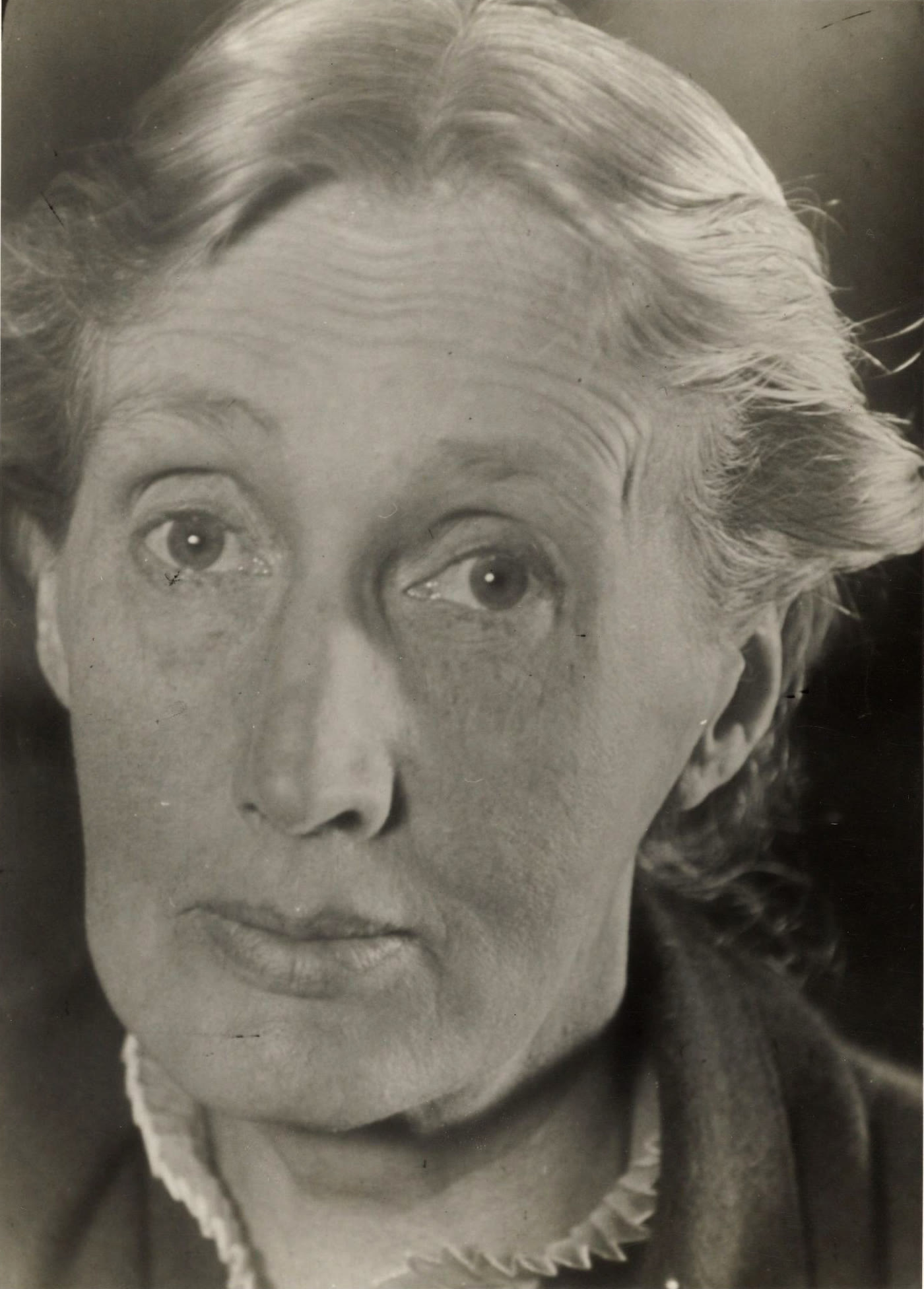
Image context: the cover uses a 1939 Harvard Library photograph of Woolf preserved on Wikimedia Commons. It suits this essay because the image catches the late public authority of a writer whose prose is often mislabeled as diffuse, when it is in fact exacting about what a face, a room, or a social surface can hold.[6]
Not a mist machine but a threshold writer
Woolf's prose moves, but it almost never floats free of the world.[1][2] The city enters through shop windows, traffic, bells, weather, and social errands. The house enters through stairs, dinner tables, corridors, and the management of guests. A Woolf sentence may pivot inward, but it usually begins from a threshold where outer pressure crosses into private sensation.
That is what the famous first movement of Mrs Dalloway actually demonstrates.[3] Clarissa stepping out to buy flowers is not a decorative pretext before the "real" inward novel begins. The errand is the form. Woolf uses the street to show that selfhood is porous: memory arrives with movement, status arrives with shops and servants, mortality arrives with sound, and the city keeps cutting into thought before thought can pretend it is sovereign.[2][3] David Bradshaw's British Library essay on Woolf's London is useful here because it stresses not just the city's beauty but its excitement and inequalities.[2] Woolf loved London, yet she never writes it as a neutral backdrop. It is a pressure field.
Once you see that, "stream of consciousness" stops being a vague compliment and becomes a technical description with limits.[1] Woolf is not interested in dumping all mental content onto the page. She is interested in what happens when consciousness is punctured by shared time and common space. Her minds are not sealed chambers. They are membranes.
The clock outside the self
Woolf's modernity also lies in the way she externalizes time.[1][2] In weaker psychological fiction, inwardness simply accumulates. In Woolf, it is repeatedly struck by public measures: clocks, appointments, social rituals, visits, weather, the prospect of travel, the memory of war. The self does not own time; it is forced to live inside it.
That structure is plain in Mrs Dalloway, where one day in June has the density of a whole life.[3] Clarissa's burst of feeling, her memory of Bourton, her party preparations, Septimus's breakdown, and the city's recurring sounds all exist under the same civic clock. The reader never gets the luxury of treating private consciousness as private property for long.[2][3] Woolf keeps reminding you that subjectivity has a public meter.
To the Lighthouse sharpens that pressure by making a promise do almost all the opening work.[4] "Yes, of course, if it's fine tomorrow" sounds gentle. It is also Woolf's way of placing desire under contingency from the first line.[4] The trip to the lighthouse becomes less a plot point than a test of how hope survives postponement, parental authority, weather, and time's indifference. Then the middle section, "Time Passes," strips the house of human centrality and lets duration itself become an active force.[4] Woolf's reputation for delicacy can hide how ruthless this is. She does not merely notice passing time. She lets time repossess the scene.
So when readers say Woolf made the novel more interior, that is true only if we add the missing half of the sentence: she made interior life more answerable to external structure.[1][3][4] Her great move was not withdrawal from the world, but a new contract between mind and interval.
The room as enabling condition
The sentence from A Room of One's Own is quoted so often that it can lose its edge.[5] Read inside Woolf's wider body of work, it becomes less a slogan about comfort than a statement about form. Money and a room are not luxuries in the essay's logic. They are the material preconditions for sustained attention, for the right to shape experience instead of merely absorbing it.[5]
That insight reorganizes the fiction. Woolf's rooms are never just shelters. They are instruments. Clarissa's drawing-room world is where sociability turns into choreography; the Ramsay house becomes a vessel in which authority, resentment, art, and decay can all register at once; the imagined room of the woman writer names the minimum boundary required for art to exist under unequal conditions.[3][4][5] Woolf cares about thresholds because she cares about permeability, but permeability alone is not enough. The boundary has to exist first.
This is why Woolf's work still feels fresher than the stereotype attached to it. She is not a novelist of vague inward drift. She is a novelist of controlled exposure. She keeps asking how much of the world a consciousness can admit without losing shape, and how much shape it needs in order to admit the world truthfully.[1][5]
Why the profile still feels current
Woolf now reads like a writer who understood interruption before the digital age made interruption ordinary.[1][2] She knew that perception is montage-like, that the mind is crowded by scraps, shocks, returns, and ambient pressure. But she refused to make fragmentation an alibi for looseness. Her books are full of permeability, yet they are also full of architecture.
That is the real continuity across Mrs Dalloway, To the Lighthouse, and A Room of One's Own.[3][4][5] The street, the summer house, and the writer's room are not separate symbols. They are three scales for the same question: under what conditions can a self register the world without being erased by it? Woolf's answer is neither solitude alone nor immersion alone. It is patterned exposure. She gives the novel moving minds, but she also gives those minds bells, windows, errands, weather, money, and walls.
Put that way, her authorial system looks less like a period style and more like a permanent reading tool.[1][2] Woolf teaches that consciousness is social before it is expressive, spatial before it is abstract, and temporal before it is confessional. That is why she remains modern. She does not ask us merely to go inward. She teaches us how inward life is built from rooms, clocks, and the city's pressure.[1][3][4][5]
Sources
- The British Library, "Virginia Woolf."
- David Bradshaw, "Virginia Woolf's London," The British Library.
- Virginia Woolf, Mrs Dalloway (Project Gutenberg Australia text).
- Virginia Woolf, To the Lighthouse (Project Gutenberg Australia text).
- Virginia Woolf, A Room of One's Own (Project Gutenberg Australia text).
- Wikimedia Commons, "File: Virginia Woolf 1939.jpg" (Harvard Library archival photograph source page).