Silas Marner is often reduced to a neat Victorian sentence: miser loses gold, finds child, becomes human again. The outline is true, but it is too smooth for what George Eliot is actually doing. The novel is built around a harsher question. What happens when a man has been cut out of trust so completely that he can hold on only to things that do not answer back? In Eliot's design, the real movement is not from selfishness to kindness. It is from sealed accumulation to reciprocal attention.[1][2][3]
That is why the novel still feels sharper than its reputation in 2026. Eliot published it in 1861, but the pressure it studies is not antique: a life can become efficient, repetitive, and self-protective long before it becomes visibly cruel.[2][4] Silas does not begin as a stock miser. He begins as a man whose faith, friendship, and social meaning have collapsed with Lantern Yard. The gold comes later as a substitute system, and Eliot spends the whole book showing why that system can never be enough.[1][3]
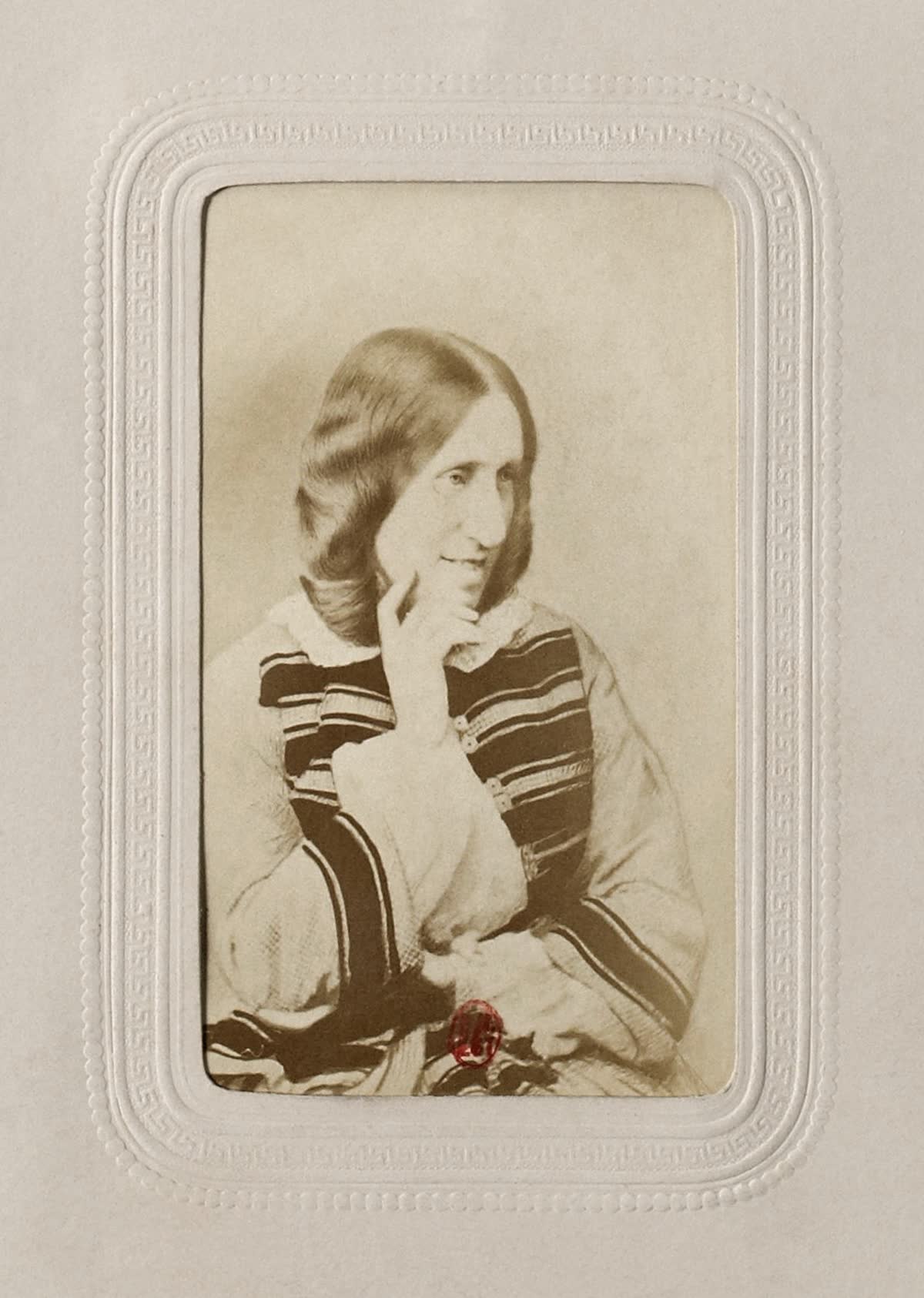
Image context: the cover image is an archival photographic portrait of George Eliot from Wikimedia Commons, sourced from Gallica. It belongs here as author-context for a novel whose strongest transformation is not spectacular redemption, but a patient change in scale: from loom and coin to hearth, child, neighbor, and season.[5]
1) Eliot first turns Silas into a machine
The opening chapters are some of Eliot's bleakest prose about work. Silas's body and tools have settled into a "constant mechanical relation" with one another, and the loom's repetition becomes the rhythm of his whole existence.[1][3] Eliot is precise about how this happened. The betrayal at Lantern Yard has not simply made him sad. It has collapsed the institutions that once connected labor, belief, and affection. In Raveloe, weaving remains, appetite remains, bodily habit remains, but shared meaning does not.[1]
That is why the early gold scenes matter so much. When Eliot says Silas "loved no man" to whom he might offer a share of his earnings, she is not describing ordinary thrift.[1] She is describing a world in which money has survived relation. The coins are attractive because they are tangible, countable, and obedient. They do not misread him, accuse him falsely, or vanish into doctrinal fog. They stay where he puts them. They return the pressure of his touch with the same hard surface every time.
In that sense, Silas's avarice is not expansion but contraction. His life keeps shrinking toward what can be controlled by hand. Eliot even makes his pleasures tactile before they are abstract: counting, sorting, feeling rounded outlines, letting habit turn possession into ritual.[1] The gold is not merely wealth. It is an anti-social prosthesis.
2) Gold gives him sameness; Eppie gives him time
Eliot states the contrast more cleanly than most of the novel's reputation does. The gold keeps Silas's mind in an "ever-repeated circle"; Eppie arrives as a creature of "changes and hopes."[1] That difference is the essay's key. Gold offers repetition without development. It enlarges a store while narrowing a life. Eppie does the opposite: she interrupts labor, disordering the weaver's schedule while reopening his senses to growth, weather, noise, other households, and the future.[1][2]
The famous hearth scene is therefore much more than sentimental substitution. Eppie first appears as a gleam in the snow, and Silas momentarily mistakes her golden hair for the return of the guineas.[1] Eliot lets the error happen because she wants the reader to feel how strong the old groove still is. But the correction begins at once. Coins lie still; children demand sequence. Gold can be locked away from daylight; Eppie must be washed, fed, watched, carried, taught, and answered. Gold lets a man remain identical to yesterday; a child forces him into tomorrow.
This is why touch matters so much in the middle movement of the novel. Silas had once bathed his hands in coin. Now those same hands are occupied with clothing, food, sleep, flowers, and the practical comedy of childcare.[1] The scale of value changes from storage to maintenance. That is the book's real conversion.
3) Raveloe is not ideal, but it is habitable
Another simplification about Silas Marner is that Eppie alone saves him. Eliot is more exact. Eppie reopens Silas, but Raveloe gives that opening social form. Dolly Winthrop's patient kindness, the village's rough customs, the church rituals Silas does not fully understand, and the ordinary fact of neighboring households all help turn private attachment into durable belonging.[1][2]
This is one place where Eliot's larger moral imagination matters. The Stanford Encyclopedia's account of her fiction repeatedly returns to sympathy as both emotional and cognitive discipline, not mere softness.[3] That fits Silas Marner exactly. Silas is not healed because he has one strong feeling. He is healed because feeling starts carrying knowledge again. Through Eppie, he relearns what other people need, how custom works, what seasons ask of a household, and how one's own life can be measured by another person's flourishing.
Raveloe, importantly, is not utopia. It is provincial, credulous, and sometimes coarse. Lantern Yard is never restored; the old injustice is never truly repaired; the novel's late return to the city finds the place itself erased into commercial anonymity.[1][2] Eliot keeps that loss intact. Moral repair does not mean historical reversal. It means building a livable present at a smaller, humbler scale than metaphysical certainty once promised.
4) The ending refuses inheritance logic
The last movement confirms how thorough the change has been. Godfrey can offer Eppie money, status, and legal recognition. Those things matter in the world of property, but Eliot has spent the whole novel teaching us that property is not the deepest unit of attachment here.[1][2] Eppie stays with Silas because her life with him has been made in use, memory, and chosen habit. The bond is not theoretical; it has been woven day by day.
That choice also clarifies what the book means by fatherhood. Silas is not redeemed by possessing a child in place of coins. He becomes a father because care has trained his perception outward. By the time the novel closes, he has learned customs he once regarded as alien, accepted advice he once could not hear, and recovered a dim but real sense of goodness in a world he no longer experiences as blank hostility.[1]
So what Silas Marner heals is not simply loneliness. It heals a distortion of scale. In the gold years, Silas lives at the size of a locked room, a loom, and a pile of coins. After Eppie, he lives at the size of meals, errands, seasons, neighbors, memory, and a future that can no longer be counted one piece at a time.[1][3][4] That is why the novel keeps its force. Eliot knows that moral life rarely returns through revelation. More often it returns through the stubborn, ordinary fact that another living being keeps making claims on your time, your body, and your imagination.
Sources
- George Eliot, Silas Marner (Project Gutenberg HTML text).
- Encyclopaedia Britannica, "Silas Marner".
- Nancy Henry, "George Eliot," Stanford Encyclopedia of Philosophy.
- Encyclopaedia Britannica, "George Eliot".
- Wikimedia Commons, "File:George Eliot BNF Gallica.jpg" (lead image source).