César Vallejo’s “The Black Heralds” begins with a certainty and immediately runs out of explanation. Life deals terrible blows; the speaker cannot say what to make of them. Rebecca Seiferle translates his recurring admission as “I don’t know!” Robert Bly makes it “Don’t ask me!” The difference is small enough to pass unnoticed in a reading, yet it changes the room. An inability to explain has become something said to another person.[1][2][3]
The poem opens Vallejo’s first collection, published in Lima in July 1919, although its title page bears the year 1918. The Biblioteca Nacional del Perú attributes the delay to the unsuccessful wait for a promised preface by Abraham Valdelomar. The book finally appeared with its own arresting threshold: a voice trying to speak about suffering before it has found a language equal to it.[4]
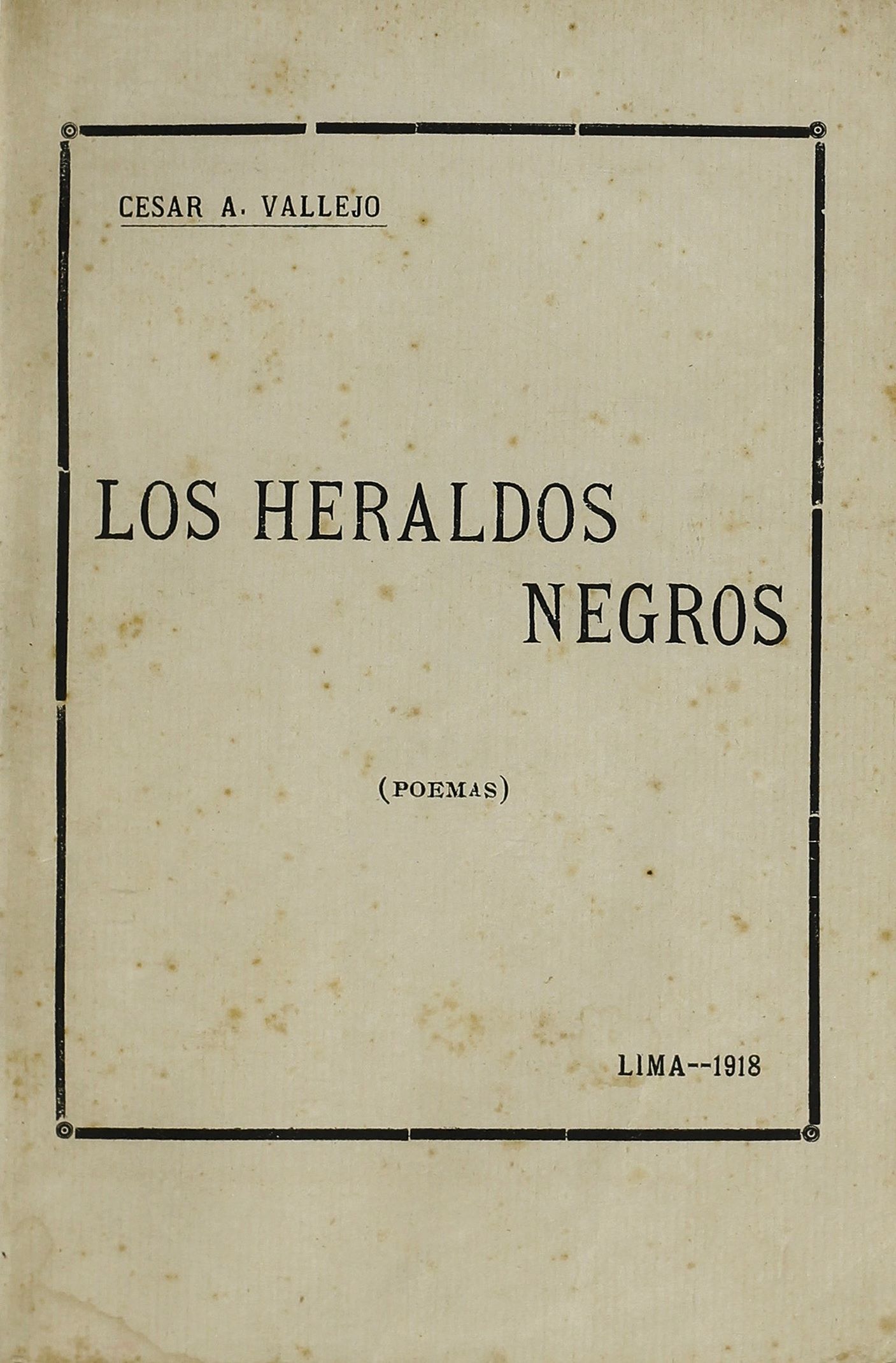
An admission acquires a listener
The Spanish refrain, “Yo no sé,” appears in lines 1 and 4, then returns in the seventeenth and final line. Between those appearances, the poem offers images of violence, damaged faith and ordinary sustenance going wrong. Its return matters because the images have not produced an answer. The speaker has found ways to make the blows felt without establishing why they happen.[1]
Seiferle’s version keeps the statement directed at the speaker’s own knowledge. The exclamation mark gives it force: this is bewilderment with pressure behind it, rather than a mild hesitation. In the opening line, the ellipsis arrives after the description of the blows’ intensity. We seem to approach an explanation, then hear the voice acknowledge its limit.[1][2]
Bly’s imperative introduces an implied you. It can sound defensive, exhausted, intimate or even conversationally wry. Someone might say it while turning away; someone else might say it to a friend who already understands. Those are possibilities created by the English, not stage directions supplied by Vallejo. The translation makes a relationship audible where the Spanish explicitly reports a state of mind.
Critic John Cotter identifies this contrast in his review “One Man’s César Vallejo.” He places Bly’s translations within the American poets’ attraction to Deep Image poetry and its imaginative leaps toward the unconscious. That context helps explain why a lively English utterance might take priority over the precise grammar of an admission. It also keeps the comparison from becoming a spelling test with one correct answer: an expressive gain can carry an interpretive cost.[3]
For this poem, I prefer the admission. Its uncertainty leaves the listener free to stay nearby. The imperative gives the listener a more definite role, even when spoken tenderly. Yet Bly catches something an overly solemn translation could lose: the abruptness with which a human voice breaks into the poem’s large, ominous imagery.
Suffering collects before it overflows
The refrain is easier to hear when we follow the water around it. In the first stanza, past suffering returns as a resaca, an undertow or backwash, and threatens to gather within the soul. Near the end, everything the afflicted person has lived through collects in his gaze. Vallejo links the moments through forms of the same verb: empozara in line 4 and empoza in line 16. The later image explicitly gives that accumulation the shape of a pool.[1]
Seiferle preserves the connection through “well up” and “wells up.” Her English makes an inward pressure perceptible. Something rises toward the surface, ready to become visible. A rendering built around pooling would put more weight on what remains trapped or gathered. Both can convey accumulation; they make us imagine its movement differently.[2]
That distinction affects the refrain. If grief wells up, the speaker sounds close to being overwhelmed by what has returned. If grief pools, he seems to confront an accumulation that will not disperse. Neither image supplies a cause for the original blows. It gives uncertainty a physical situation: the person trying to understand is also the person in whom everything is collecting.
The change from suffering to the whole of lived experience is equally unsettling. At the end, the returning material includes more than a catalogue of injuries. The gaze holds a life, colored by guilt. On this reading, the poem shows how a blow can alter the way someone sees everything that preceded it. The feeling of guilt is part of that experience; it does not establish that the sufferer deserved the blow.[1]
The small word beside the burning bread
In the third stanza, the poem moves from injured faith to bread burning at an oven’s entrance. The sudden domestic scale gives the reader something almost painfully recognizable after the religious language. Food that should sustain someone is being lost at the moment it seems close to readiness.[1]
The Spanish phrase se nos quema includes a small but consequential nos: the burning happens to us, affects us. Seiferle’s “burns up on us” keeps that involvement in ordinary English. Her phrasing makes the loss feel like something we were depending on that has gone wrong. It does not require us to identify who left the bread there or decide whether carelessness caused the burning.[1][2]
This shared involvement complicates the opening’s solitary admission. Elsewhere, death sends its messengers to us; later, a touch on the shoulder summons us. The poem keeps moving between one bewildered voice, an observed suffering person and a collective vulnerability. Its pronouns make company possible even when explanation fails.[1]
That is what hangs on the choice between admitting ignorance and redirecting a question. At the close, Vallejo repeats the opening line without resolving its uncertainty. But we have heard the water gather and watched the bread burn. The repeated words now reach a listener who has been given something to recognize. A translation can preserve that quiet change: the speaker still cannot explain, while the reader is better able to remain with him.
Sources
- César Vallejo, “Los heraldos negros,” Spanish text on Wikisource. Line references count the seventeen verse lines, excluding the title.
- César Vallejo, The Black Heralds, translated by Rebecca Seiferle, Copper Canyon Press (2003). Publisher’s page reproducing the title poem; source for the English refrain, water verbs and burning bread.
- John Cotter, “One Man’s César Vallejo,” Open Letters Monthly (June 1, 2007). Review quoting Bly’s alternative refrain and discussing the American translation context.
- Biblioteca Nacional del Perú, “En la biblioteca digital puedes leer gratis ‘Los heraldos negros’ de César Vallejo” (October 2, 2019). First-edition publication date and explanation of the delayed preface.
- Biblioteca Nacional del Perú, catalogue record for Los heraldos negros, item 12676. Title-page photograph, 1918 imprint corrected to 1919, and provenance of the copy dedicated to José María Eguren.