The first time the candle goes out, it hits someone on the head. Four friends have settled into a supposedly haunted house with whisky, pipes, and cards. Meagle, their self-appointed master of ceremonies, has stuck the candle on the mantelpiece badly. It falls. He laughs; Barnes strikes a match and puts it back. For a moment, the frightening event has an explanation and the explanation has a remedy.[1]
That small repair is worth remembering. Later, the same light will pass between the men, illuminate bodies that will not wake, burn a friend's finger, and finally disappear in a draught. In W. W. Jacobs's “The Toll-House,” collected in Sailors' Knots in 1909, household objects keep changing their uses. Following the bell, candle, and broken balusters shows how a practical joke can outgrow the person who thinks he is directing it.[1]
This essay discusses the ending. Scene references follow the complete text in source 1.
A bell that still knows its job
The story begins over tea at the Three Feathers Inn. Barnes dismisses ghost stories, but Meagle controls something more immediate: the teapot. He serves the other two men first, then tells the impatient Barnes to ring for hot water. A little later, Lester rings to summon the landlord. Bells belong to a working household, where a gesture produces an answer.[1]
The haunted house offers the same fittings without the people who make them useful. Meagle insists on knocking at the front door, although the landlord has told them about a window they can use. He pretends to rebuke the servants for keeping them waiting. Once inside, he pulls a bell-handle to request the water missing from their whisky. A bell sounds in the distant kitchen. Nobody brings anything.[1]
His performance depends on treating an abandoned building as an establishment where he can expect service. The joke is easy to share while the four men remain together. But the bell's mechanical success makes its social failure audible: the handle works, the sound travels, and the expected reply never arrives.
Barnes thinks he hears a door opening and footsteps below. Meagle greets this with delight. He has decided in advance what his companion's fear means: the unbeliever is coming round. Any sound can become evidence that the entertainment is working.
This comic beginning fits the wider Jacobs. Brigham Young University's Modernist Short Story Project emphasizes how much of his writing was humorous, despite the fame of “The Monkey's Paw.”[2] Here, control of the tea and control of the conversation belong to the same small social bully. The ghost story begins before anything unmistakably ghostly happens, in the pleasure of making someone else uncomfortable.
Light for looking, light for hurting
The candle initially makes that discomfort manageable. Meagle carries it through the house, showing his companions where the balusters have broken away. Upstairs, he fixes it to the mantelpiece. Barnes repairs the arrangement when it falls. The light gives them a common view of their surroundings; its ordinary failure can be put right.[1]
Barnes describes himself as “nervous but rational.” That distinction is more intelligent than his friends allow. He can feel afraid without accepting a supernatural explanation. He can also think leaving would be sensible without conceding that ghosts exist. Meagle's teasing makes those positions difficult to maintain in company.[1]
Then White falls into a sleep from which shaking and shouting cannot rouse him. Lester follows. Barnes takes down the candle and stands over them, dripping tallow on the floor. Meagle wants to escape immediately. Barnes resists abandoning the sleepers and puts the light back so that he can try again to wake them.[1]
The exchange matters because the practical object distinguishes two responses to uncertainty. One man wants to get himself out; the other pauses over what leaving would mean for his friends. Barnes's fear has not prevented him from recognizing an obligation.
After Meagle apparently falls asleep too, Barnes goes into the corridor and challenges whatever may be there. Only then does Meagle lift his head. His own collapse was a performance. He now worries that they have driven Barnes mad, but White and Lester still do not respond when he tries to end the joke.[1]
The candle changes hands again. Meagle holds its flame to White's finger. The light that helped the group see now becomes an instrument for forcing a response from a body. In the morning, White will inspect a blister: the attempted test has left a real injury, whatever explanation the reader gives the night's events.[1]
Jacobs makes this disturbing without stopping for a verdict on Meagle. We have watched his demands become more desperate. Ringing, laughing, shaking, burning: he keeps trying to make the world answer him. The candle can expose a face or hurt a hand. It cannot guarantee that he understands what he sees.
The gap everyone has already seen
Meagle carries the flame into the passages, following footsteps he hopes belong to Barnes. He must move slowly enough to keep it alight. At a kitchen doorway, cold air extinguishes it. Earlier, a fallen candle was a comic interruption that Barnes could repair. Now the loss of light leaves Meagle alone with sounds whose source he cannot identify.[1]
The front door also changes its promise. On arrival, it was an opportunity to stage an entrance. During his flight, Meagle's search narrows to one hope: reach the stairs and open the hall door. He remembers where to go, but finding the stairs will not be enough to protect him.
Jacobs has already shown us the gap in the balusters. Meagle himself illuminated it, connecting it with the landlord's account of a tramp found hanging there. The detail carries both a story and a physical danger. Once absorbed into the ghostly anecdote, it is easy to remember as atmosphere and forget as a place where a person might fall.[1]
During the final pursuit, Meagle runs for the stairs and moves aside as the footsteps gain on him. Then he falls. Morning brings a much clearer view: Barnes wakes near the broken railing, the others join him, and they discover Meagle's body below.[1]
The return to that gap gives the ending a material shape without explaining everything. We know Meagle pretended to sleep. We do not thereby know that White and Lester did, or that Barnes knowingly pursued him. Barnes cannot remember reaching the place where he wakes. The blister proves that the flame touched White; it does not tell us why he failed to wake. Each object supplies evidence with a limit.
A comfortable place to be frightened
The story's later publishing life restores the comfort its characters abandon. Biblioasis's 2017 catalogue places The Toll House in its Christmas Ghost Stories series, selected and illustrated by Seth. The surrounding copy presents small books suited to seasonal gifts and reading at home.[3] That setting offers a pleasing reversal: readers can remain in comfort while Jacobs's walkers leave their beds behind.
The pleasure of that arrangement depends on the writing's precision. A bell carries a request into an empty kitchen. Wax drops while a man hesitates over his sleeping friends. A light reveals a gap that will matter later. These details invite us to notice what the characters cannot keep steadily in mind.
By morning, the house has yielded a body and a burnt finger. Its bell could ring, its candle could burn, and its broken railing could fail to protect. The men's confidence rested on the much less reliable expectation that someone would answer when called.
Sources
- W. W. Jacobs, “The Toll-House,” in Sailors' Knots (1909), Part 7; Project Gutenberg—complete primary text, from the Three Feathers tea table through the final discovery.
- Isaac Robertson and Maddie Holbrook, “W. W. Jacobs,” Brigham Young University's Modernist Short Story Project—Jacobs's predominantly humorous writing and literary context.
- Biblioasis, Fall 2017 Catalogue, pp. 12–13—Christmas Ghost Stories selected and illustrated by Seth, including the 2017 edition of The Toll House.
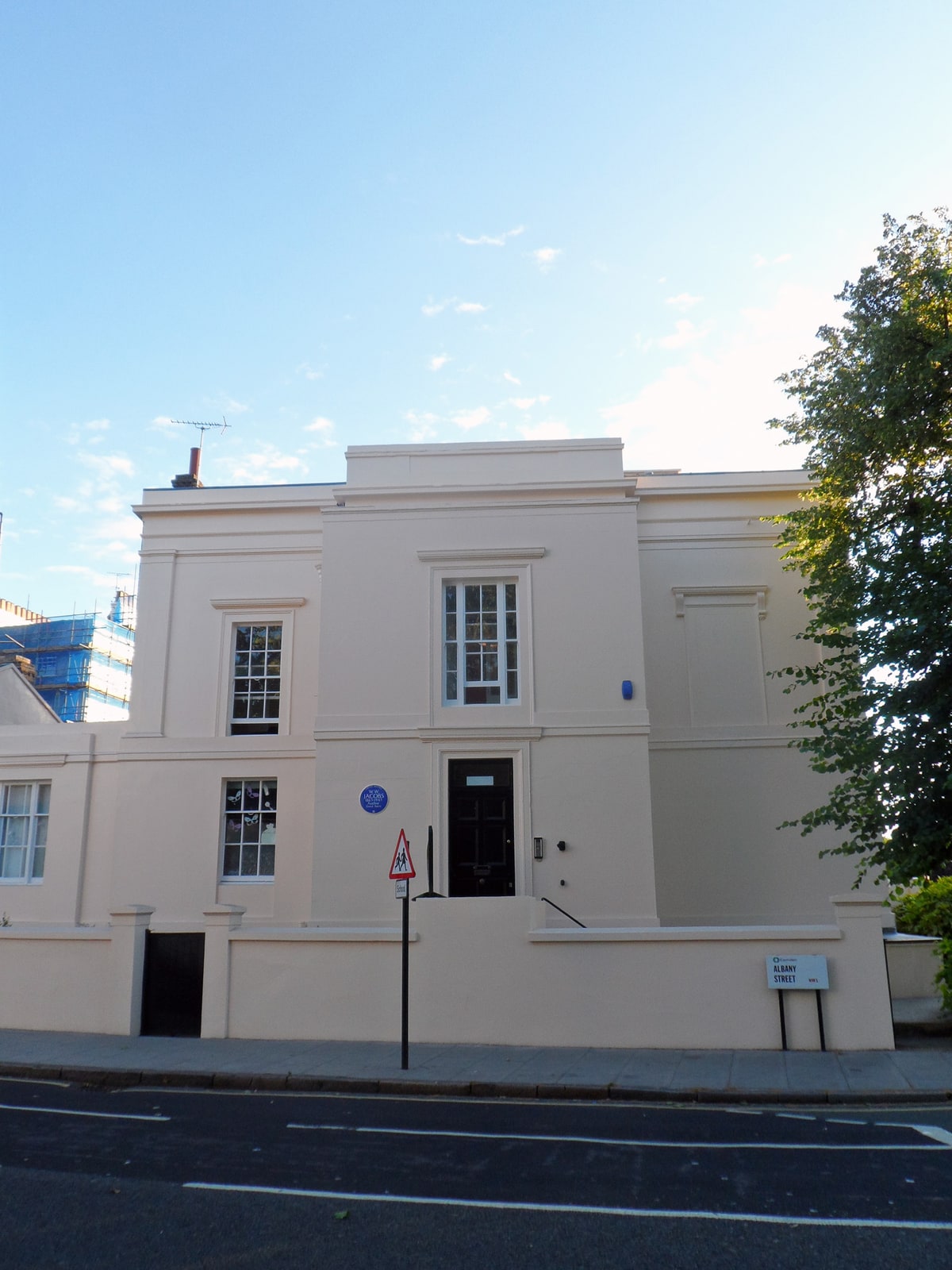
- Spudgun67, photograph of W. W. Jacobs's former home at 15 Gloucester Gate, Albany Street frontage, London, July 7, 2015; Wikimedia Commons—image provenance, CC BY-SA 4.0.