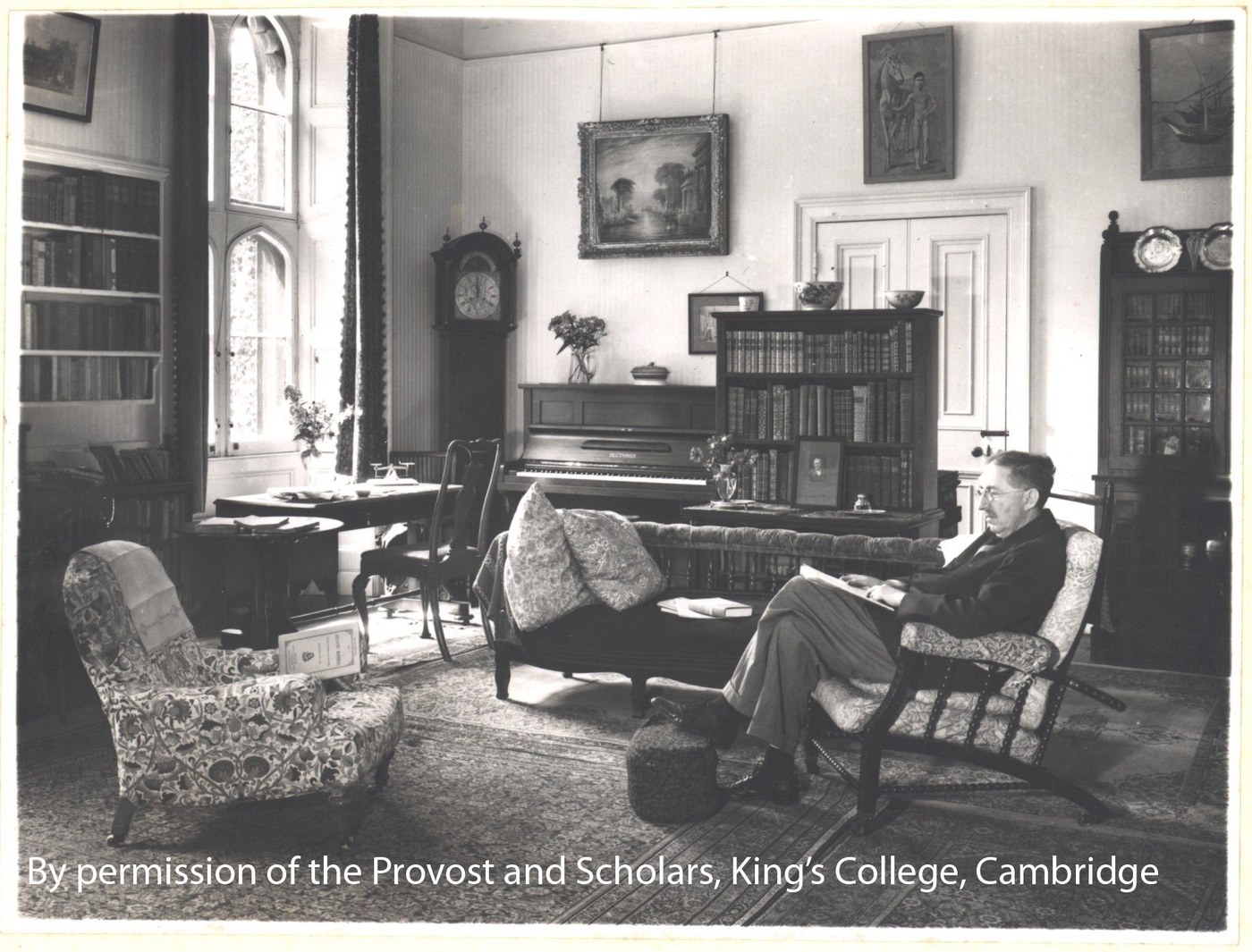
At the end of E. M. Forster's “The Road from Colonus,” an old man complains about water in the plumbing. Earlier, water flowing from a hollow tree had made the world seem newly intelligible to him. Now he wants to write to the landlord. His daughter has just discovered that their departure from a Greek inn saved his life. He scarcely attends to her explanation.[1]
The ending delivers its shock through an ordinary sound. The water returns; the capacity to hear it as anything beyond a nuisance has gone. But what should a reader feel toward the survivor? A published exchange in Connotations turns that question into an argument about Forster's art: whether his irony leaves Mr. Lucas too little inner life, and whether the author might be implicated in the vulnerability he depicts.[3][4]
This essay discusses the complete story, including its ending.
A classical holiday goes wrong
Forster knew Greece through travel as well as books. King's College's biographical account records his classical education, travels with his mother, and a Greek cruise with fellow Kingsmen.[2] “The Road from Colonus,” published in June 1904, belongs to this early period; the text cited here appears in a 1912 edition of The Celestial Omnibus, and Other Stories.[1][4]
The story gives its tourists a classical vocabulary that seems to explain everything in advance. Mrs. Forman calls Lucas's daughter Ethel “Antigone,” assigning her the role of companion to an aging Oedipus. Lucas finds himself expected to inhabit the corresponding part. In Sophocles' Oedipus at Colonus, the displaced old king reaches a sacred grove and ultimately dies; Forster's title announces a journey away from that destination. This classical frame is central to both critics' readings.[1][3][4]
Yet Lucas's revelation begins with something less grand than a tragic identity. Inside the hollow plane tree, he sees small votive offerings: models of limbs and organs left in gratitude for recovery. Other people's troubles and hopes have already occupied the place he thought he might possess. Forster writes, “There was no such thing as the solitude of nature.”[1]
That sentence changes the scene. Lucas's escape from his companions leads him toward evidence of other lives. The old woman spinning, the young man arriving on a mule, even the pig acquire significance. He imagines leaving a model of an entire person as his own offering. My reading is that his renewal involves a temporary release from treating everything as an extension of his discomfort.
The release is difficult to communicate. When he tries to express his delight, he produces “It impresses me very favourably.”[1] The language sounds like a cautious hotel recommendation. Forster puts an expansive experience beside the cramped social vocabulary available to report it. Lucas can be ridiculous while something important is happening to him.
White: what the ending takes away
In her 2006/2007 essay, Laura M. White reads the tourists as successors to Coleridge's person from Porlock, the visitor blamed in the preface to “Kubla Khan” for interrupting its composition. On her account, social pressure destroys Lucas's inspiration. The final return to plumbing completes that destruction.[3]
White's reservation concerns its completeness. Coleridge's speaker can still long for a vanished vision; Lucas seems unable even to register his loss. She questions the plausibility of so powerful an experience leaving so little inward residue. His final pettiness, she argues, prevents the dignity of tragedy and leaves him available for irony. The story's concern with inspiration is therefore also a problem of representation: how much humanity has the ending sacrificed to make its point?[3]
This objection sends us back to the breakfast table. Lucas has a brief, troubled response when the Greek inn is mentioned, then returns to his grievances. Forster lets recognition flicker without developing it into an account Lucas can tell.[1] The reader must hold the two versions of the man together.
Mei: the author inside the joke
Shenyou Mei's 2022 response explicitly offers a biographical supplement to White. He proposes that Lucas partly represents the young Forster, while Ethel's supervision reworks the author's dependence on his mother, Lily. Anxiety about losing inspiration links the character to the writer. Under this interpretation, the irony becomes partly self-directed: Lucas can be pitiable as well as laughable.[4]
The suggestion usefully changes the emotional distance. A writer imagining his own susceptibility to diminished feeling might portray the collapse harshly because he fears it. Still, the identification remains a critical inference. Mei acknowledges that no recorded incident shows Lily literally interrupting Forster's creative work in the manner of the visitor from Porlock. His broader claim about her role in the loss of Forster's inspiration should not be mistaken for an established cause.[4]
The two essays leave us with different pressures on the same ending. White asks whether its erasure convinces; Mei makes room for authorial vulnerability within its cruelty. Biography may enlarge sympathy, but the story must also produce its effects for someone who knows nothing about Forster's home life.
The rescue has two witnesses
Consider how the departure is staged. Ethel recruits Mr. Graham, who physically lifts Lucas onto his mule. Graham then punches a young Greek man who tries to intervene. Ethel admires his strength. The narrator calls the retreating Greeks “the rescue party, if such it is to be considered.”[1] For a moment, the word rescue belongs to the people trying to keep Lucas there.
The final newspaper report reverses the practical evidence. The tree blew down that night and killed the inn's occupants. Ethel has sound reason to be horrified at how narrowly her father escaped. Forster gives her account a fact that cannot simply be dismissed because her manners and assumptions repel us.[1]
What she cannot measure is the change the reader has witnessed. At breakfast, her speech about deliverance and his complaint about noise run alongside each other without meeting. Earlier, the stream made Lucas receptive to a whole scene; now running water supplies another reason to shut the world out. This contrast makes his survival emotionally unsettled without requiring us to treat death as the proper reward for revelation.
For me, the ending's force lies in that unequal distribution of memory. Lucas cannot sustain the significance of the grove, Ethel can explain the escape, and the reader remembers both. White is right to make us question the abruptness of his collapse; Mei helps explain why ridicule need not exhaust our response. The story leaves its fullest act of attention to someone outside the breakfast room: the person who can still hear the spring when Lucas complains about the pipes.
Sources
- E. M. Forster, “The Road from Colonus,” sections I–II, in The Celestial Omnibus, and Other Stories, 1912 edition. Project Gutenberg; primary text for the grove, forced departure, and final breakfast scene.
- King's College, Cambridge, “Biographies,” entry for Edward Morgan Forster. Background on his classical education, family life, and early European travels.
- Laura M. White, “The Person from Porlock in ‘Kubla Khan’ and Later Texts: Inspiration, Agency, and Interruption,” Connotations 16.1–3 (2006/2007), pp. 172–193, especially 184–189. The Coleridge connection and the objection to Lucas's loss of inwardness.
- Shenyou Mei, “Forster's Self-Ironizing in ‘The Road from Colonus’: A Response to Laura M. White,” Connotations 31 (2022), pp. 112–125. Publication context and a biographical interpretation of inspiration, dependence, and self-directed irony.
- Bonhams, Fine Books and Manuscripts, 9 November 2022, lot 286, Forster's Morris armchair. Source of the archival room photograph, credited in the catalogue to the Provost and Scholars of King's College, Cambridge.