
“The Weary Blues” begins as an act of listening. Its speaker hears a pianist on Lenox Avenue, watches his body move, quotes his singing, and stays with the sound after the player has gone to bed. Even before music is added, the poem contains at least two voices and an instrument: an observing narrator, a blues singer, and a piano that seems to answer both. The opening phrase, “Droning a drowsy syncopated tune,” does more than describe rhythm. Its clustered sounds make the reader's mouth enter that rhythm.[4]
The poem appeared in 1925 and gave its name to Hughes's first collection in 1926, when he was twenty-four.[2][3] The Academy of American Poets notes that Hughes expected poems from the book to be performed with musical accompaniment and that the title poem moves among different voices.[3] That history makes the surviving 1958 television performance more than an author reading a favorite old work. Thirty-three years after publication, Hughes places a poem built from remembered music beside musicians who can answer in the present tense.
There is cultural weight in that choice. Hughes treated jazz and the blues as Black art forms capable of carrying both hardship and self-definition; he listened in clubs, read with ensembles, and collaborated with major musicians.[2] “The Weary Blues” does not convert a blues performer into picturesque background. It gives the musician work to do: his foot keeps time, his hands make the piano speak, and his song turns solitude into public form. The poem's weariness is real, but so is the craft that shapes it.
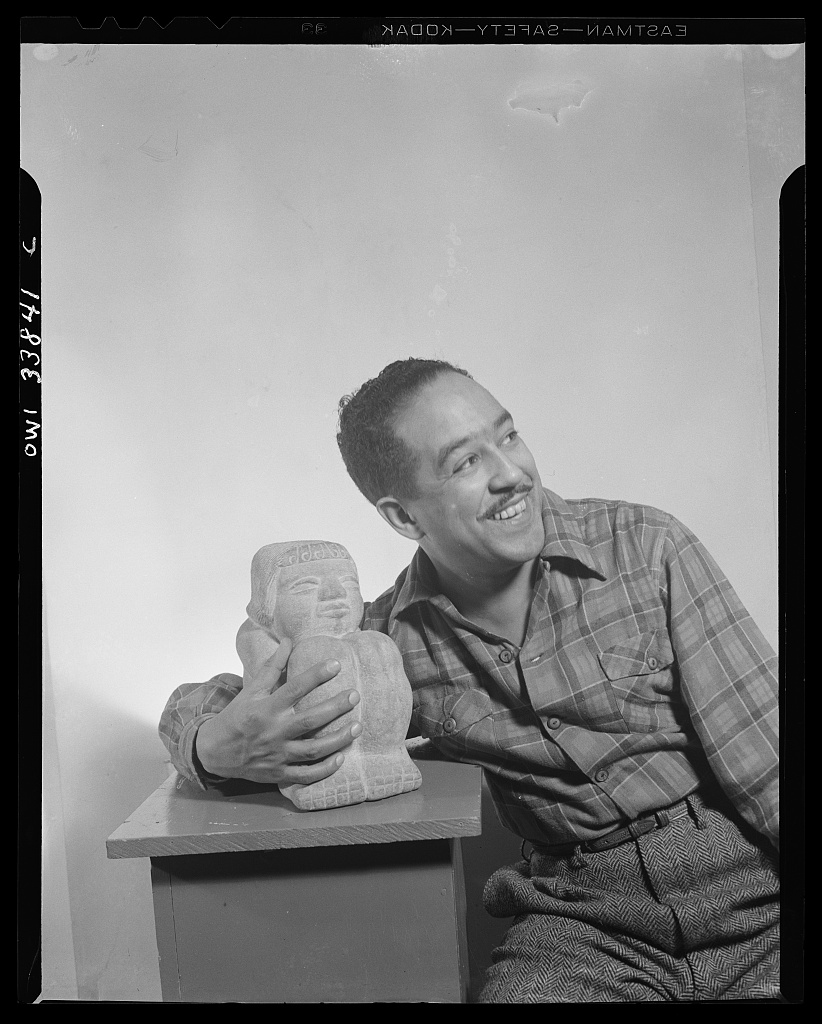
The cover photograph supplies a separate piece of archival context. Gordon Parks made the portrait for the U.S. Office of War Information in 1943, fifteen years before the broadcast. It should not be read as an image of the Canadian appearance. Instead, it records another camera's encounter with Hughes as a public literary figure, while the television clip below lets posture, timing, voice, and collaboration unfold rather than freeze.[7]
What the recording preserves
The online clip is the vanalogue upload titled “Langston Hughes — ‘The Weary Blues’ on CBUT, 1958.” Its underlying footage comes from CBUT, CBC's Vancouver station, and the program The 7 O'Clock Show; the accompaniment is by the Doug Parker Band.[1][2] Those details matter because this is not a later montage laid over a studio recording. It is a television performance: a poet, an ensemble, and a broadcast frame sharing one brief event.
The upload is also a modest archive rather than a complete institutional record. Its title identifies the poem, station, and year, but it offers little production documentation on its own.[1] The National Endowment for the Arts corroborates the program and band, while the Poetry Foundation discusses the same footage as an example of what online video can restore to poetry: an author's cadence, manner, and conception of a text that readers may have carried silently for years.[2][5] That combination—fragile online object, independently documented event—is precisely why the clip deserves close viewing.
The first surprise is Hughes's restraint. He does not strain to impersonate the singer inside the poem, and he does not sell every internal rhyme as a flourish. Austin Allen describes his delivery as smooth and professional, noting that Hughes trusts the musicality already present in the language.[5] That is exactly the performance's discipline. Hughes keeps the narrator audible as a narrator—someone reporting what he heard—even while the band makes the remembered scene newly present.
This restraint prevents accompaniment from becoming illustration. The musicians do not merely supply a generic “jazz mood” behind a finished verbal object. Hughes leaves space around clauses and line endings, and the ensemble occupies that space. A phrase can arrive in his voice and acquire an afterlife in the band; at other moments, the instrumental pulse establishes a floor that his speech can lean against or depart from. The poem is therefore neither recitation over soundtrack nor song in the conventional sense. It is a negotiation over who gets to complete the line.
On the page, Hughes visibly organizes that negotiation. “He did a lazy sway” appears twice, set apart, while “thump, thump, thump” turns the singer's foot into printed percussion.[4] Repetition in performance cannot be identical repetition: the band has moved, the breath has changed, and the listener has already heard the phrase once. The second utterance remembers the first while revising its weight. What typography presents as recurrence, the ensemble reveals as time.
The poem also keeps crossing the boundary between witness and quotation. The outer speaker describes the musician; the inner singer voices loneliness and dissatisfaction; then the observer returns to follow him toward sleep.[4] Hughes could sharply differentiate those speakers, but the broadcast's measured delivery makes the border more porous. The blues singer is a person observed from across the room, yet his cadence travels into the narrator's account. By the time Hughes speaks it on television, the poem has become a third relay: a poet voices a narrator who remembers a singer, while present musicians answer all three.
The visual arrangement adds a tension that sound alone cannot. Hughes, a Black poet reading a poem grounded in Black musical life, appears with an all-white jazz band on Canadian television.[5] The camera does not resolve what that crossing means. It shows both the reach of Hughes's poetics and the institutional frame through which a Canadian television audience encountered it. The ensemble's attentiveness makes collaboration visible, but the image also keeps authorship and cultural origin from disappearing into a vague claim that music is universal. The performance travels; it does not become culturally weightless.
Near the poem's close, music outlasts the described act of playing. On the page, the pianist stops, goes to bed, and sleeps “like a rock or a man that's dead.”[4] Yet the blues continue to echo in his head, and in the broadcast the surrounding musicians make that persistence materially audible. This is where the band most decisively finishes the line: not by supplying a missing word, but by demonstrating that a verbal ending is not necessarily an acoustic ending. The poem closes; the event takes longer to leave the room.
A performance, not a verdict
An author's reading can tempt viewers to treat cadence as final authority: this is how the poem really goes. The archive is more useful if it prompts the opposite conclusion. Hughes shows one powerful way the text can inhabit time, but the performance exposes choices rather than abolishing them. A reader can now return to the indented repetitions, nested quotation, and shifts in voice with sharper questions. Where does speech hand off to music? How much of the beat is printed, and how much is supplied by memory or company?
The 1958 appearance also belongs to a longer practice rather than standing as a novelty. Hughes frequently read with jazz musicians, and his 1959 album Weary Blues placed his recitations over music associated with Charles Mingus and Leonard Feather.[2][6] The television clip catches that practice in a particularly legible form because viewers can see collaboration happening. Its legacy is not that jazz proves the poem was musical all along. It is that the poem makes listening part of authorship: Hughes writes a singer into the page, then steps before a camera and allows other artists to answer him.
That is what the small archival video preserves. Not a definitive soundtrack for “The Weary Blues,” and not a decorative encounter between literature and jazz, but a live demonstration of relation. Hughes speaks; the band listens. The band answers; Hughes adjusts the space around the next phrase. A poem that began with one person hearing another becomes, for a few televised minutes, a record of artists hearing one another.[1][5]
Sources
- vanalogue, “Langston Hughes — ‘The Weary Blues’ on CBUT, 1958,” YouTube video.
- Rebecca Gross, “Jazz Poetry & Langston Hughes,” National Endowment for the Arts.
- Academy of American Poets, “The Weary Blues” (book overview and publication context).
- Langston Hughes, “The Weary Blues,” Academy of American Poets (poem text and publication credit).
- Austin Allen, “Close Viewing,” Poetry Foundation.
- Rebecca Gross, “Across Disciplines: When Poetry Inspires Jazz,” National Endowment for the Arts.
- Library of Congress, “Portrait of Langston Hughes” by Gordon Parks, 1943 (LC-DIG-fsa-8d39489).