A photograph has already changed places before Stephen Glennard sells anything. In his sitting room, the portrait of Alexa Trent, the woman he hopes to marry, occupies the spot where the novelist Margaret Aubyn’s picture used to stand. Aubyn is dead. She loved him; he could never quite love her. The rearranged desk seems to put that difficult history away.[1]
Edith Wharton’s The Touchstone keeps bringing such things back. Private letters reappear as books, a commercial notice enters a domestic bundle of papers, and the displaced photograph returns on a magazine page. Each object changes its setting without losing the relationship attached to it. Glennard’s trouble is that he keeps mistaking a change of form for a release from responsibility.
This essay discusses the ending. Chapter references follow the text in source 1.
A drawer full of value
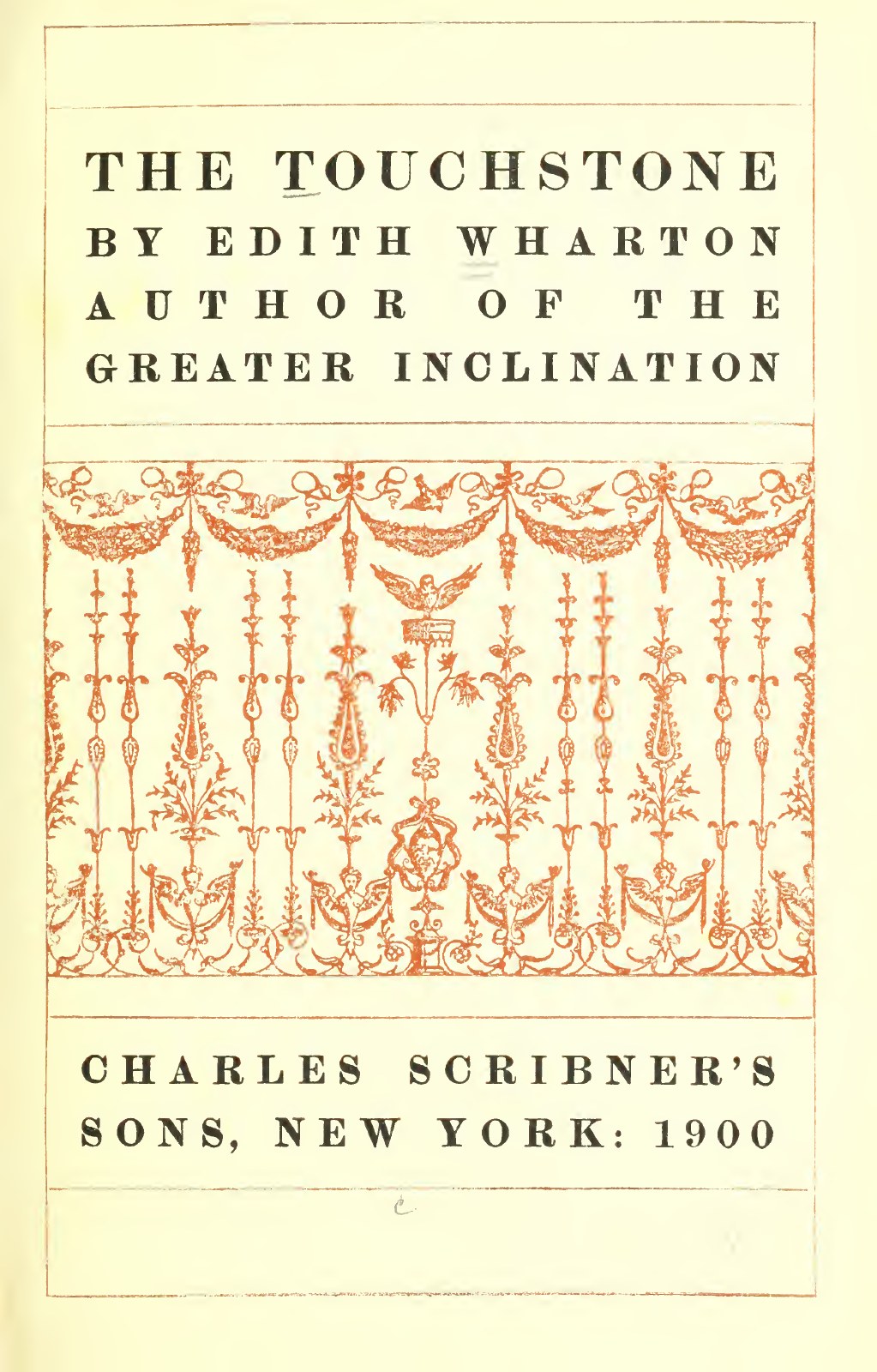
The novella appeared in 1900, early in Wharton’s career as a fiction writer; the American edition shown above carries the imprint of Charles Scribner’s Sons.[3][4] Its first chapter opens with an appeal from Aubyn’s prospective biographer. Because she had few regular correspondents, her “letters will be of special value.” The phrase initially means value to a literary life. As Glennard returns to it, another meaning starts to emerge.[1]
He needs money to marry Alexa. He also possesses a large correspondence from a famous woman whose private generosity he found exhausting. Those two facts begin to fit together. In Chapter II, he unlocks a drawer and handles the packets: some envelopes have faded ink; the later English postmarks belong to the years when Aubyn’s reputation was expanding beyond him.[1]
The envelopes preserve a chronology that his memory has flattened. Letters that arrived as demands on his attention now look like an accumulated resource. Wharton makes the shift visible through an imagined alchemy: staring at the pages, Glennard can almost see them turn to gold. He briefly carries them toward the fire, then decides that burning so many would take too long. Back into the drawer they go.[1]
That wonderfully inadequate excuse keeps the temptation available. The drawer can protect a confidence, but it can also preserve something until its owner finds a profitable use for it. Its moral character depends on what Glennard intends to do when he next turns the key.
At Barton Flamel’s apartment in Chapter IV, manuscript letters sit among collectible books. Flamel’s remark that Harriet Westbrook’s suicide increases the value of Shelley’s letters to her gives this market a chilling unit of measurement: another person’s suffering can add to an object’s price. Glennard soon asks what his own collection might fetch. He disguises its origin by inventing a dead friend who left it to him.[1]
His fiction removes the living recipient from the transaction. Aubyn will be named and exposed; the man who failed to answer her love can remain anonymous.
Two volumes that will not stay shut
Chapter V jumps forward to a flourishing marriage and garden. Glennard has invested the proceeds, and success is attracting more success. The newspaper carries reassuring financial information—until he turns to an advertisement for Aubyn’s letters. The same printed sheet that confirms his prosperity announces its source.[1]
Wharton lets the garden change around him without moving a leaf. A hedge that seemed to protect the couple’s privacy suddenly feels crowded with watching eyes. This is Glennard’s perception, not an actual discovery by his neighbours. His fear nevertheless reverses the direction of exposure: he begins to feel what it means to have a private life made available to strangers.
The correspondence then comes home in a particularly humiliating way. Alexa asks him to buy the book. In Chapter VI, he finds Aubyn’s name repeated across a bookseller’s window and counter, pays in haste, and leaves without waiting for the volumes to be wrapped. He carries one in each pocket.[1]
Once again, he physically possesses the letters. Now he possesses only a purchasable copy. The private abundance he could lock away has become something any reader can obtain.
Opening a volume, he sees the familiar phrases as “wounded animals in the open.”[1] The image makes print feel like the removal of cover. Yet Wharton gives us his horrified response rather than a sequence of intimate letters for us to consume. We can understand the exposure without being offered Aubyn’s confidences as our reward for reading about it.
The books also give Alexa a life as a reader that Glennard cannot manage. He had imagined the sale as a means of securing their future together. It has produced an object through which his wife can encounter the woman he excluded from that future.
A receipt tries to do a confession’s work
The next important piece of paper looks much less literary. In Chapter IX, Glennard has deposited his latest royalty payment, but the accompanying notice remains. Unable to confess directly, he slips it into a bundle of bills and other papers he asks Alexa to sort.[1]
He knows what she will learn. He also describes the bundle as unimportant. The notice becomes a confession arranged so that its author need not be present when it is understood.
This repeats the earlier movement of the letters: something leaves Glennard’s keeping, and another person must deal with its meaning. The document supplies information while sparing him the immediate difficulty of answering for it. He then watches Alexa’s behaviour, trying to extract the response he has avoided asking for.
In Chapter XIII, she confirms that she understood the notice and had already suspected the truth from his manner. Her silence has not meant ignorance or indifference. Glennard’s attention to what the paper will reveal has left him poorly equipped to imagine what knowing might cost her.[1]
The notice establishes where the money came from. It cannot conduct the conversation that must follow.
The face on the magazine page
Between that evasive disclosure and their eventual confrontation, Aubyn’s photograph returns. In Chapter X, Glennard opens a magazine and finds a reproduction of the very portrait that once stood on his desk. Small remembered details—the movement of her hands, the way she leaned forward—begin to restore a person whom fame and his own convenience had reduced to an abstraction.[1]
This complicates any easy equation of publication with corruption. The printed letters have exposed Aubyn; a printed image now helps Glennard recognize her. The medium has not changed its moral nature between chapters. His way of looking is changing.
Recognition does not immediately make him generous. When Alexa asks for the magazine, he lies about having seen it; he has already locked it in his desk. The drawer returns: he again tries to keep Aubyn to himself, this time as the private source of his remorse. Wharton lets a real emotional discovery coexist with another act of concealment.[1]
Glennard’s problem began before he had anything to sell. The returning portrait brings him back to the failure of attention that the sale has magnified. Seeing Aubyn more clearly is a beginning; allowing that recognition to alter his conduct is harder.
Wharton herself had to negotiate how her work would reach readers. Drawing on her correspondence with editors, Ellen Dupree records that Scribner’s rejected a friend’s cover design for The Touchstone in 1900.[2] In A Backward Glance, Wharton recalled another unwelcome change: the British edition had appeared as A Gift from the Grave, a title she considered misleading and said had been chosen without consulting her. She remembered its stronger sales with mixed anger and amusement.[3] Her account offers a small publishing echo of the novella’s larger concern: the presentation that makes a work attractive to buyers may displace the intention behind it.
The ending does not supply an uncomplicated refund. Alexa insists on repaying the money; its inadequacy as reparation does not excuse keeping it. But Glennard knows the original sum understates their material benefit: the money has generated further opportunities. More painfully, giving money away cannot return privacy to a dead woman. Alexa proposes that an action they cannot undo might still change how they live thereafter (Chapters XIII–XIV).[1]
Her final understanding of Aubyn’s gift is generous, but it remains an interpretation offered by the survivors. Aubyn cannot confirm that their reconciliation compensates her. The letters, the notice, and the photograph have brought Glennard toward recognition; none gives him the right to declare the account settled. He can begin to answer for the relationship he once tried to put in a drawer.
Sources
- Edith Wharton, The Touchstone (1900), Project Gutenberg—primary text; especially Chapters I–II, IV–VI, IX–X, and XIII–XIV.
- Ellen Dupree, “‘Usually the Reward of Tosh’: Edith Wharton’s Business Education,” Edith Wharton Review, vol. 17, no. 2, Fall 2001, especially p. 4—correspondence documenting editorial decisions about the novella’s cover; archived at Washington State University.
- Edith Wharton, A Backward Glance (1934), Chapter 6, “Life and Letters,” Project Gutenberg Australia—Wharton’s retrospective account of the novella’s British title and reception.
- Tufts Digital Library, The Touchstone (1900), item 086131019—digitized Tisch Library copy, publication evidence, and source of the title-page scan.