Paul Manning brings his cousin good news while standing in her way. In Part III of Elizabeth Gaskell’s Cousin Phillis, he has followed the distressed young woman into a snowy orchard and persuaded her into a cow-house. There he occupies the doorway while explaining why she need not be unhappy. The scene smells of cattle and offers shelter from the cold. It also gives his kindness a revealing physical arrangement: he can speak, and she cannot easily leave.[1]
Paul wants to help. Gaskell makes that desire convincing enough to trouble us. We recognize the pleasure of possessing exactly the information that might lift someone’s spirits, and the impatience to see it work. His mistake grows out of an affectionate impulse that runs ahead of his judgment.
This essay discusses the ending. Part references follow the primary text in source 1.
The satisfaction of being useful
Paul is the story’s narrator as well as its intermediary. A young engineering assistant, he moves between his admired superior, Edward Holdsworth, and the Holman family at Hope Farm. Phillis, the minister-farmer’s daughter, is an accomplished reader whose learning can embarrass him. He can report what happens around her more readily than he can understand what her experience means.[1]
That difference matters to the novella’s critical afterlife. Philip Rogers’s 1995 study challenges Paul’s assumption that Phillis’s education makes her resemble a man. Rogers argues that the male supervision of her studies and the models available in her reading continue to constrain her as a woman.[3] Intelligence alone does not determine how much freedom she has. Nor does Paul’s access to her household give him an equally intimate knowledge of her desires.
For a moment, however, he possesses something she urgently wants. Before leaving for Canada, Holdsworth has admitted that he loves her and hopes to return and declare himself. At Christmas, Paul discovers how deeply his absence has affected her. He repeats the confession, and her anguish gives way to happiness.[1]
The news is genuine. Holdsworth has truly expressed affection, but has entrusted Paul with no proposal to deliver. That awkward space between a real feeling and a settled commitment is where the scene becomes dangerous. An intention expressed to a friend acquires the force of reassurance when carried to someone waiting in pain.
Gaskell lets us feel the immediate success before we can measure its cost. Paul sees relief and takes it as confirmation that he has understood the situation. His evidence answers the easiest question—whether Phillis loves Holdsworth—while leaving the harder one untouched: what can she safely expect from him?
The doorway quietly qualifies the rescue. Paul describes his commands as “necessarily authoritative words.”[1] Necessarily is his own small certificate of permission. He has decided what would help, so he also decides how the conversation must happen. His tenderness includes a wish to direct its recipient.
A confidence travels in one direction
Part IV makes Paul’s discretion more complicated. He considers writing to Holdsworth about the Christmas conversation, then hesitates over his unfinished letter. Explaining his intervention would mean revealing Phillis’s feelings. He decides to protect her privacy and leaves the matter alone.[1]
There is a real scruple here. Her love is hers to disclose. Yet his silence leaves the two people living with different accounts of their relationship: Phillis knows that Holdsworth has spoken of marriage; Holdsworth does not know that his private hope has reached her. Paul has altered her expectations without making his own part in that alteration known to his friend.
The narration records this difficulty without entirely escaping it. Paul can give an honorable reason for withholding the second confidence, just as he could give a compassionate reason for repeating the first. Each decision looks defensible when considered separately. Together they create an unequal distribution of knowledge that he cannot control.
His disappointment when Phillis initially avoids him at Easter is particularly exposing. He thinks he may have committed a folly “all for her sake,” and feels insufficiently appreciated.[1] The phrase turns a favor into a small claim upon her. Gratitude would reassure him about his judgment; her reserve leaves him alone with his doubt.
Her wish for privacy need not mean that she rejects his kindness. It means that the subject belongs to her even after he has helped. Paul struggles to let the pleasure he has given exist without becoming proof of his own usefulness.
What his confession cannot explain
Holdsworth’s letter announcing his marriage to Lucille Ventadour destroys the expectation Paul has encouraged. Paul must now deliver the painful news himself. Phillis responds partly by trying to spare him: she insists that he has been kind and asks him not to look so grieved.[1]
The comforter becomes someone who needs comforting. Gaskell does not suggest that his distress is false. She shows how easily it can become another demand on the person already suffering. Phillis must manage both her disappointment and his visible remorse.
When her father eventually questions him, Paul admits what he said. He describes his fault as being “in the way of judgment,” distinguishing it from sin. Holman answers with an accusation: Paul has introduced thoughts of love into a child’s peaceful life.[1]
That explanation is wrong too. Phillis interrupts to say that she already loved Holdsworth. Paul’s disclosure changed what she hoped for; it did not create her capacity to desire. Her father has mistaken his own ignorance of her feelings for their absence.
Patsy Stoneman’s reading helps locate the pressure in this confrontation: Phillis has committed no sexual act, yet experiences shame that her social world has taught her to feel.[4] The family’s tenderness has not made it easy for her to acknowledge an adult emotional life. Blaming Paul for everything would preserve that earlier misunderstanding.
The scene therefore refuses a satisfying division into the guilty meddler and the innocent household. Paul must answer for his intervention; Holman must recognize a daughter whose inward life has developed beyond his supervision. Phillis’s speech forces her father to revise his accusation and gives her own account authority.
Leaving the last wish with Phillis
The story appeared in the Cornhill Magazine; Elizabeth Gaskell’s House records that Gaskell herself described the novella as a complete fragment.[2] Its ending rewards that description. After illness and a slow recovery, Phillis asks Paul whether she might stay with his parents for a while. She wants a change of scene before returning to the peace she remembers.[1]
This is another hopeful plan. Its difference lies in who speaks it. Phillis formulates the wish and asks for practical help; Paul no longer supplies her with someone else’s imagined future.
Her final words, “I can, and I will!”, do not establish that the old happiness can be restored.[1] The narrator has already acknowledged that she never entirely became her former self. Gaskell leaves determination and uncertainty together, without making Paul settle the question for us.
He has been a valuable witness precisely because his account contains more than his excuses can explain: the blocked doorway, the unfinished letter, the gratitude he wanted, the correction he needed. Reading him closely means accepting his affection while noticing its limits. By the last page, the most useful thing he can offer Phillis is room for a wish she has made herself.
Sources
- Elizabeth Gaskell, Cousin Phillis, Project Gutenberg—primary text, especially Parts III–IV: Holdsworth’s departure, the Christmas disclosure, Paul’s unfinished letter, the confession to Holman, and the ending.
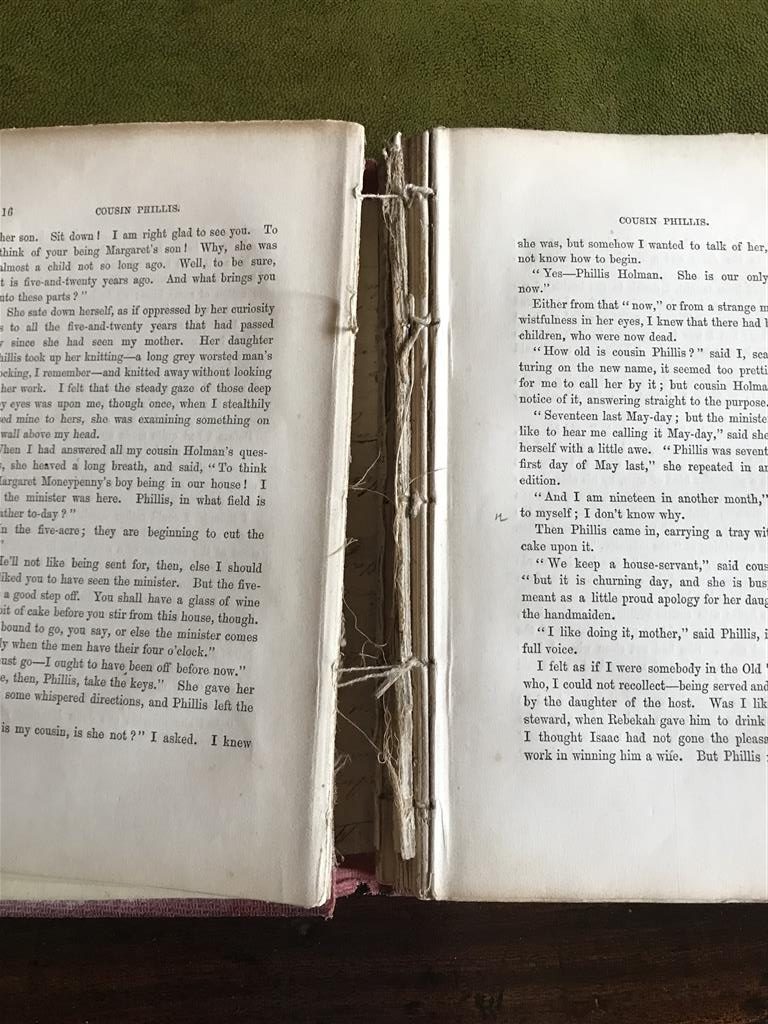
- Jane Mathieson and Diana Ashcroft, “Keeping Books Alive,” Elizabeth Gaskell’s House, 28 March 2022—serialization context, Gaskell’s description of the novella, conservation history, and source of the book photograph.
- Philip Rogers, “The Education of Cousin Phillis,” Nineteenth-Century Literature 50, no. 1 (June 1995), pp. 27–50—public publisher abstract on Paul’s assumptions and the constraints surrounding Phillis’s education.
- Patsy Stoneman, “Cousin Phillis (1863),” in Elizabeth Gaskell, Manchester University Press, pp. 105–111—public chapter summary on pastoral change, innocence, and socially imposed shame.