
The 92Y video posted on April 29, 2015 looks, at first, like a standard publication-night event: Toni Morrison arrives to read from God Help the Child, then sits for a conversation with Farah Jasmine Griffin after an introduction by Chirlane McCray.[1] What gives the clip unusual literary value is that Morrison does more than promote a new book. She describes, in public and with unusual plainness, how her late fiction works. Trauma does not disappear from book to book; it re-enters through altered voices. Beauty matters, but only as a dangerous first surface. And narration should not complete the reader's work in advance.[1][2][5]
That makes the event worth revisiting now. By 2015 Morrison was already a Nobel laureate and one of the few living American novelists whose work had become both canonical and continuously argumentative in classrooms, criticism, and public life.[3][4] Yet the clip is not ceremonious. It feels practical. Morrison uses the occasion to explain why a short late novel can carry old thematic weight without repeating the architecture of The Bluest Eye or Beloved.[1][5]
The book itself helps explain the stakes. Penguin Random House frames God Help the Child as a novel about childhood injury misshaping adult life, and Morrison's own conversation keeps returning to exactly that pressure: how damage reorganizes desire, self-image, and relation.[1][2] What the video adds is method. It shows how Morrison wants those injuries rendered: not as a therapeutic diagram, and not as a totalizing explanation that closes character before the reader arrives.
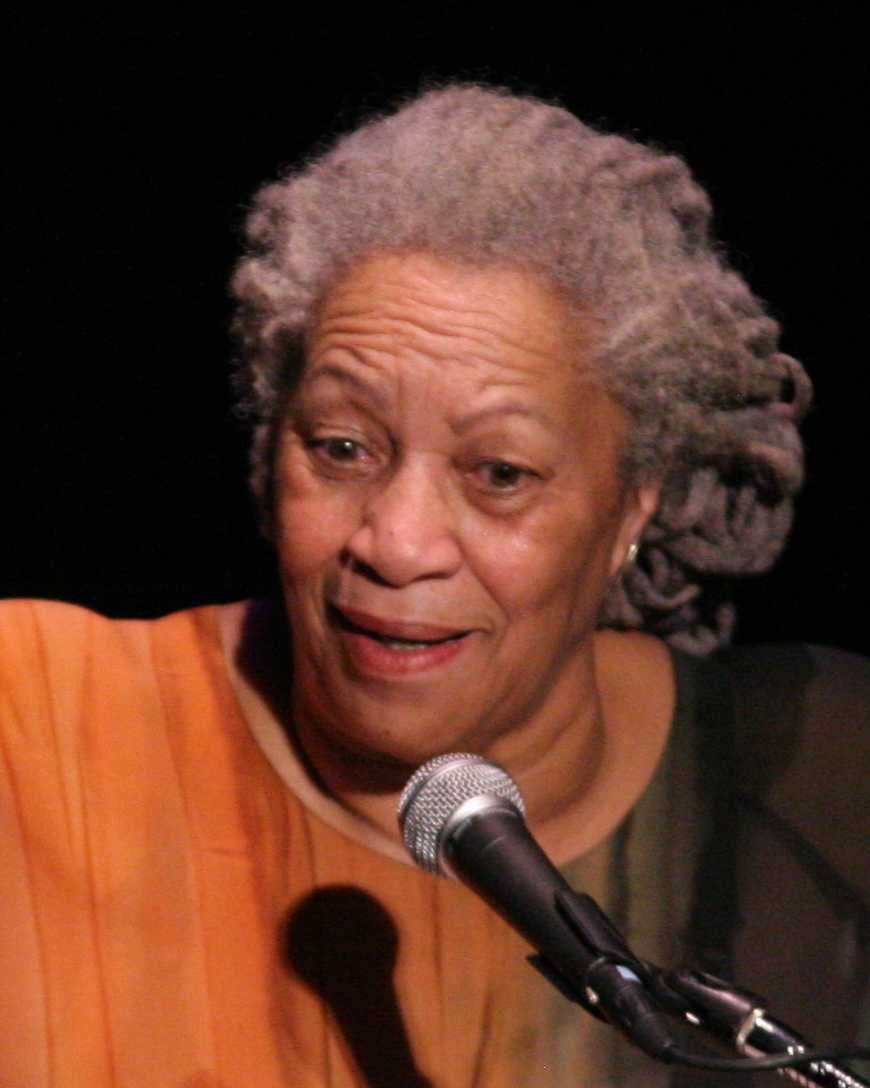
Image context: the cover uses a real 2008 public-event photograph of Morrison from Wikimedia Commons rather than a jacket image or an illustration. That choice fits the article because the 92Y clip is fundamentally about Morrison as a public reader and explainer of craft, standing before an audience and making compositional decisions audible.[6]
Around 11:25, Morrison opens with a child voice instead of an explanatory frame
When Morrison begins the reading, she does not summarize the plot or supply a thesis statement. She says she will read "a couple of pages" and then enters the section called "The Voice," giving the room Rain's account of "my black lady" in syntax that is intimate, damaged, funny, and incomplete all at once.[1] That choice matters because it stages the novel's ethic before the audience has time to reduce it to issue language. We do not enter through diagnosis. We enter through a person sounding like herself.
Rain's speech is a good example of why Morrison's late prose can feel stripped down without becoming thin. The sentences are short, but the information density is high: abandonment, foster care, violence, attachment, literacy, and desire for a defensible relation all arrive in the span of a few minutes.[1][2] Morrison lets those facts come embedded in idiom. The reader hears cognition under pressure, not a case file.
That is one reason the clip works better than a jacket summary. The book page tells you the novel concerns childhood trauma; the reading shows how Morrison prevents trauma from becoming a flat label.[1][2] Rain's voice carries wit, appetite, and misrecognition along with injury. The effect is central to Morrison's fiction more broadly, where harm is rarely the whole story of a person even when it governs the story's pressure system.[3][5]
Around 20:10, she names the late-style shift: old themes, new language, less authorial control
The event becomes especially valuable once Griffin asks how this novel emerged. Morrison's answer is remarkably direct. Some of the earlier themes, she says, were "still bubbling up and surfacing," but now she needed "a new language" and "a new collection of people" to express them.[1] That sentence is a compact map of late Morrison. She is not chasing novelty through subject matter alone. She is testing whether recurring historical and psychological burdens can be made newly legible by changing diction, cast, and narrative pressure.
Then comes the more important craft statement. Morrison says she shies away from the "omnipotent author" and is always trying to get the reader to "work with me," to step through "a little door" and do "the rest of the work."[1] That is as clear an account of her narrative contract as one is likely to get in public. She does not want narration to dominate interpretation from above. She wants the book to create openings through which the reader must move.
Placed beside her 2015 New Yorker interview, the 92Y answer looks even sharper. There too, Morrison stresses the importance of voices arriving with their own pressure and grain rather than being over-managed by explanatory authority.[5] The 92Y clip translates that principle into plain compositional terms. Readers are not passive recipients of completed meaning. They are collaborators asked to infer sequence, motive, and moral weather from partial access.
This is why the event matters as more than promotional ephemera. It publicly links Morrison's late brevity to an ethics of reading. The shorter novel is not thinner because the reader is doing more of the connective labor. Morrison removes explanatory padding so that relation, shame, and withheld knowledge can stay alive as formal problems rather than harden into information.[1][5]
Around 24:40 and 28:30, beauty gets offered, then demoted
The conversation's richest stretch comes when Griffin asks about the distinction between race, color, and racism. Morrison first clarifies that Rain's phrase "my black lady" is a description of who Bride is to the child, not a doctrinal racial label.[1] That answer is small but important. It keeps language local to relation before it becomes theory.
A few minutes later Griffin presses on one of the novel's most striking surfaces: Bride is a "jet black" woman described as gorgeous, and the conversation acknowledges how rare that remains in American fiction.[1] Morrison's reply is one of the best keys to the novel. She grants the force of beauty, even luxuriates for a moment in the image, then cuts it down. Beauty "ain't enough," she says in substance; what matters more is becoming a "three-dimensional person" and turning outward toward care rather than circling the self's wound.[1]
That demotion is the article's central reason for returning to the clip. Morrison gives the audience the seductive surface and then deliberately refuses to let surface become redemption. In The Bluest Eye, beauty standards destroy. In God Help the Child, beauty can still mislead if it is treated as cure.[1][2][5] Morrison is not denying physical appearance any charge. She is denying it final authority.
The move also explains why the novel feels late rather than simply repetitive. Morrison revisits an old field of damage, but she rearranges its moral geometry. What interests her here is less the original injury by itself than the adult habit of fastening identity to that injury. The conversation's turn toward caregiving, mutual attention, and the labor of becoming more than what happened to you gives the book its austere hope.[1][2]
The afterimage of the event: literature as work that should not be interrupted
Near the end, Griffin recalls Morrison's advice after the George Zimmerman verdict: you have to write, because it is the job of evil to keep us from doing our work.[1] The line comes secondhand in the room, but it clarifies the emotional weather of the whole evening. Morrison is talking about child damage, beauty, and race; she is also defending literary labor as a disciplined response to damaged public life.
That is why the 92Y video has staying power. It preserves Morrison not only as an icon or laureate, but as a working novelist explaining the mechanics of her own seriousness.[1][3][4] Old themes return. Voices change. Authority is redistributed toward the reader. Surface attracts, then fails. Care becomes harder and therefore more valuable. The clip lasts because it turns those principles into audible craft, and because it lets Morrison make one more thing unmistakably plain: novels are not vessels for solved lessons. They are occasions for difficult participation.
Sources
- The 92nd Street Y, New York, "Toni Morrison Reads From and Discusses 'God Help the Child'" (official YouTube upload, posted April 29, 2015).
- Penguin Random House, God Help the Child by Toni Morrison (publisher book page).
- Encyclopaedia Britannica, "Toni Morrison" (biography and career overview).
- Nobel Prize, "Toni Morrison - Facts" (1993 Nobel context and major works).
- The New Yorker, "Toni Morrison on Her Last Novel and the Voices of Her Characters" (2015 interview).
- Wikimedia Commons, "File:Toni Morrison 2008 (cropped).jpg" (source page for the article image).