Anton Chekhov is still routinely praised in a way that half-misreads him. People call him subtle, atmospheric, plotless, humane. The words are not wrong, but they can blur the actual technical achievement. Chekhov does not make drama disappear. He relocates it. Instead of loading fiction with obvious climaxes, he lets ordinary speech, stale routines, and familiar rooms absorb pressure until a person understands, a little too late, what has already happened to a life.[1][2][3][4]
That is why a work-centered author profile is more useful than a biographical one. Biography matters: doctor, late-imperial Russian observer, one of the modern short story's central makers.[4] But the real signature is formal. In story after story and play after play, Chekhov makes the event arrive after the event. The action has often technically occurred already; what he studies is the after-sensation, the moral lag, the interval in which consciousness catches up to consequence.
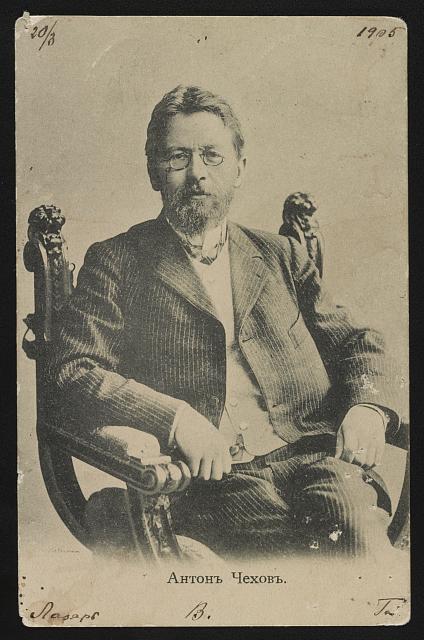
Image context: the cover uses a 1905 Wikimedia Commons photograph of Chekhov seated outdoors. It belongs here because this essay is about composure under pressure. Chekhov's characters rarely announce themselves in grand gestures. They sit, talk, wait, joke, complain, and only then discover that the room has been keeping score.[5]
1) Chekhov begins where melodrama usually ends
The cleanest example is The Lady with the Dog. Its premise sounds almost mechanical: seaside boredom, a married man, an affair, an adulterous attachment that ought to move toward either scandal or separation. Chekhov starts even lower than melodrama would. Gurov enters the story as a man who cynically calls women "the lower race," convinced that repetition has made him worldly.[1] A weaker writer would use that cynicism as setup for an ironic punishment or a sentimental reform.
Chekhov does something harder. He lets the affair become real slowly enough that Gurov notices the change only after he is already inside it. By the end, the story does not arrive at a solved crisis but at a new difficulty. The unforgettable last movement says that "the most complicated and difficult part of it was only just beginning."[1] That line is the key to Chekhov's whole method. He refuses to make climax feel terminal. Recognition arrives as an opening into greater complication.
This is why the story still feels modern. Chekhov understands that people usually do not experience decisive change as a trumpet blast. They realize late. They go on speaking in old tones after the old life has already cracked. In The Lady with the Dog, the real event is not adultery; it is the lag between conduct and self-knowledge. Chekhov turns delay into form.[1]
2) He makes ordinary rooms act like pressure chambers
The plays deepen that method by stripping away the consolations of eventfulness. Uncle Vanya is full of grievance, desire, waste, self-reproach, and practical disappointment, but most of its force comes from people sharing air badly.[2] The estate is not merely a setting. It is an instrument that stores years of misdirected labor and belated resentment. Characters talk as if they are circling familiar complaints, yet the repetition is exactly what makes the play unbearable. Everyone is living in the echo of choices that were made too early or understood too late.
Chekhov's genius here lies in tonal discipline. He does not inflate frustration into rhetoric for long. He lets people sound tired, petty, funny, embarrassed, and piercing by turns. Then he places Sonia's closing words with devastating plainness: "What can we do? We must live our lives" and, later, "We shall rest."[2] Those lines are moving not because they solve anything, but because they measure the distance between consolation and repair. Life will continue; redress will not arrive on cue.
That is what makes Chekhov feel so severe beneath the gentleness. He knows that despair often survives in domestic language. It does not always appear as scream or catastrophe. Sometimes it comes as endurance vocabulary, spoken in a room where everyone already knows enough to be miserable. Uncle Vanya turns stillness into dramatic pressure by refusing to pretend that recognition itself guarantees action.[2]
3) He writes comedy with an axe already waiting offstage
The Cherry Orchard extends the same logic into a broader social field. It is often treated as a nostalgia play, but nostalgia is only one of its temperatures.[3] The play is funnier, stranger, and less single-minded than that label allows. Characters posture, drift, talk past one another, misread history, and keep mistaking tone for reality. The comedy matters because it shows how people protect themselves from measurement. They keep talking in inherited registers even as the structure around them changes.
Chekhov's tonal doubleness is perfectly visible in Trofimov's famous claim that "All Russia is our orchard."[3] The line enlarges the play's scale beyond one estate, but it does not release anyone from embarrassment, guilt, debt, or self-deception. Social history enters the room without becoming a speechifying abstraction. Later, the eerie "sound of a breaking string" and Anya's farewell, "Good-bye, old life!" make transition feel both theatrical and irreversible.[3] Change in Chekhov never arrives in a single emotional key. Loss and ridiculousness occupy the same air.
That mixed tone is not decoration. It is the method by which Chekhov keeps human beings from simplifying themselves. A family can be ridiculous and tragic at once. A room can feel comic until the axe is already imaginatively falling on the orchard outside it. This is why Chekhov's so-called quietness is a false description. The work is quiet only if one mistakes volume for force. Chekhov's force lies in tonal crosscurrents and in the fact that people rarely know what genre they are living in while they are living it.[2][3]
4) Why the profile still feels current
Britannica's account of Chekhov places him where he belongs: among the supreme short-story writers and dramatists of modern literature.[4] What keeps that judgment alive is not reverence but utility. Chekhov remains readable because he found a durable unit of human truth: belated recognition. He understood that people do not merely suffer from what happens to them. They suffer from the delay with which meaning arrives.
That delay is the common structure linking Gurov, Sonia, Vanya, Ranevskaya, and so many others.[1][2][3] Their lives are not small because they take place in drawing rooms, hotels, verandas, or estates. Those enclosed places are where time thickens enough for error to become audible. Chekhov's great realism lies in understanding that ordinary surroundings do not reduce drama; they reveal its actual scale.
So the old charge that "nothing happens" in Chekhov should be turned inside out. Too much happens, but not in the order melodrama taught readers to expect. The affair becomes serious after it should have remained casual. The wasted life becomes visible after youth is gone. The social ending is heard as comedy, farewell, and fracture all at once. Chekhov's real drama happens one beat late, and that lateness is exactly why it keeps breaking open new readers.[1][2][3][4]
Sources
- Anton Chekhov, The Lady with the Dog and Other Stories (Project Gutenberg; Gurov opening and the final "only just beginning" passage cited).
- Anton Chekhov, Uncle Vanya (Project Gutenberg; Sonia's closing lines and the play's domestic pressure structure cited).
- Anton Chekhov, The Cherry Orchard in Plays by Chekhov, Second Series (Project Gutenberg; Trofimov, the breaking-string moment, and the final farewell cited).
- Encyclopaedia Britannica, "Anton Chekhov" (biographical and reception context).
- Wikimedia Commons, "File: Anton Chekhov (1905).jpg" (archival photograph source page).