A rose short of petals ought to be a disappointment. A journey through city lights ought to put distance between two people. H.D.’s “Sea Rose” and Amy Lowell’s “The Taxi” make those ordinary situations feel stranger: the damaged flower acquires value, while distance seems to acquire edges capable of cutting someone.[1][2]
The poems share an appetite for abrasive detail. Yet the abrasiveness does different work. H.D. asks us to reconsider what deserves admiration. Lowell makes us feel how a person’s attachment can alter the texture of everything outside it. Reading them together lets us hear two distinct uses of a poetic language often gathered under the single name Imagism.
“Sea Rose” opens H.D.’s Sea Garden (1916); “The Taxi” appears in Lowell’s Sword Blades and Poppy Seed (1914).[1][2] Both writers contributed to the Imagist anthologies that helped establish the movement between 1914 and 1917. Those shared covers provide a historical reason to place the poems beside each other, without treating one as an explanation of the other.[4]
Where the roughness enters
H.D. begins with an address: “Rose, harsh rose.” The familiar noun arrives, then has to be heard again with an unwelcome quality attached. The first stanza continues by counting deficiencies: scant petals, thinness, sparse foliage. Its short phrases make the eye pause over what a florist might wish to conceal (lines 1–4).[1]
The next stanza makes its judgment before explaining it. The isolated phrase “more precious” gives the damaged rose precedence over a wet flower standing singly on its stem. We have to carry that surprising valuation into the remaining lines. H.D. has made the reader look twice before supplying anything like a reason.
Lowell’s opening takes the opposite route. “When I go away from you” establishes the attachment immediately. The world’s altered appearance follows from the departure. Her first comparison is a “slackened drum”: a sound without the tension that would give it resonance. Then the imagery acquires harder surfaces. Stars jut; wind has ridges; streets force the beloved farther away (lines 1–8).[2]
There is a small violence in giving wind ridges. Air becomes something the voice must push against. Likewise, the city’s lamps obstruct sight by hurting the eyes. Illumination, which ought to make things visible, helps erase the beloved’s face. The poem does not settle whether this face belongs to a last actual glimpse or to an image the traveller is trying to retain. Its loss matters in either case.
H.D. makes an unlikely object precious. Lowell makes a recognizable world painful. Neither effect could be preserved by replacing the details with a general statement about strong emotion.
Who is doing the moving?
Their verbs sharpen the difference. H.D.’s rose is caught, flung and lifted. Wind moves the sand around it; the flower receives the action. Even the upward movement gives it no secure resting place (lines 8–13).[1]
That passivity matters. It is tempting to turn the poem into encouragement about becoming stronger through adversity. But the rose performs no act of overcoming. It remains exposed. The speaker supplies a different scale of value; the poem gives us no evidence that the flower has mastered its conditions. Admiration does not require a victory story.
Lowell begins with the speaker leaving, then transfers much of the action to the surroundings. The streets “wedge” the beloved away; the lamps “prick” the speaker’s eyes. For several lines, the moving city seems responsible for the separation. Only at the end does the grammar bring responsibility back to the person who departed, with “To wound myself” (lines 8–12).[2]
This makes the title unusually useful. The vehicle itself never appears in the poem’s body. “The Taxi” supplies a practical frame for the rapidly succeeding streets, while the lines give us the journey as the passenger experiences it. Transport and feeling move at different speeds: a ride can proceed efficiently while every new street feels like another injury.
Precision can include distortion
The poets’ contemporaries already needed help with this distinction. The preface to Some Imagist Poets, 1916 reports widespread discussion and misunderstanding of the previous volume. Its authors explain that Imagism concerns the “manner of presentation.” An exact word, they argue, conveys an object’s effect on the poet’s mind; it need not simply inventory the object’s properties.[3]
That defence helps explain why a precise poem can give the night sharp edges. Lowell’s distortion concentrates the experience of leaving. H.D.’s scarcity of foliage is visible enough, but the leap from damaged appearance to greater value belongs to an act of judgment. Both poems make perception consequential.
The preface also insists on rhythm and on reading cadenced verse aloud.[3] Try the short, interrupted descriptions at the beginning of “Sea Rose,” then Lowell’s expanding final question. One makes us linger over a difficult object. The other allows distress to stretch across a longer breath. Their shared movement leaves room for different speaking voices.
Two questions, two destinations
“Sea Rose” ends by asking whether the spice-rose can produce comparable “acrid fragrance,” concentrated in a leaf (lines 14–16).[1] The question continues the preference already announced. Its force is challenging: can the more conventionally appealing flower offer this? Scent becomes the last test of a value that appearance alone might miss.
Lowell’s question turns inward. The speaker asks why departure should happen when it means this pain. No timetable, obligation or destination answers back. The poem also supplies no return journey. Its ending lets the emotional objection occupy the whole available space.[2]
The distinction keeps the comparison alive. H.D.’s question presses a judgment upon us; Lowell’s makes an action difficult to justify. One poem leaves us beside a flower we have learned to esteem differently. The other leaves us in motion, feeling every street that comes between two people.
Sources
- H.D., “Sea Rose,” Sea Garden (Constable, 1916), p. 1; Project Gutenberg transcription of the collection. Line references count the poem’s sixteen verse lines, excluding stanza breaks.
- Amy Lowell, “The Taxi,” Sword Blades and Poppy Seed (1914); Project Gutenberg text. Line references count the poem’s twelve verse lines.
- “Preface,” Some Imagist Poets, 1916: An Annual Anthology (Houghton Mifflin, 1916), especially pp. v–vi and ix–x; contemporary explanations of exact language, subjective perception, cadence and reading aloud.
- Modernist Journals Project, “Some Imagist Poets”; the 1914–1917 anthology sequence, contributors and its role in establishing Imagism.
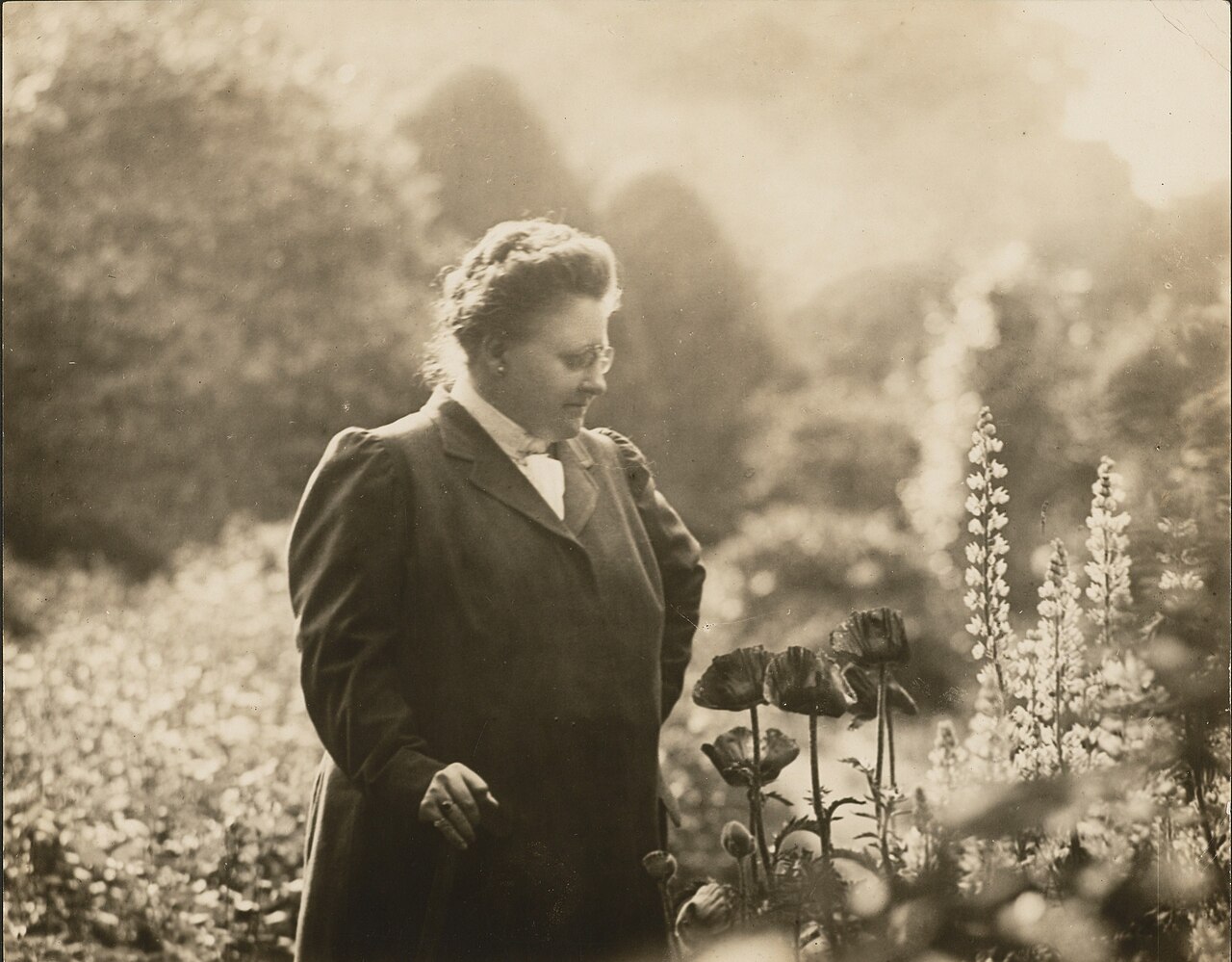
- Bachrach, photograph of Amy Lowell at Sevenels (1924), MS Lowell 62 (5), Houghton Library, Harvard University; archival image and catalogue information on Wikimedia Commons.