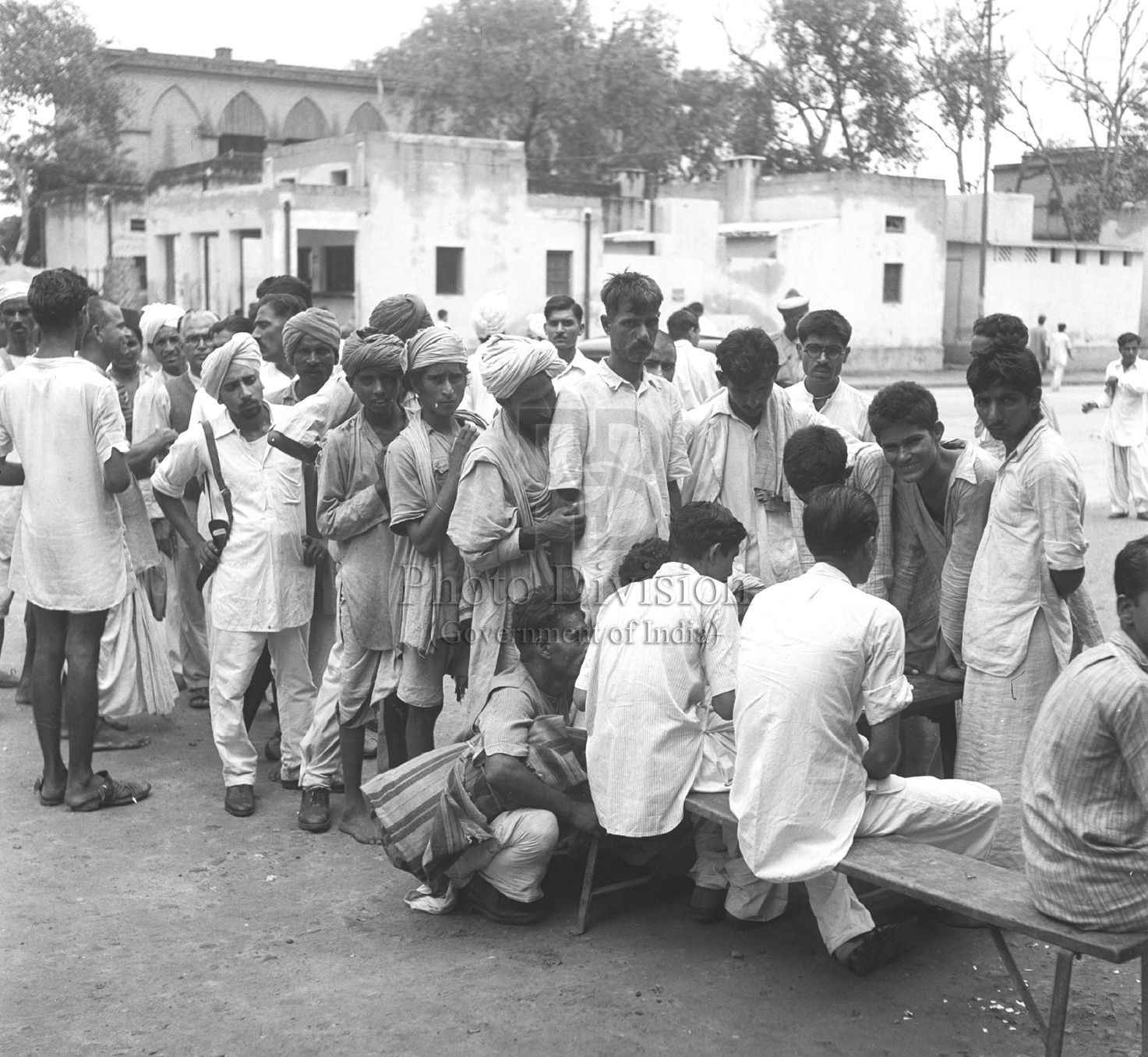
Saadat Hasan Manto’s Toba Tek Singh ends with two countries, two lengths of barbed wire, and a piece of earth that officially belongs to neither. It is tempting to remember the scene as a clean emblem: Bishan Singh rejects India and Pakistan, chooses no-man’s-land, and collapses there in protest.
The prose is less consoling than that. Bishan does refuse to cross. But he does not choose to fall, does not found a third country, and does not receive a final revelation about home. Officials contradict one another, the exchange continues around him, and his body gives way only after it has been administratively tolerated as harmless. The story’s force lies in that sequence. Manto turns resistance into exhaustion, an exception into a fall, and a village name into the only phrase capable of occupying unnamed ground.[1][2]
The story appeared in Hindi and Urdu in 1955, the year Manto died; its Urdu book form was published in Lahore.[3] It came after his own move from Bombay to the new Pakistan. Partition had made a writer with deep attachments across the subcontinent answerable to a national division he could neither treat as abstract nor narrate as orderly.[4][5][6] Yet the ending does not ask biography to do the literary work. Its argument is built from verbs: enter, pull, stop, stand, allow, shriek, fall, lie. Read those verbs closely and the familiar symbol becomes a more disturbing scene.
The register comes before geography
The exchange at Wagah happens at night. Lorries bring Hindu and Sikh patients from the Lahore asylum; officials from both sides meet, complete their preliminary procedures, and begin passing people from one set of wardens to another. Some patients will not leave the vehicles. Others run, strip off the clothes put on them, sing, cry, quarrel, or mutter. Against that disorder, the state has one steady instrument: the register.[1]
When Bishan Singh’s turn arrives, an officer begins entering his name. Only then does Bishan ask where Toba Tek Singh is. The order matters. The register can decide where a person must go before anyone present can give that person a reliable account of where his home has gone. Classification is operational even when knowledge is not.
This is not merely a surreal invention. India and Pakistan did exchange psychiatric patients after Partition. The receiving arrangements exposed the material violence hidden inside administrative symmetry: East Punjab had no equivalent hospital ready for those transferred from Lahore, and hundreds of non-Muslim patients were moved into makeshift accommodation at Amritsar in 1950.[4] Manto does not reproduce that history as a report. He reduces its logic to a desk at the border, where a name can be processed while a place remains uncertain.
The officer’s first answer is that Toba Tek Singh lies in Pakistan. Bishan breaks away toward the companions he has not yet left. Guards seize him and pull him toward India. He cries, “Toba Tek Singh is here!” The sentence can mean that his village is on the Pakistani side, that it is wherever he stands, or that the man whom the asylum calls Toba Tek Singh is present and refuses to be converted into an entry on the other side.[1]
The officials respond with a grotesque flexibility. Now they say the town has gone to India—or, if it has not, it will be sent there immediately. A place becomes movable cargo because the procedure needs a reassuring answer. Their language is more detached from geography than Bishan’s supposedly unintelligible speech. The satire does not reverse sanity and madness in a simple slogan. It shows a bureaucracy able to function without resolving the human question its paperwork creates.[4][5]
A body trained to remain upright
Long before the border, the story gives Bishan one impossible physical habit: for fifteen years he has remained on his feet, day and night. His legs are permanently swollen. He sometimes leans against a wall, but he does not lie down. The detail first feels like one more item in the asylum’s catalogue of behaviors. At Wagah it becomes the scene’s clock.[1]
Standing is not yet political when Manto introduces it. Bishan stood before the proposed exchange, before his repeated questions about India and Pakistan, and before the visit from Fazal Din, the old friend who cannot keep the two countries straight when asked where Toba Tek Singh now lies. The body has its own prior history. That prevents the ending from becoming a tidy allegory in which national crisis suddenly manufactures a single heroic gesture.
At the border, however, the old habit acquires a new pressure. When guards try to drag Bishan across, he plants himself between the two sides on the same swollen legs. The narration describes a force that cannot move him. This is his clearest act of refusal—but even here the state decides the terms under which it may continue. Because he is considered harmless, the guards stop using force and let him remain while the exchange proceeds.[1]
That permission is chilling. No-man’s-land is not offered as asylum. It is a temporary procedural convenience for a man who does not threaten the operation. The officials do not recognize his claim, suspend the transfer, or revisit the map. They work around him.
Then dawn approaches. Bishan gives one piercing cry and collapses for the first time in fifteen years. The distinction between standing and falling keeps the ending honest. He chooses not to cross; he does not choose the bodily failure that follows. Calling the whole sequence a triumphant selection of no-man’s-land makes his exhaustion look too sovereign. Manto allows refusal but withholds mastery over its result.
The sentence changes the owner of a name
Throughout the story, other people call Bishan Singh by the name of his home town. The narrator reports that nickname but continues to identify the man as Bishan Singh. That small discipline reserves an ambiguity until the last sentence.[2]
After the fall, the prose looks outward. On one side, behind wire, is Hindustan. On the other, “behind the same kind of wire,” is Pakistan. The repeated material matters: the rival national names produce matching barriers. Between them lies what the translation calls “on that piece of ground that had no name.” Only after the scene establishes named states and unnamed earth does the final clause arrive: “lay Toba Tek Singh.”[2]
Grammatically, the phrase names the person. Spatially, it answers the question that has driven the story: where is Toba Tek Singh? The answer is neither a corrected map coordinate nor a mystical homeland beyond politics. It is a body on ground produced by the border but excluded from both of its labels.
Frances W. Pritchett’s teaching edition is especially valuable here because it keeps the final construction close to the Urdu and places it beside the original text.[2] A freer ending might explain that Bishan represents his village, that he has found his own country, or that he has deliberately selected the strip. Manto does none of those things. The sentence simply lets the name cross from absent village to fallen man. Interpretation enters through syntax, not commentary.
That transfer also completes a series of failures in naming. The patients cannot understand what Pakistan is. A self-proclaimed god has not yet issued an order locating the town. Fazal Din changes his answer in mid-sentence. Border officials turn geography into a promise that can be revised on demand. Bishan’s recurring verbal formula absorbs new political words without becoming a translation of them. Finally, the one territory explicitly said to have no name receives his.
The ending therefore does not erase Toba Tek Singh from the map. It shows what a map cannot hold once home, name, person, and jurisdiction have been pulled apart.
Not a third country
Critical readings have understandably treated the final strip as a figure of Partition’s uncanny geography: the familiar made strange, home rendered inaccessible by a national order that claims to clarify belonging.[5] Other place-centered readings emphasize how Bishan’s attachment resists reducing location to an administrative coordinate. Both approaches explain why the ending has travelled so far beyond its few sentences.
But the scene becomes weaker if no-man’s-land is romanticized as freedom. It is created and maintained by the same two states whose classifications Bishan resists. It exists between their wires, under their officers’ watch, during their exchange. He can stand there only because he has been judged harmless, and he can remain there only until his body fails. The strip is an administrative remainder, not an independent refuge.
The story also resists using psychiatric patients merely as comic masks for supposedly mad governments. Its patients have different fears, attachments, languages, and strategies; the actual history of institutional transfer involved vulnerable people whose consent and continuity of care were largely invisible to the policy.[4] Manto’s deadpan narration may invite laughter at declarations from trees or at improvised political identities, but the final scene steadily moves the object of satire away from symptoms and toward the officials’ confident procedure.
The officers can name the countries. They can complete forms, transfer custody, and improvise an answer about a town. What they cannot do is make the categories adequate to Bishan’s relation to home. His question is not difficult because Toba Tek Singh was geographically unknowable. It is difficult because a correct cartographic answer would still not explain why he must become foreign to it.
What remains after the exchange
Manto’s own post-Partition writing is often read through the shock of his move to Lahore, and Ayesha Jalal’s work places that migration inside a longer life divided among Punjab, Bombay’s film world, and the new state’s cultural politics.[6] Toba Tek Singh converts that historical fracture into a miniature with almost no scenery: cold, darkness, lorries, registers, wire, ground.
Its compression is why the final tableau remains so available to quotation—and why it deserves to be slowed down. The scene is not only the last image of a man between countries. It is an exact sequence in which the state writes first, answers second, contradicts itself third, permits an exception, and carries on.
Bishan’s body interrupts that sequence without defeating it. The exchange finishes. India and Pakistan remain named. The wires remain parallel. What changes is the phrase Toba Tek Singh. It no longer points securely to a district, a village, a patient, or a metaphor. It lies across all four possibilities.
The map does not end because Bishan discovers somewhere outside history. It ends because the final sentence reaches the point where official geography can still draw a border but can no longer say what, exactly, has been placed on either side.
Sources
- Saadat Hasan Manto, “Toba Tek Singh,” translated by Richard McGill Murphy for Words Without Borders (2003) — complete English text of the story.
- Frances W. Pritchett, “About the Story” — close-to-the-Urdu final sentence, narrator naming, publication notes, and links to the bilingual teaching edition.
- Francesca Orsini, “Literary Activism: Hindi Magazines, the Short Story and the World,” in The Form of Ideology and the Ideology of Form. Open Book Publishers, 2022 — the story’s 1955 Hindi and Urdu publication history.
- Tahir Jokinen and Shershah Assadullah, “Saadat Hasan Manto, Partition, and Mental Illness through the Lens of Toba Tek Singh,” Journal of Medical Humanities 43 (2022), pp. 89–94 — historical patient exchange and mental-health context.
- Noor Asif, “The Postcolonial Uncanny in ‘Toba Tek Singh,’” Cambridge Journal of Postcolonial Literary Inquiry 11, no. 1 (2024), pp. 66–73 — the asylum, displacement, and uncanny national geography.
- Ayesha Jalal, The Pity of Partition: Manto’s Life, Times, and Work across the India-Pakistan Divide. Princeton University Press, 2013 — biographical and historical context.
- Wikimedia Commons, “Registration of refugees from West Punjab” — source and provenance page for the September 27, 1947 Government of India Photo Division image.