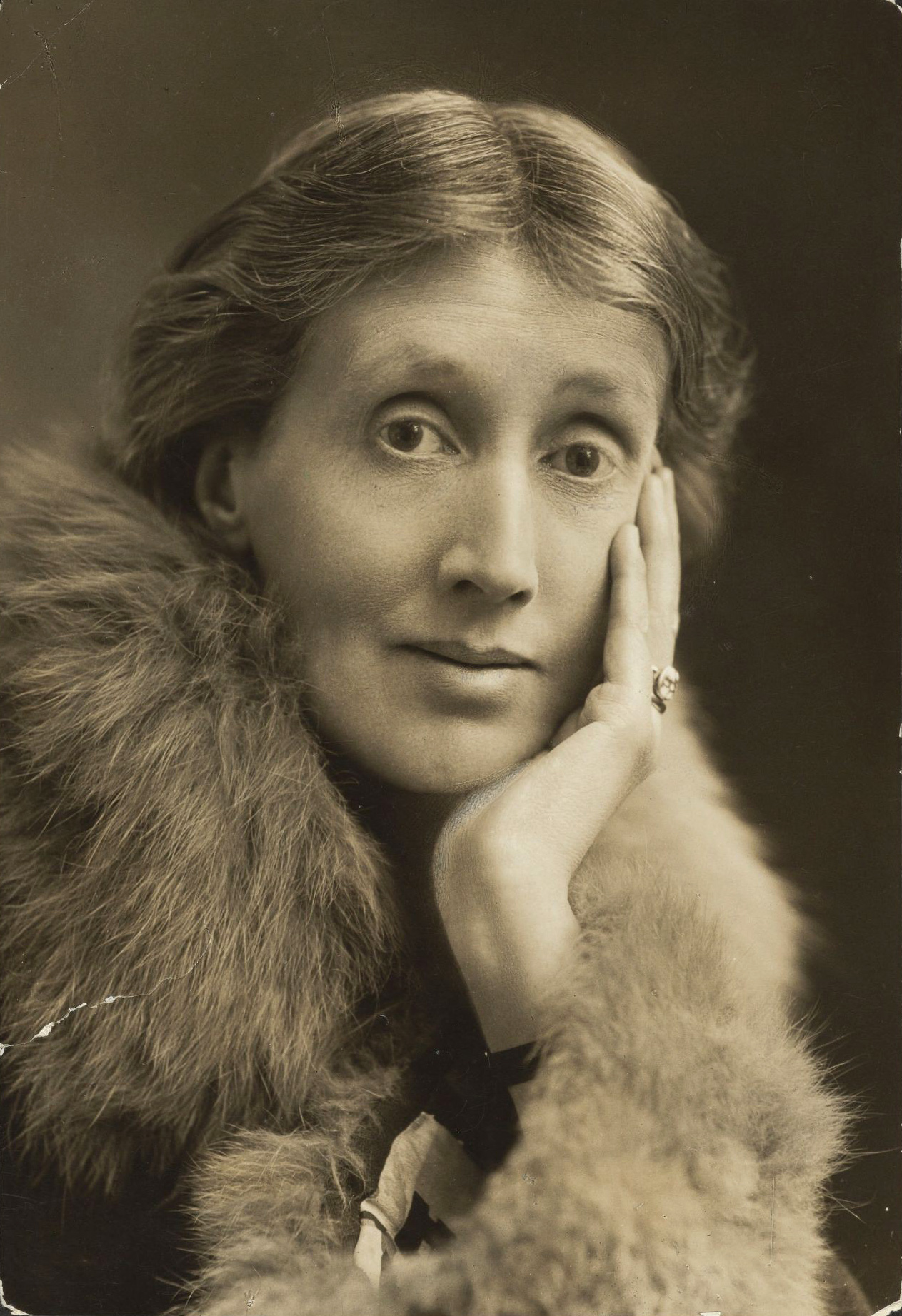
Many first descriptions of To the Lighthouse flatten it into a general modernist haze: interiority, shifting perspective, a dinner party, a lighthouse deferred. That description touches the book’s surface, yet the mechanism that makes it hold is more exact. Woolf builds the novel as a triptych. The first panel loads relation, the middle panel strips human centrality away and lets time, weather, and war work on the page, and the last panel returns to unfinished perception and gives the structure its closing line.[1][6]
Image context: the 1927 Woolf portrait is useful here because the novel belongs to the same publication moment in which Woolf had already turned family memory, St Ives atmosphere, and the figures of her parents into formal material rather than memoir.[2][5][7]
1) Why the book needs three parts instead of one continuous flow
The surface plot sounds almost slight. In the Ramsays’ summer house, a trip to the lighthouse is proposed and postponed; years pass; a smaller group returns; the trip finally happens.[1][6] If Woolf had wanted a conventionally sequential family novel, she could have told that story straight through. She divides it because her real subject is not event order. Her subject is how people share a room while living under different pressures of desire, authority, grief, vanity, and attention.[1][3]
“The Window,” the long opening section, therefore does two jobs at once. It establishes the household’s emotional geometry, and it trains the reader to register consciousness as a field of adjacency. Mr. Ramsay’s hunger for sympathy, Mrs. Ramsay’s social composure, James’s child-intensity, Lily Briscoe’s painterly concentration, Charles Tansley’s brittle self-assertion: Woolf arranges them less as isolated portraits than as forces crossing the same domestic space.[1][4] The dinner scene matters because it shows that temporary harmony can be composed without ever becoming permanent.
2) “The Window” as a chamber piece of suspended action
What makes the opening section so powerful is the ratio between tiny action and heavy consequence. A child hears that the lighthouse trip depends on weather. A guest says it will not happen. A hostess manages seating, feeling, and atmosphere. Woolf treats these small motions as if they were structural beams. The proposed excursion becomes a measure of desire and frustration long before it becomes a physical journey.[1]
Mrs. Ramsay is central to that design. She draws others into provisional coherence, yet Woolf never lets that coherence feel fixed. The section keeps showing how unity has to be made and remade through hosting, tact, reassurance, and selective silence. Lily Briscoe, watching from the edge, supplies the section’s artistic counterpoint: she is inside the social field and slightly apart from it, trying to convert fugitive relation into composition.[1][4]
That is why the first part gains force from delay. The novel spends dozens of pages teaching the reader how much pressure can gather around a meal, a window, a sentence about tomorrow’s weather, or a child’s image of a promised trip. The book is loading weight that the middle section will later drop.
3) Why “Time Passes” is the real engine
The middle section is short, but it does the heaviest structural work in the novel. The house stands largely empty. Wind, darkness, salt air, decay, and the labor of caretaking move across the pages while major human events are reported almost sideways, often in brackets.[1] Mrs. Ramsay dies; Prue dies; Andrew dies in the war. Woolf refuses ceremonial enlargement and lets impersonal duration dominate the page.[1][5]
This is the point at which To the Lighthouse reveals what kind of book it has been all along. The first section gathered feeling into rooms. The middle section asks how much of that feeling survives when rooms lose their temporary organizer and become matter again: fabric, furniture, dust, sound, vacancy.[1][6] The brackets are devastating because they deny death the spaciousness readers expect from major fiction. History enters as interruption, not as climax.
Many readers remember “Time Passes” as experiment. It is more useful to read it as a redistribution of authority. Human consciousness no longer holds a monopoly on significance. Weather, emptiness, and interval become active narrative agents. Once that happens, the final section cannot simply resume family-novel business where the first left it. It has to answer the middle.
4) Lily Briscoe and the novel’s delayed completion
“The Lighthouse” works because Woolf does not try to restore the lost world whole. Mrs. Ramsay is gone, the earlier household arrangement is gone, and even the long-postponed boat trip arrives under altered emotional weather.[1] The novel therefore needs another principle of completion, and Lily provides it.
Britannica’s capsule on Lily Briscoe is useful because it names what readers feel immediately: she is both participant and observer, and her struggle to finish her painting runs parallel to the book’s struggle to resolve perception after loss.[4] Lily’s painting is not a decorative subplot. It is Woolf’s formal answer to the question raised by “Time Passes.” If time has broken the house’s earlier composition, what kind of order can still be made? Lily’s answer is neither recovery nor consolation. It is composition under damage.[1][4]
By the time the boat reaches the lighthouse and Lily finally draws her line in the center, Woolf has made completion feel narrow, earned, and provisional.[1] The ending does not reverse fracture. It gives fracture a shape that can be carried.
5) Family memory converted into structure
The novel’s emotional authority becomes clearer once it is set beside Woolf’s biographical materials. Britannica and the British Library both emphasize how deeply Woolf’s fiction remained entangled with family experience, with the formative St Ives summers, and with the long afterlife of her parents inside later writing.[2][3] Smith College’s account of the manuscripts sharpens this further: To the Lighthouse is bound up with Woolf’s sustained return to the figures modeled on Julia and Leslie Stephen, then with the work of moving them out of private grief and into art.[5]
That context matters only when it is used carefully. The strongest payoff is structural. Woolf found a form adequate to mourning by refusing straight memorial narrative. She divided time, displaced catastrophe into the middle distance, and gave the last movement to an artist who cannot restore the dead and yet keeps looking hard at what remains.[1][5]
This is also why the lighthouse matters less as a single solved symbol than as a formal destination. In the first section it is wished for, blocked, and imagined; in the last it is approached under diminished circumstances.[1][6] The physical arrival matters, yet the larger achievement is that the novel has trained the reader to feel delay itself as material.
6) What the novel still teaches
A quick classroom summary can make To the Lighthouse sound static. The book is anything but static. It is one of the clearest demonstrations in English fiction that structure can do emotional work often assigned to plot. Woolf lets relation gather, lets time strip the scene, then lets art recover a livable line without pretending to cancel damage.[1][5]
That is why the novel still feels fresh in 2026. Its modernity does not rest on stream-of-consciousness alone. It rests on a harder achievement: Woolf makes absence structural. She turns vacancy, postponement, and interval into form. Once that becomes visible, the triptych stops looking like modernist ornament and starts looking like the novel’s real intelligence.
Sources
- Virginia Woolf, To the Lighthouse. Wikisource text.
- Encyclopaedia Britannica, "Virginia Woolf: Mrs. Dalloway, To the Lighthouse, A Room of One's Own, and other major works."
- British Library, "Virginia Woolf."
- Encyclopaedia Britannica, "Lily Briscoe."
- Smith College Insight, "Virginia Woolf's To the Lighthouse: the manuscript, the memories."
- Encyclopaedia Britannica, "To the Lighthouse."
- Wikimedia Commons, "File:Virginia Woolf 1927.jpg."