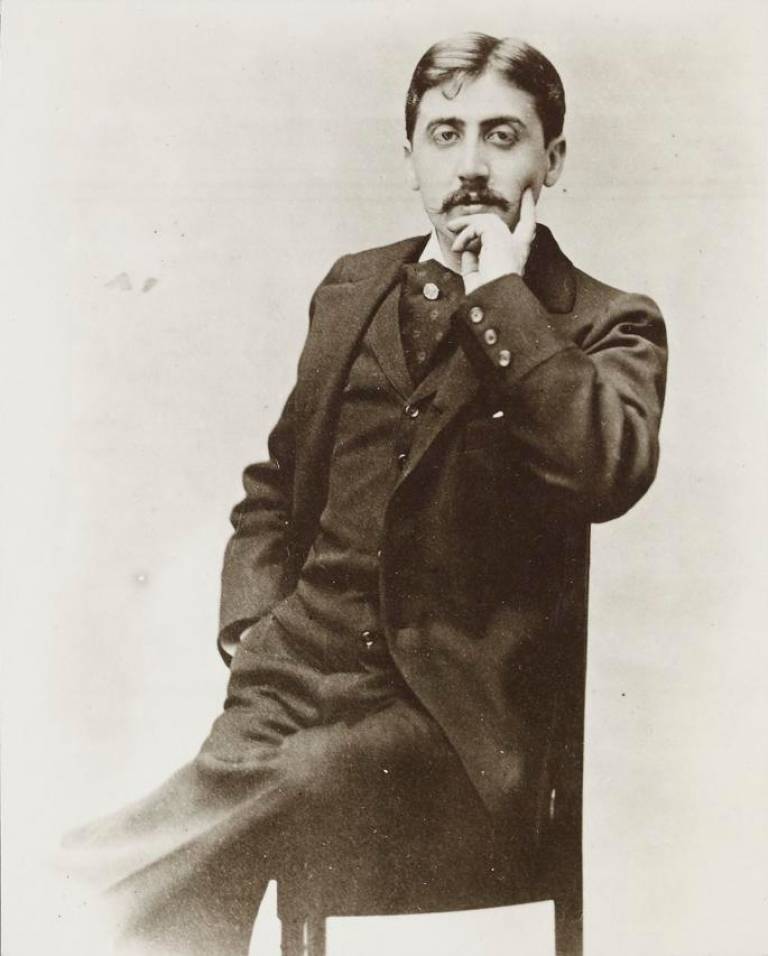
People delay In Search of Lost Time for years because they imagine the only respectable entry is a heroic one: seven volumes in strict sequence, maximal annotation, no skipped days, no confusion. That expectation kills more first attempts than Proust’s sentences ever do.
A better entry starts with one adjustment: treat this work less like a mountain and more like a city. You do not conquer a city in one line. You learn routes, districts, and returning points. Proust rewards that kind of reading because the novel itself is built from return, variation, and delayed recognition.[1][6]
1) Begin with the first volume, but decide your contract first
Yes, start with Swann’s Way. The reason is structural rather than ceremonial. The opening movement establishes the memory mechanics, the social optics, and the way attention shifts between intimate sensation and public performance.[1][5]
Before page one, set a contract you can actually keep:
- Session size: 20–35 minutes.
- Cadence: 4–5 sessions per week.
- Immediate goal: finish one scene unit, not one chapter.
This pacing protects the book’s long-wave effect. Proust’s prose often plants significance early and cashes it out far later; if you read in irregular binges, the pattern signal weakens.[1][6]
2) Translation choice is not a purity test; it is a rhythm choice
Most readers stall because they pick a translation based on prestige discourse instead of reading rhythm. For an entry run, what matters is sentence pressure you can sustain over weeks.
A practical split:
- If you want maximum historic texture: sample the Moncrieff lineage (public-domain route via Project Gutenberg).[5]
- If you want cleaner contemporary syntax for re-entry reading: sample newer trade editions such as the Yale and NYRB lines for Swann’s Way.[3][4]
Read five pages from two versions before committing. Keep the one that lets you continue tomorrow. In this project, continuity beats purity.
3) Read for recurring instruments, not for constant plot acceleration
Many first-time readers wait for conventional plot tempo and misdiagnose the book as static when events spread out. A better method is to track recurring instruments:
- spaces (bedroom, salon, street)
- social masks (how people perform class and intimacy)
- sensory triggers (taste, sound, light, weather)
- retrospective reframing (what a later passage redefines in an earlier one)
The novel’s momentum lives in these recurrences. Once you begin to see the same emotional mechanism reappear under new social surfaces, the reading stops feeling slow and starts feeling cumulative.[1][2][6]
4) Keep two notes only: one social map, one motif map
Do not over-annotate on first pass. Keep two lightweight logs:
- Social map (names + relation + current tension).
- Motif map (object/sensation + where it returns).
Each log should fit on one screen. The goal is orientation, not scholarship performance. Overloaded notes make the book look harder than it is and shift attention away from prose movement.
5) Use a three-step recovery protocol when you lose the thread
Losing the thread is normal in this novel and not a failure signal. Use this reset:
- Re-read the last two paragraphs aloud.
- Write one line: “Who is perceiving what right now?”
- Continue for ten minutes before deciding whether to pause.
In most cases, the rhythm returns during that ten-minute bridge. If not, stop without guilt and restart next session. Preservation of cadence is more valuable than forced duration.
6) When to add context, and when to defer it
Background helps, but timing matters. Add context after initial traction, not before.
- Use short biographical or publication-frame references when needed for orientation.[2]
- Defer dense criticism until you can identify your own reading questions.
If you front-load commentary, your reading voice gets replaced by borrowed verdicts. Proust is most alive when the sentence meets your present attention before it meets secondary consensus.
A durable entry plan (first six weeks)
- Weeks 1–2: establish cadence and translation fit; no heavy annotation.
- Weeks 3–4: maintain social/motif logs; mark one recurring pattern each session.
- Weeks 5–6: review earlier marks and note one reinterpretation caused by later passages.
That is enough to convert In Search of Lost Time from intimidating object into readable environment.
The hidden payoff is that this method improves more than one book. It retrains attention for any long-form work whose meaning accumulates through recurrence rather than speed. Proust then becomes not a test of endurance, but a training ground for precision.
Sources
- Encyclopaedia Britannica, In Search of Lost Time (overview, structure, publication context).
- Encyclopaedia Britannica, “Marcel Proust” (biographical and literary context).
- Yale University Press, Swann’s Way (edition and translation context).
- New York Review Books, Swann’s Way (modern translation edition page).
- Project Gutenberg, Swann’s Way / Remembrance of Things Past (public-domain translation route).
- Wikipedia, “In Search of Lost Time” (volume map and reception summary; secondary reference).