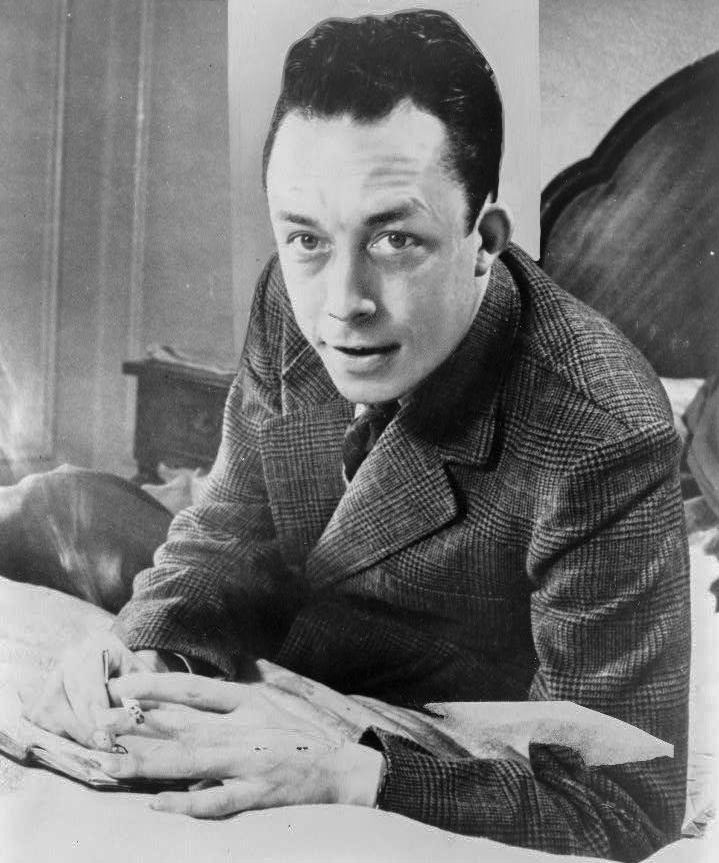
"Maman died today. Or yesterday maybe, I don't know."
The opening of The Stranger (L'Étranger, 1942) is among the most discussed two sentences in twentieth-century fiction. Critics have focused on the shock of "maman" — the childlike word for mother — and the admission of uncertainty about when she died. But the deeper disturbance is syntactic. Two declarative clauses, coordinated only by uncertainty. No adjective for the mother. No emotion named. The voice that delivers this information is, from the first syllable, a style.
1) Écriture blanche: Roland Barthes's diagnosis
In Writing Degree Zero (1953), Roland Barthes identified a strand of French prose that he called écriture blanche — writing at zero degree, stripped of stylistic ornament, social inflection, or literary posture. He named Camus's The Stranger as its central example [2].
What Barthes meant was not that the prose is unformed, but that it refuses the signals prose normally transmits. Literary style in the 1940s French novel carried class markers, rhetorical tradition, and authorial presence. L'Étranger withholds all of these. The sentences arrive without cause-and-effect connectives, without emotional escalation, without the authorial warmth or irony that tells a reader how to feel. The absence is the presence: this white writing is itself a position.
The philosophical freight of that position is considerable. If a novel's voice enacts a worldview, then Meursault's zero-degree narration is not accidental emotional flatness — it is absurdism written at the sentence level. A universe that offers no inherent meaning cannot be narrated with inherited meaning-conferring syntax [3].
2) Parataxis as epistemology
The structural backbone of Meursault's narration is parataxis: the coordination of clauses without subordination, without "because" or "therefore," without the grammatical architecture of cause and effect.
Consider a representative passage from Part One, when Meursault is at his mother's vigil:
The caretaker lit a lamp and we all moved into a bright light. I noticed that the other two people were with us.
The first clause gives a physical fact. The second gives an observation. What connects them — what a conventional narrator would supply — is interpretation: acknowledgment of other mourners, social awareness, some reaction. Meursault notices the people. He does not assess, feel, or respond. The semicolon (or period) replaces the causal tissue.
This is not a stylistic quirk. It is an epistemological claim: Meursault records sense data and sequences events. He does not interpolate cause and effect because, in his frame, experience does not organize itself that way. The world presents as surfaces, not meanings. Narrating it as surfaces — clause by clause, without hierarchy — is the only honest grammar [3].
The effect on readers is distinctive. We are given the information needed to project conventional emotions onto the scene, but the narrator refuses to confirm projection. Each reader's sense of unease is partly their own work.
3) Sensory precision, emotional vocabulary
Meursault's sentences are not vague. They are quite precise — but the precision runs almost entirely through sensory registers. Heat, light, sound, smell, physical position. He describes the sun on the beach with close attention. He notes the blue of Marie's dress, the particular texture of a Saturday afternoon, the smell of brine.
What is missing is an equally calibrated emotional register. Meursault has access to sensation and scarcity of access to emotion. When he does use emotional language, it lands in a restricted form: "I wasn't unhappy." The negative construction is characteristic. He names the absence of a state rather than the state itself. Pleasure is registered as the absence of discomfort; grief does not appear in the first half at all.
This creates an inversion of conventional fictional technique. Where most narrative protagonists give us inner states that illuminate outer events, Meursault gives us outer events that stand in for inner states. The reader is not guided. The prose makes trust conditional.
4) The trial and the voice as evidence
The second half of the novel performs a significant shift. Meursault kills an Arab man on the beach — a fact reported in the same flat declarative grammar as every other event — and goes to trial. At trial, his voice and behavior before his mother's death become the prosecution's primary evidence. He did not cry at the funeral. He drank coffee and smoked by the coffin. He started an affair the day after.
The state cannot prosecute the sensory narration directly. It prosecutes the emotional narration Meursault never gave. His style, which had been a philosophical stance, is reclassified as moral deficiency. The trial turns his zero-degree voice into an indictment.
This is Camus's most pointed structural move. The justice system and society demand a narrative of grief, propriety, and cause-and-effect moral response. Meursault produces none of these. His zero-degree style — which seemed private, even innocent, in Part One — collides with an institution that runs entirely on emotional coding and social performance [1].
The novel's second half does not change Meursault's voice. His sentences in prison remain as flat as they were on the beach. But the frame around them has changed: we now understand what his voice costs him in a world that requires performed interiority.
5) Translation stakes: "Maman" and the register problem
The question of how to translate the novel's first word — Maman — has become a site of significant critical debate, because it concentrates the voice problem into a single choice.
Stuart Gilbert's 1946 English translation opened with "My mother died today." This is accurate in denotation. But it loses the register signal: Maman in French carries a child's intimacy and slight softness absent in "my mother." Matthew Ward's 1988 Vintage translation restored the French word: "Maman died today." [1]
Ward's choice was formally and philosophically correct. Maman is doing something in that sentence that "my mother" is not. It creates an immediate small dissonance: the diction is younger and warmer than the sentence's emotional emptiness. That gap — between the tender word and the reported fact — is the voice's first move. A translation that closes the gap makes the opening more ordinary.
The translation debate extends throughout the novel. Ward prioritizes the flatness of Camus's passé composé — the compound past used throughout, which has a slightly abrupt, completed-action quality in French — over the smoother English "I went" or "she said." The roughness is a feature, not a flaw. The English must feel slightly wrong, slightly underfurnished, to preserve what the French is doing.
Reading The Stranger through its two English translations side by side is itself a tutorial in style as argument. What Ward defends — and what Gilbert smooths — is the philosophical insistence that a narrator's refusal to interpret is not a narrative failure but a position.
Sources
- Albert Camus, The Stranger, trans. Matthew Ward. Vintage International, 1989.
- Roland Barthes, Writing Degree Zero (Le Degré zéro de l'écriture), 1953. Hill and Wang. WorldCat record.
- Stanford Encyclopedia of Philosophy, "Albert Camus" (2021 ed.). Includes analysis of absurdism and fictional method.
- Nobel Prize Foundation, Albert Camus — biographical note and Nobel lecture context (1957).